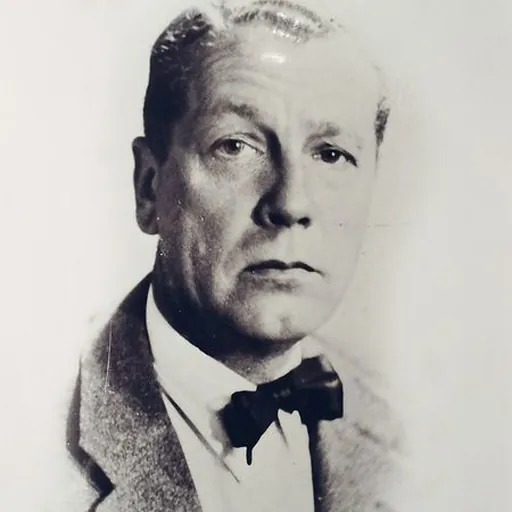
About Stefan Norblin
Lived 1892 – 1952 (aged 59–60). Stefan Norblin was a Polish painter, sculptor, graphic artist, typographer and illustrator.
Juliusz Stefan Norblin de la Gourdaine (1892-1952), known as Stefan Norblin, was a Polish visual artist, painter, caricaturist, illustrator, poster designer, and interior, architectural and fashion designer. He created, among others, modernist and Art Nouveau advertising posters as well as Art Deco paintings. He also realised the interior decoration (frescoes) of several rooms of the Umaid Bhawan Palace in Jodhpur, Rajasthan, India.
Biography Origins and childhood Stefan Norblin was born in Warsaw on 26 June 1892, into a wealthy industrialist family. The latter moved to Poland in 1774 at the invitation of Adam and Izabela Czartoryski, to be employed as a drawing teacher for the prince's children. he was the great-grandfather of Stefan.
Stefan is the son of factory owners: his grand-uncle Wincenty founded the Norblin, Bracia Buch i T. Werner a Joint-stock company of metal factory, which was taken over by Stanisław Ignacy, Stefan's father.
In 1910, Stefan graduated from the Antwerp's Academy of Economy and Trade and took a job at a paper company. Afterwards, he went to mingle among artistic societies in Paris and London under an assumed name. In particular, he realised during this interwar period a series of posters promoting Polish cities, following a commission by the Polish Ministry of Communication.
Lena's and Stefan's careers developed and the couple had a villa built in the outskirts of Warsaw, Willa Kaskada. The edifice, an ancient dye house, had been personally redesigned by the artist into a residential modernist home, with elements of art deco. Norblin even included in his plans a room for a film studio for his wife Lena: the project never saw completion.
The "Willa Kaskada" was razed during WWII; a commemorative plaque unveiled in 2012 can be seen on the site, now located in the Keller's Ponds Park in Warsaw.
Second World War At the start of the Invasion of Poland in September 1939, the couple left the country for Romania, accompanied by writer and journalist Marian Hemar, then the husband of Stefan's first wife. Afterwards, the Norblins intended to find shelter in United States, traveling through Asia.
On the way, they initially stayed in Persia and Iraq where he painted the country's royal family and the British Ambassador. the largest private residence in the country. In addition, Norblin decorated: the Patna palace of Maharaja Kamakhya Narain Singhs Ramarha (1943); the Sardar Samand hunting lodge, built in 1933 for Maharaja Umaid Singha; the Darbargadh Palace in Morbi, Gujarat.
The couple's son, Andrew, was born in India in 1944, and the local climate had regularly a bad effect on the toddler's health. His condition became so serious that the Maharaja of Jodhpur sent a private plane to bring medicine for the child.
By and large, he received few commissions and after a while, he stopped painting as his eyesight began to falter due to glaucoma: at the Powązki Cemetery in Warsaw. The ceremony was attended by the Minister of Culture and National Heritage, Bogdan Zdrojewski.
International resurgence For decades after Norblin left for the US, his Indian works remained largely unknown. Little was known about them in Poland and the rest of Europe, and in India the artist was forgotten – to the point that he was sometimes mistakenly called Snorblin, due to a misreading of the artist's signature, "S. Norblin", left on the paintings.
In 2007, Polish Television produced a documentary film directed by Robert Ćwikliński, titled Stefan Norblin, relating the artist's life.
In 2011, another documentary was shot, Chitraanjali. Stefan Norblin in India ; it was directed by Małgorzata Skiba and produced by the National Audiovisual Institute in cooperation with the Polish Embassy in New Delhi. The film depicts Norblin's work in India, combining European motifs with Indian mythology and culture. This documentary received an Honorary Mention in the prestigious Los Angeles Film Awards in 2012.
Further research and comprehensive promotion of Norblin's work has been carried out by the National Institute of Polish Cultural Heritage Abroad "Polonika" established in 2017. The institute produced the following films about the artist: an animated film, Eternal Fire , which brings to life six scenes from the Oriental Hall and one of the paintings from the Umaid Bhawan Palace in Jodhpur; a documentary, Ramayana in the Palace in Jodhpur. Recovered Thread in the Works of Stefan Norblin .
Exhibitions An exhibition, "Stefan Norblin (1892-1952). Master of Many Arts" , was displayed at the Regional Museum of Stalowa Wola (September 2011), then traveled to New Delhi at the National Gallery of Contemporary Art (November 2011) and Mumbai (December 2011 – January 2012). It notably comprised a series of 16 portraits painted in Poland, Iraq and India. A retrospective of Norblin's poster works (Art beyond time. Stefan Norblin 1892–1952) happened from 12 October 2012 to 31 January 2013 at the Poster Museum in Wilanów. From 28 February to 31 March 2024, an exhibition about Norblin's posters (Stefan Norblin – artysta plakatu) occurred in Warsaw at the Fabryka Norblina, the ancient family factory, now revamped into a cultural area and a shopping centre.
Family
Jean-Pierre Norblin de La Gourdaine (1745-1830), French painter, draughtsman, engraver and caricaturist. Louis-Pierre Norblin (1781-1854), French musician. (1796-1884), French painter. Aleksander Jan Konstanty Norblin (1777-1828), Polish sculptor on bronze.
Jan Piotr Sylwin Norblin (1812-1870), teacher at the Nobility Institute in Warsaw. (1805-1872), Polish philanthropist and industrialist, co-founder of the Norblin, Bracia Buch i T. Werner. Adam Julian Norblin (1814-1873) (1836-1914), plater and co-founder of the Norblin, Bracia Buch i T. Werner. The metal factory of silverware and industrial metal components located in Warsaw operated in the years 1834-1939. It moved in 1882, on Żelazna Street. In 1947, after nationalization it became the Walcownia Metali "Warszawa", operating till 1981. Today, it has been converted into urban premises encompassing offices, shops, restaurants, an eco-bazaar, a boutique cinema and an open-air museum. (1859-1920), Polish industrialist, banker and social activist. Juliusz Stefan Norblin (1892-1952) Andrew Norblin (born 1944), professional guitarist.
Gallery
Don’t just read it —
keep it.
Full-length biographies made to live with: read them, listen on the way to work, watch them tonight.
- E-book
- Audio
- Video
Instant download · yours to keep · every purchase keeps this site free
Important facts
People in Stefan Norblin's life
Named in this biography and alive at the same time
Related people
Same field, nearest in time


Contemporaries
People whose lives overlapped Stefan Norblin's

Frequently asked questions
Who was Stefan Norblin?
Polish painter (1892-1952)
When was Stefan Norblin born?
Stefan Norblin was born in 1892 in Warsaw, Kraków.
When did Stefan Norblin die?
Stefan Norblin died on 14 July 1952 in San Francisco.
What was Stefan Norblin's occupation?
Stefan Norblin was a painter, sculptor, graphic artist, typographer and illustrator.
What nationality was Stefan Norblin?
Stefan Norblin was Polish.
Sources & further reading
· DBpedia: Stefan Norblin de la Gourdaine
Cite this page
APA: Biography.guide. (2026). Stefan Norblin. https://biography.guide/stefan-norblin/
MLA: "Stefan Norblin." Biography.guide, https://biography.guide/stefan-norblin/.
Chicago: "Stefan Norblin." Biography.guide. https://biography.guide/stefan-norblin/.
Data last updated: 2026-09-20 · Spot an error? Report a correction.
Portrait: Wikimedia Commons · author & licence
Page generated 2026-09-27 04:57 UTC