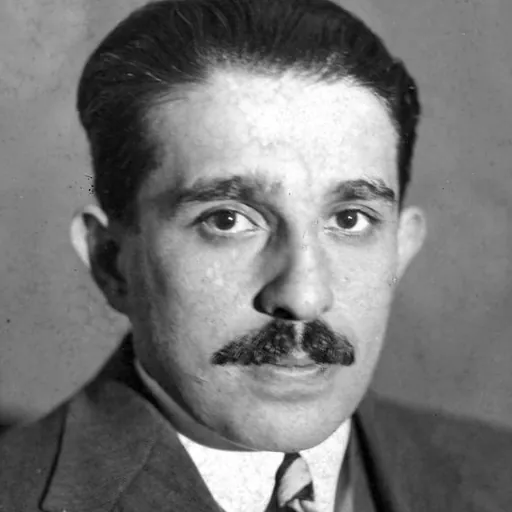
About Marian Hemar
Lived 1901 – 1972 (aged 70). Marian Hemar was a Polish poet, writer, journalist, playwright, songwriter and lyricist.
Marian Hemar (1901–1972), born Marian Hescheles (other pen names: Jan Mariański, and Marian Wallenrod), was a Polish poet, journalist, playwright, comedy writer, and songwriter. Hemar himself stated that before the outbreak of World War II he had already written 1,200 songs, including such widely popular hits as Może kiedyś innym razem (Maybe Some Other Time) and Upić się warto (Let's get drunk). Hemar was a final pen name adopted by Marian in his literary career. It was formed from the first two letters of his last name, Hescheles, and the first three letters of his given name, Marian.
Life Marian Hemar was born to a Jewish family on 6 April 1901 in Lemberg. He studied medicine and philosophy at the Jan Kazimierz University locally, and took part in the Defense of Lwów in 1918 and 1919 as a volunteer on the Polish side of the Polish–Ukrainian War of independence. At the invitation of Jerzy Boczkowski, director of the legendary Qui Pro Quo Theatre, he left for Warsaw in 1924. By 1925 he was already a well-known personality in the arts community of Warsaw, working at the Qui Pro Quo cabaret with Julian Tuwim. He was a key figure in the productions of , , and Cyrulik Warszawski (Barber of Warsaw) cabarets; as well as the author of hundreds of Polish Radio sketches.
His unhappy love affair with the Warsaw diseuse Maria Modzelewska inspired many of his songs including
Soon after the outbreak of World War II Hemar fled Warsaw after being searched for by the Gestapo and reached Romania, and eventually the Middle East, where he signed up and served in the Polish Independent Carpathian Rifle Brigade. During the war he continued his literary activity, organizing concerts, speeches and field theater plays for Polish troops. He also organized one of the few theaters operating in besieged Tobruk. He was called "The bard of Lvov, the troubadour of the London emigration". For 16 years (1953-1969) he prepared and presented weekly cabaret programmes for Radio Free Europe, in which - in prose and verse - he commented upon all the important news from post-war Poland. — Polish Art Center
Notable works
Collections of poems Koń trojański (Trojan Horse; 1936) Dwie ziemie święte (Two Holy Lands; 1942) Siedem lat chudych (Seven Lean Years; 1955) Ściana płaczu (Wailing Wall; 1968) Comedies Dwaj panowie B. (Two Mr. B's; 1929) Firma (The company; 1933) Feuilletons Awantury w rodzinie (Family Feuds; 1967) Świstki z podróży (Scraps from a Journey; 1964).
Don’t just read it —
keep it.
Full-length biographies made to live with: read them, listen on the way to work, watch them tonight.
- E-book
- Audio
- Video
Instant download · yours to keep · every purchase keeps this site free
Important facts
People in Marian Hemar's life
Named in this biography and alive at the same time
Related people
Same field, nearest in time

Contemporaries
People whose lives overlapped Marian Hemar's



Frequently asked questions
Who was Marian Hemar?
Polish writer (1901–1972)
When was Marian Hemar born?
Marian Hemar was born on 6 April 1901 in Lviv.
When did Marian Hemar die?
Marian Hemar died on 11 February 1972 in Dorking.
What was Marian Hemar's occupation?
Marian Hemar was a poet, writer, journalist, playwright, songwriter and lyricist.
What nationality was Marian Hemar?
Marian Hemar was Polish.
Sources & further reading
Cite this page
APA: Biography.guide. (2026). Marian Hemar. https://biography.guide/marian-hemar/
MLA: "Marian Hemar." Biography.guide, https://biography.guide/marian-hemar/.
Chicago: "Marian Hemar." Biography.guide. https://biography.guide/marian-hemar/.
Data last updated: 2026-09-23 · Spot an error? Report a correction.
Portrait: Wikimedia Commons · author & licence
Page generated 2026-09-27 05:08 UTC