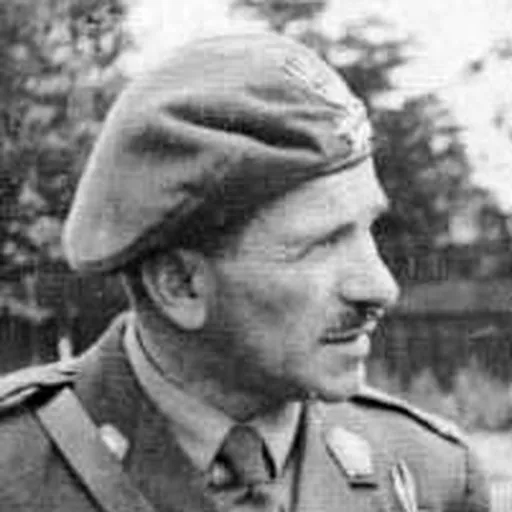
About Stanisław Sosabowski
Lived 1892 – 1967 (aged 75). Stanisław Sosabowski was a Polish military officer and laborer.
Stanisław Franciszek Sosabowski (; 8 May 1892 – 25 September 1967) was a Polish general in World War II. He fought in the Polish Campaign of 1939 and at the Battle of Arnhem (Netherlands), as a part of Operation Market Garden, in 1944 as commander of the Polish 1st Independent Parachute Brigade.
Early military career
Early years and studies Stanisław Sosabowski was born on 8 May 1892 in Stanislau , in what was then Austria-Hungary and is now Ivano-Frankivsk in western Ukraine. His father was a railway worker. His father died in 1904. In 1905, he became involved in the independence movement, first as part of the Association of the Polish Youth "Zet", then in the Organisation of Independent Youth Zarzewie. He also became a member of the Polish Military Association, where he was actively involved under the pseudonym "Stanisław Węglarz". Sosabowski graduated from a local gymnasium and in 1910 he was accepted as a student of the faculty of economy of the Jagiellonian University in Kraków. However, the death of his father and the poor financial situation of his family forced him to abandon his studies and return to Stanislau. There he became a member of Drużyny Strzeleckie, a semi-clandestine Polish national paramilitary organisation. He was soon promoted to the head of all Polish Scouting groups in the area.
World War I
In 1913, Sosabowski was drafted into the Austro-Hungarian Army. After training, he was promoted to the rank of corporal, serving in the Imperial and Royal 58th Infantry Regiment. After the outbreak of World War I he fought with his unit against the Imperial Russian Army in the battles of Rzeszów, Dukla Pass and Gorlice. For his bravery, he was awarded the Silver Medal for Bravery 2nd Class and the Gold Medal for Bravery and promoted to first lieutenant. In 1915, he was badly wounded in action in a skirmish against the Russians near Brest-on-the-Bug and withdrawn from the front.
In November 1918, after Poland regained its independence Sosabowski volunteered for the newly formed Polish Army, but his wounds were still not healed and he was rejected as a front-line officer. Instead, he became a staff officer in the Ministry of War Affairs in Warsaw.
France Following the Polish surrender, Sosabowski was made a prisoner of war and interned at a camp near Żyrardów. However, he escaped and remained in Warsaw under a false name, where he joined the Polish resistance. He was ordered to leave Poland and reached France to report on the situation in occupied Poland. After a long trip through Hungary and Romania, he arrived in Paris, where the Polish government in exile assigned him to the Polish 4th Infantry Division as the commanding officer of infantry.
Then, Sosabowski decided to transform his brigade into a Parachute Brigade, the first such unit in the Polish Army. The volunteers came from all the formations of the Polish Army. In Largo House in Fife, a training camp was built and the parachute training was started. Sosabowski himself passed the training and, at 49 years of age, made his first parachute jump. According to relations of Sosabowski's former subordinates, the colonel was a strict yet just commander. Impulsive and harsh, Sosabowski could not stand opposition and demanded loyalty.
In October 1942 the Brigade was ready for combat and was named the 1st Independent Parachute Brigade. Since the Polish General Staff planned to use the Brigade to assist a national uprising in Poland, particularly Warsaw, the soldiers of the 1st Polish Para were to be the first element of the Polish Army in Exile to reach their homeland. Hence the unofficial motto of the unit: by the shortest road (najkrótszą drogą).
In September 1943, Lieutenant-General Frederick Browning proposed that Sosabowski reform his unit into a division and fill the remaining posts with British troops. Sosabowski himself would be assigned to the newly formed division and promoted to general. However, Sosabowski refused. Nevertheless, on 15 June 1944 he was promoted to Brigadier General.
Warsaw Uprising In early August 1944, news of the Warsaw Uprising arrived in Great Britain. The Brigade was ready to be dropped by parachute into Warsaw to aid their comrades from the underground Polish Home Army, who were fighting a desperate battle against overwhelming odds. However, the distance was too great for the transport aircraft to make a round trip and access to Soviet airfields was denied. The morale of the Polish troops suffered badly and many of the units verged on mutiny. The British staff threatened its Polish counterpart with disarmament of the Brigade, but Sosabowski retained control of his unit. Finally, Polish Commander in Chief Kazimierz Sosnkowski put the Brigade under British command, and the plan to send it to Warsaw was abandoned. It was not until after the war that General Sosabowski learnt that his son, , a student of Medecin and member of the Kedyw, had been hit by a grenade during the Warsaw Uprising, causing him to lose the sight in his second eye.
Battle of Arnhem
Gen. Sosabowski (left) with Lt-Gen Frederick Browning, commander of the British 1st Airborne Corps.
During the planning for Operation Market Garden, Sosabowski expressed serious concerns regarding the feasibility of the mission. Among Sosabowski's concerns were the poorly conceived drop zones at Arnhem, the long distances between the landing zones and Arnhem Bridge and that the area would contain a greater German presence than British intelligence believed. Despite Sosabowski's concerns and similar warnings from the Dutch Resistance that two SS Panzer Divisions were in the operations area, Market Garden proceeded as planned.
The Polish 1st Independent Parachute Brigade was among the Allied forces taking part in Market Garden. Due to a shortage of transport aircraft, the brigade was split into several parts before being dropped into the battle. A small part of the brigade with Sosabowski was parachuted near Driel on 19 September, but the rest of the brigade arrived only on 21 September at the distant town of Grave, falling directly on the waiting guns of the Germans camped in the area. The brigade's artillery was dropped with the British 1st Airborne Division, commanded by Major-General Roy Urquhart, while the howitzers were to arrive by sea, which prevented the brigade from being deployed effectively. Three times Sosabowski attempted to cross the Rhine to come to the assistance of the surrounded 1st Airborne Division. Unfortunately, the ferry they hoped to use had been sunk and the Poles attempting to cross the river in small rubber boats came under heavy fire. Even so, at least 200 men made it across the river and reinforced the embattled British paratroopers.
Despite the difficult situation, at a staff meeting on 24 September, Sosabowski suggested that the battle could still be won. He proposed that the combined forces of XXX Corps, under Lieutenant-General Brian Horrocks, and the Polish 1st Independent Parachute Brigade should start an all-out assault on the German positions and try to break through the Rhine. This plan was not accepted, and during the last phase of the battle, on 25 and 26 September, Sosabowski led his men southwards, shielding the retreat of the remnants of the 1st Airborne Division. Casualties among the Polish units were high, approaching 40%, and were at least in part the result of Lieutenant-General Browning's decision to drop the paratroops 7 kilometres from the bridge at Arnhem.
After the battle, on 5 October 1944, Sosabowski received a letter from Field Marshal Bernard Montgomery, commander of the Anglo-Canadian 21st Army Group, describing the Polish soldiers as having fought bravely and offering awards to ten of his soldiers. However, on 14 October 1944, Montgomery wrote another letter, this time to the British commanders, in which he scapegoated Sosabowski for the failure of Market Garden. Sosabowski was accused of criticizing Montgomery, and the Polish General Staff was forced to remove him as the commanding officer of his brigade on 27 December 1944.
In the opinion of historian Michael Alfred Peszke, "The worst thing that a subordinate can do is to question orders and to be proved right." Sosabowski had expressed doubts about the feasibility of the Market Garden Operation.
At the Moscow Conference in October 1944, a turning point came in Anglo-Polish relations. On Prime Minister Churchill's request, the Polish delegation arrived in Moscow on 12 October 1944. Upon arrival, Churchill told them to be present at the discussions between himself, Soviet ruler Joseph Stalin, and the Communist Polish Lublin Committee. Churchill coerced Polish Prime Minister Stanisław Mikołajczyk into cooperating with Stalin or risk losing Britain's support for the remainder of the war. From the British perspective, any news that could be beneficial to their coercion tactics would be welcome. The information came on 16 October in a telegram to Field Marshal Sir Alan Brooke, the Chief of the Imperial General Staff, who was present in Moscow as Churchill's military advisor.
The message stated that Sosabowski's brigade performed badly. Churchill could use this claim to put more pressure on Mikołajczyk to cooperate, because it could be argued that one of his most valuable assets, Sosabowski's elite brigade, was no longer useful to the Allied war effort. Montgomery's telegram is contradictory to most of his behaviour at the time. Two days before sending the telegram he was praising the Polish contribution to the war, while six weeks later he awarded a Distinguished Service Order to General Stanisław Maczek and decorated members of the Polish 1st Armoured Division. In addition, war correspondents spoke highly of the Polish contribution to Market Garden in the same period as Montgomery was expressing his negative experiences, via Field Marshal Brooke, to Churchill.
Sosabowski was eventually made the commander of rearguard troops and was demobilized in July 1948.
After the war
Shortly after the war Sosabowski succeeded in evacuating his wife and only son from Poland. Like many other Polish wartime officers and soldiers who were unable to return to Communist Poland due to the risk of death or "disappearance", he settled in West London, finding a job as a factory worker at the CAV Electrics assembly plant in Acton.
All Polish Generals who fought under the Allied forces; General Anders, General Maczek and General Sosabowski were denied pension after being relieved of their duties. It has never been proven but the popular belief in Poland is that somehow Stalin had leverage over the British and therefore denied general Sosabowski his honour and pension.
Death Sosabowski died in London on 25 September 1967. In 1969, his remains were returned to Poland, where he was reinterred at Powązki Military Cemetery in Warsaw.
Legacy: depictions and recognitions
Sosabowski was portrayed by Gene Hackman in the award-winning 1977 war film A Bridge Too Far.
In The Hague, on 31 May 2006, Queen Beatrix of the Netherlands awarded the Military Order of William to the Polish 1st Independent Parachute Brigade. The brigade's commander, Sosabowski, was posthumously awarded the "Bronze Lion". In part this was the result of a Dutch TV documentary depicting the brigade as having played a far more significant role in Market Garden than had been hitherto acknowledged. In this film by Geertjan Lassche, the father of the Queen, Prince Bernhard of the Netherlands, said the Poles deserved to be honoured with the highest military medal.
The following day, on 1 June, a ceremony was held at Driel, the town where the Polish 1st Independent Parachute Brigade fought. Among the speakers at the ceremony were the mayor of Overbetuwe, as well as Sosabowski's 2 grandsons and 3 great-grandchildren.
In the summer of 2012 1st Airborne Major Tony Hibbert made a video appeal for Sosabowski to be pardoned and honoured.
His bust was unveiled on 1 September 2013 in Kraków's Jordan Park. Sosabowski is one of many Polish historical figures honoured in the Park.
In 2018, at a ceremony held at the Royal Castle in Warsaw on the 100th anniversary of Poland regaining its independence, Polish President Andrzej Duda posthumously conferred the country's highest distinction, the Order of the White Eagle, upon 25 distinguished Poles including Sosabowski.
The elite Polish 6th Airborne Brigade, which traces its traditions back to the 1st Independent Parachute Brigade, is officially named 6 Brygada Powietrznodesantowa im. gen. bryg. Stanisława Franciszka Sosabowskiego, in honor of Sosabowski.
In September 2023, the Polish School in Glasgow, a Saturday complementary school, decided to adopt the name of General Sosabowski as its patron. The honours to the famous patron were celebrated with the Polish and British parachute corps, and the veterans' organisations.
Sosabowski was awarded many military honours, including:
Don’t just read it —
keep it.
Full-length biographies made to live with: read them, listen on the way to work, watch them tonight.
- E-book
- Audio
- Video
Instant download · yours to keep · every purchase keeps this site free
Important facts
People in Stanisław Sosabowski's life
Named in this biography and alive at the same time





Related people
Same field, nearest in time


Contemporaries
People whose lives overlapped Stanisław Sosabowski's

Frequently asked questions
Who was Stanisław Sosabowski?
Polish general (1892-1967)
When was Stanisław Sosabowski born?
Stanisław Sosabowski was born on 8 May 1892 in Ivano-Frankivsk.
When did Stanisław Sosabowski die?
Stanisław Sosabowski died on 25 September 1967 in London Borough of Hillingdon.
What was Stanisław Sosabowski's occupation?
Stanisław Sosabowski was a military officer and laborer.
What nationality was Stanisław Sosabowski?
Stanisław Sosabowski was Polish.
Sources & further reading
· Wikipedia: Stanisław Sosabowski
· DBpedia: Stanisław Sosabowski
Cite this page
APA: Biography.guide. (2026). Stanisław Sosabowski. https://biography.guide/stanislaw-sosabowski/
MLA: "Stanisław Sosabowski." Biography.guide, https://biography.guide/stanislaw-sosabowski/.
Chicago: "Stanisław Sosabowski." Biography.guide. https://biography.guide/stanislaw-sosabowski/.
Data last updated: 2026-09-23 · Spot an error? Report a correction.
Portrait: Wikimedia Commons · author & licence
Page generated 2026-09-27 05:06 UTC