
Stanisław Maczek
Polish military officer of World War I and World War II
About Stanisław Maczek
Lived 1892 – 1994 (aged 102). Stanisław Maczek was a Polish military officer, bartender and soldier.
Lieutenant General Stanisław Władysław Maczek (; 31 March 1892 – 11 December 1994) was a Polish tank commander of World War II, whose division was instrumental in the Allied liberation of France, closing the Falaise pocket, resulting in the destruction of 14 German Wehrmacht and SS divisions. A veteran of World War I, the Polish–Ukrainian and Polish–Soviet wars, Maczek was the commander of Poland's only major armoured formation during the September 1939 campaign, and later commanded a Polish armoured formation in France in 1940. He was the commander of the famous 1st Polish Armoured Division, and later of the I Polish Army Corps under Allied Command in 1942–45.
Family Stanisław Władysław Maczek was born on 31 March 1892 in the Lwów suburb of Szczerzec (now Ukrainian: Shchyrets), then in Austro-Hungarian Galicia. His father was a lawyer, who after retiring opened chambers in Drohobycz. he was a cousin of the Slovenian Croatian (and Polish) politician Vladko Maček.
Education After graduating from the grammar school at Drohobycz in 1910, he attended the philosophy faculty of Lwów University where he studied Polish philology (i.e. language and literature). Among his tutors were the renowned Polish philologists and Józef Kallenbach, defending Lesser Poland and Silesia. Equipped with only light tanks and tankettes and with only one artillery battery of just eight heavy cannons, the brigade went into battle on the first day of war. After the Battle of Jordanów, Maczek's unit faced the entire German XVIII Corps of Gen. Eugen Beyer and successfully shielded the southern flank of the Polish forces, along the Beskids. Supported by only a few battalions of Border Guards and National Defence troops, Maczek's motorized brigade faced two Panzer divisions However, Maczek's unit was much too weak to achieve success against German armoured divisions. Polish soldiers managed to cover only one retreating French infantry division by attacking German forces in Champaubert-Montgivroux. Later the brigade had to withdraw with the rest of the French troops and joined the French XXIII Corps. On 16 June the brigade attacked by night the town of Montbard over the Burgundy Canal. Maczek's soldiers achieved complete surprise and took many German prisoners.
However, by then the brigade was fighting alone, with the French units on both flanks either routed or in retreat. There were no French forces to take advantage of that victory and the decimated Polish unit found itself surrounded and without fuel. On 18 June, Maczek decided to destroy unusable equipment and withdraw on foot. Later that day he had to split the remnants of his brigade into small groups, so they could pass through the enemy lines. Many of Maczek's men, including the general himself, found their way through Vichy France, North Africa and Portugal to the United Kingdom, where a Polish armored unit was recreated, while others joined the Polish and French resistance organizations in France and Belgium. Maczek relocated to London.
Scotland Initially, the British high command wanted to use the recreated Polish Army solely for defence of the Scottish coastline between Aberdeen and Edinburgh, and the veterans of the Polish tank formations who arrived to the UK were pressed into the Polish 2nd Rifle Brigade under General Rudolf Orlicz-Dreszer. However, immediately on Maczek's arrival the idea was abandoned and General Władysław Sikorski managed to persuade the British government to create instead a Polish armoured unit. After two years of training at the Blairgowrie training ground, in February 1942 General Maczek formed the 1st Polish Armoured Division. Initially serving in defence of the Scottish coast between Montrose and the Firth of Forth, the division was equipped by the British authorities with Churchill and M4 Sherman tanks in preparation for the Normandy landings.
To Germany British Field Marshal Sir Bernard Montgomery in conversation with Major General Stanisław Maczek during his visit to the 1st Polish Armoured Division Headquarters in Breda, 25 November 1944.
Towards the end of July 1944 the Polish 1st Armoured Division was transferred to Normandy, where it was to prove its worth during the 1944 invasion of Normandy. Attached to the First Canadian Army, Maczek's men entered combat on 8 August, seeing service during Operation Totalize. The division twice suffered attacks of friendly fire from U.S. Army Air Force aircraft, yet achieved a brilliant victory against the Wehrmacht in the battles for Mont Ormel, Hill 262 and the town of Chambois. In this series of offensive and defensive operations, which came to be known as the Battle of Falaise, 14 German Wehrmacht and SS divisions were trapped in the huge Chambois pocket and destroyed. Maczek's division had the crucial role of closing the pocket to block the escape route of the German divisions.
Senior commanders of the First Canadian Army, May 1945. Seated from the left: Stanisław Maczek (Polish Army), Guy Simonds, Harry Crerar, Charles Foulkes, Bert Hoffmeister. Standing from the left: Ralph Keefler, Bruce Matthews, Harry Foster, Robert Moncel (standing in for Chris Vokes, Stuart Rawlins (British Army).
After this decisive battle, Maczek's Division continued to spearhead the Allied drive across the battlefields of northern France, Belgium, the Netherlands and finally Germany. During its progress it liberated Ypres, Oostnieuwkerke, Roeselare, Tielt, Ruislede and Ghent in Belgium. (Coincidentally, the Polish word maczek means "poppy" in English, the symbol of remembrance associated with the area around Ypres in the First World War.) Thanks to an outflanking manoeuvre, it proved possible to free Breda in the Netherlands after a hard fight but without incurring losses in the town's population. A petition on behalf of 40,000 inhabitants of Breda resulted in Maczek being made an honorary Dutch citizen after the war. The Division's finest hour came when its forces accepted the surrender of the German naval base of Wilhelmshaven, taking captive the entire garrison, together with some 200 vessels of Hitler's Kriegsmarine.
Maczek commanded the 1st Armoured Division until the end of European hostilities and was promoted to major-general. After the capitulation of Germany he went on to command the Polish I Corps and became commanding officer of all Polish forces in the United Kingdom until their demobilization in 1947.
Exile
After the war, Maczek was stripped of Polish citizenship by the Communist government of the Polish People's Republic, and thus had to remain in Britain. He left the army on 9 September 1948 but was denied a general's pension by the British government as he had not been a member of the British armed forces. General Stanislaw Maczek, Bench outside Edinburgh Council Chambers. Although living in the United Kingdom, General Stanisław Maczek had a strong connection to the Netherlands. Besides being a regional hero to the areas he liberated in World War II, he was awarded honorary citizenship of the city of Breda. Recently acquired archive documents show that the Polish general secretly received a yearly allowance from the Dutch government, for the rest of his life. He got his allowance, because Mayor Claudius Prinsen of Breda was worried in 1950, after receiving information that Maczek was in a 'difficult financial situation'. The Polish general was doing unskilled labor to make ends meet. He also had to take care of a chronically ill daughter who needed costly treatment.
The mayor of Breda informed the Dutch national government that a war hero was in financial need. He made an appeal to the government to help the man that liberated the Netherlands. The government decided quickly and awarded Maczek an indexed general's pension, which was paid for by the Ministry of Foreign affairs from a secret budget. The Dutch government did not want this to be made public, due to its sensitive nature. In the Cold War period, announcing that the Dutch were paying a non-communist Polish ex-general, would certainly strain diplomatic relations with the communist Polish government and the Soviet Union. Not to mention, it would confront the British government with a not so proud moment in their history. Uninformed about his improved financial situation, the Dutch public responded at once in 1965 when news came that his chronically ill daughter needed costly medical treatment in Spain. The Dutch population raised a substantial amount of money following a national radio broadcast for the Maczek family, helping out the general that liberated them. The Dutch Ministry of Defence did not meet this request, based upon the Algemene Militaire Pensioenwet (1966), which stipulates that non-Dutch persons needed to have been associated with the Dutch Armed Forces during the war period, in order to be entitled to a wartime pension.
In 1989, the last Polish Communist Government of Prime Minister Mieczysław Rakowski issued a public apology to the General, and in 1994 he was presented with Poland's highest state decoration, the Order of the White Eagle.
Lieutenant General Stanisław Maczek died on 11 December 1994, at the age of 102. According to his last wish, he was laid to rest among his soldiers at the Polish military cemetery in Breda, the Netherlands.
Honours and awards
Gallery
In popular culture Maczek, as the leader of the 10th Motorized Cavalry Brigade, is a historical figure in the novel A Witness to Gallantry: An American Spy in Poland 1939.
In The Death of the Fronsac by Neal Ascherson, a Polish officer, Maurycy Szczucki, serves with General Maczek in World War II. After the war, Szczucki returns to Edinburgh where he discovers the impoverished Maczek working as a barman in the Learmonth Hotel. The General is frequently visited by old comrades, who "salute him before they order a whisky."
Maczek is referred to in Alexander McCall Smith's short story, "In Sandy Bell's". The protagonist's landlady tells of the general working in a bar in Edinburgh. "He wasn't too proud. His men saluted him when they ordered a drink."
Don’t just read it —
keep it.
Full-length biographies made to live with: read them, listen on the way to work, watch them tonight.
- E-book
- Audio
- Video
Instant download · yours to keep · every purchase keeps this site free
Important facts
People in Stanisław Maczek's life
Named in this biography and alive at the same time


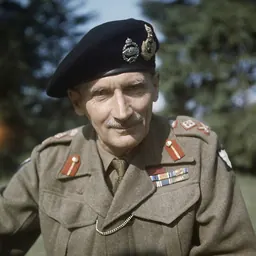

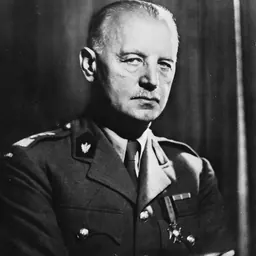
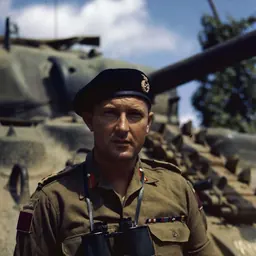

Related people
Same field, nearest in time

Contemporaries
People whose lives overlapped Stanisław Maczek's






Frequently asked questions
Who was Stanisław Maczek?
Polish military officer of World War I and World War II (1892–1994)
When was Stanisław Maczek born?
Stanisław Maczek was born on 31 March 1892 in Shchyrets.
When did Stanisław Maczek die?
Stanisław Maczek died on 11 December 1994 in Edinburgh.
What was Stanisław Maczek's occupation?
Stanisław Maczek was a military officer, bartender and soldier.
What nationality was Stanisław Maczek?
Stanisław Maczek was Polish.
Sources & further reading
Cite this page
APA: Biography.guide. (2026). Stanisław Maczek. https://biography.guide/stanislaw-maczek/
MLA: "Stanisław Maczek." Biography.guide, https://biography.guide/stanislaw-maczek/.
Chicago: "Stanisław Maczek." Biography.guide. https://biography.guide/stanislaw-maczek/.
Data last updated: 2026-09-20 · Spot an error? Report a correction.
Page generated 2026-09-27 05:30 UTC