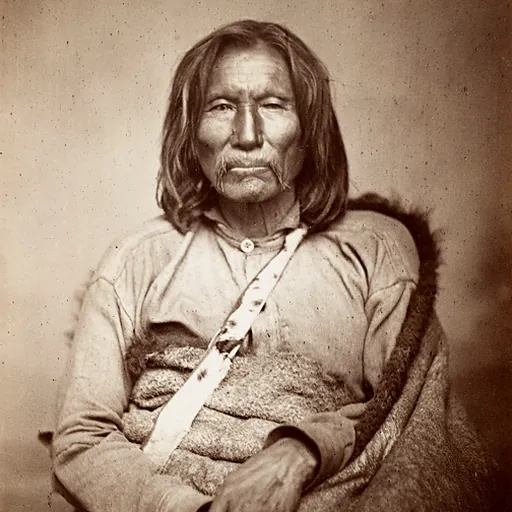
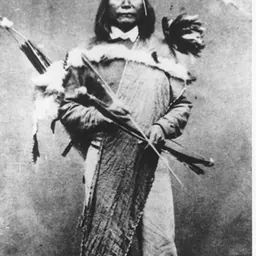
Sitting Bear
Prestigious Kiowa warrior and medicine man
About Sitting Bear
Lived 1800 – 1871. Sitting Bear was a traditional leader or chief.
Sét:àñ:gyà, commonly known as Satank (also Set-angya or Set-ankeah, translated as Sitting Bear), was a prestigious Kiowa warrior and medicine man. He was born about 1800, probably in Kansas, and killed June 8, 1871. An able warrior, he became part of the Koitsenko (or Kaitsenko, k’ói:tséñgàu),
Struggle for power after death of the Kiowa chief Little Mountain (Dohäsan)
After the death of the Kiowa supreme chief Dohäsan in 1866, Guipago was selected as the new head chief, Satanta took over the leadership as war chief, with Satank leading the Koitsenko; Tene-angopte (Kicking Eagle), together with Napawat (No Mocassins) was the leader of the white-friendly party. 1867 Satank signed the Medicine Lodge Treaty together with Satanta and other Kiowa chiefs (but not Guipago, who refused to sign).
Last years and Warren wagon-train affair
In 1870, his son, also named Satank, was killed in a raid in Texas. Disconsolate, the old man carried some of his son's bones with him. He stepped up his raiding, in retribution for his son's death, including many conducted by Satanta and other discontented Kiowa, Comanche, and Apache tribes, including the Warren Wagon Train raid, on May 18, 1871, on Salt Creek Prairie in Texas.
The survivors of the Warren train had rushed on to Fort Richardson, where they encountered General William Tecumseh Sherman, who had passed by the raiding party as it lay hidden waiting for the wagon train. The general, realizing that he had escaped death by fate, ordered Colonel Ranald S. Mackenzie and the 4th Cavalry to pursue the war party and bring back those responsible for the attack.
The Army did not catch the war party, the war party caught themselves. Leaders Satank and Satanta had come back to the reservation, and had they kept quiet, no one would have ever found out officially who had committed the Warren Wagon Train raid. But Satanta could not bring himself to be quiet. He asked the Indian agent on the Kiowa-Comanche Reservation for ammunition and supplies, bragging that he, Satank, and young war leader Ado-ete (Big Tree) had led the war party which had recently killed the teamsters at Salt Creek, and that they could have killed General Sherman if they had wished. Sherman ordered the three Kiowa sub-chiefs taken to Jacksboro, Texas, to stand trial for murder. Satank had no intention of allowing himself to be humiliated by being tried by the white man's court, and told the Tonkawa scouts before the three were to be transported to Fort Richardson that they should tell his family they would be able to find his body along the trail. Satank refused to get in the wagon, and after the soldiers threw him in, he hid his head under his red blanket, (worn as a sign of his membership in the Koitsenko). The soldiers apparently believed the old chief was hiding his face because of humiliation, but in reality, he was gnawing his wrists to the bone so that he could get out of the chains they had put on him. He began singing his death song, and when his hands were free, stabbed and wounded one of his guards - a corporal - in the leg with a knife he had secreted in his clothes, and managed to wrestle the man's rifle from him. Satank was shot to death before he could manage to fire. (A teamster, Antonio Barbello, was wounded by a random shot in the head.) Satank's body lay unburied in the road, with his people afraid to claim it for fear of the Army, though Col. Mackenzie assured the family they could safely claim the remains. Nonetheless, they were never claimed.
Final resting place Eventually his corpse was buried by the army at Chief's Knoll, on the cemetery at Fort Sill, Oklahoma. Satanta was also brought there after his suicide in prison at Huntsville, Texas, and buried nearby. Other prominent chiefs of the Kiowa, Comanche and Arapaho are also buried on or around the same knoll, such as Kicking Bird (Kiowa), Ten Bears (Comanche), Quanah Parker (Comanche), Yellow Bear (Arapaho) and Little Raven (Arapaho).
Don’t just read it —
keep it.
Full-length biographies made to live with: read them, listen on the way to work, watch them tonight.
- E-book
- Audio
- Video
Instant download · yours to keep · every purchase keeps this site free
Important facts
People in Sitting Bear's life
Named in this biography and alive at the same time





Related people
Same field, nearest in time


Contemporaries
People whose lives overlapped Sitting Bear's






Frequently asked questions
Who was Sitting Bear?
prestigious Kiowa warrior and medicine man (1800–1871)
When was Sitting Bear born?
Sitting Bear was born in 1800.
When did Sitting Bear die?
Sitting Bear died on 8 June 1871.
What was Sitting Bear's occupation?
Sitting Bear was a traditional leader or chief.
Sources & further reading
Cite this page
APA: Biography.guide. (2026). Sitting Bear. https://biography.guide/sitting-bear/
MLA: "Sitting Bear." Biography.guide, https://biography.guide/sitting-bear/.
Chicago: "Sitting Bear." Biography.guide. https://biography.guide/sitting-bear/.
Data last updated: 2026-09-20 · Spot an error? Report a correction.
Page generated 2026-09-27 05:09 UTC