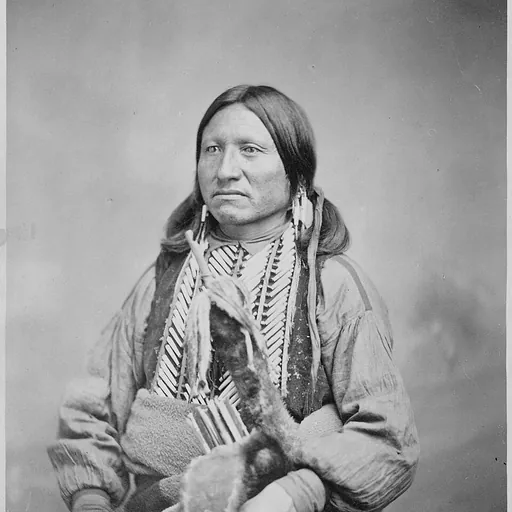
Kicking Bird
Kiowa chief
About Kicking Bird
Lived 1835 – 1875 (aged 39–40). Kicking Bird was a traditional leader or chief, known for Kiowa.
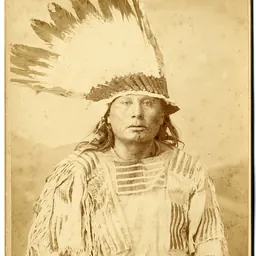
Kicking Bird, also known as T’è:néáungopd̶e, "The Kicking Bird", "Eagle Who Strikes with his Talons", or "Striking Eagle" (c. 1835 - May 3, 1875) was a High Chief of the Kiowa in the 1870s. It is said that he was given his name for the way he fought his enemies. He was a Kiowa, though his grandfather had been a Crow captive who was adopted by the Kiowa. His mysterious death at Fort Sill on May 3, 1875, is the subject of much debate and speculation.
Though he was a great warrior who participated in and led many battles and raids during the 1860s and 1870s, he is mostly known as an advocate for peace and education among his people. He enjoyed close relationships with whites, most notably the Quaker teacher Thomas Battey and Indian Agent James M. Haworth. The close relationships he enjoyed with whites engendered animosity among many of the Kiowas, making him a controversial figure. He would become the most prominent peace chief of the Kiowas, following the lead of a previous head chief, Dohasan. Kicking Bird was diplomatically active and signed the Little Arkansas Treaty of 1865 and the Medicine Lodge Treaty of 1867 and was instrumental in moving his people to reservations.
Early life (1835–65) At the time of Kicking Bird's birth in about 1835, the Kiowas inhabited the Texas Panhandle, western Oklahoma, and southwestern Kansas. Not much is known of his early life, but he participated in the Kiowa warrior tradition and was a renowned warrior and hunter. His early success qualified him as an "onde," or Kiowa warrior supreme, granting him first-rank social status in his tribe. In addition to an outstanding war-record, to be an "onde" required that a man be wealthy, generous, aristocratic in demeanor, and an imposing presence on horseback – all qualities possessed by Kicking Bird.
He fought against the Utes of Colorado, Pawnees of Nebraska, Navajos of New Mexico, and in raids along the Santa Fe Trail where he may have been shot in 1864.
Battle of Little Wichita River
Responding to claims that he was a coward and had become effeminate, Kicking Bird assembled a war party and invited some of his chief critics and worst tormentors to participate - Guipago, Tsen-tainte (White Horse), and Satank. Kiowa Old Man Horse accounted "Chiefs hostile to him said to him, ‘Kicking Bird, if you don't quit opposing us, we are going to kill you.' He said, ‘Alright go ahead.' ‘Kicking Bird,' they said, ‘you are nothing but a low-down unrecognized man, no longer a chief.' Kicking Bird said, ‘It may be true, but I am trying to put you in a good road which will be a protection for the lives of the women and children.'" In the battle, he was said to have personally lanced one soldier.
The Battle of Little Wichita River reaffirmed Kicking Bird's martial acumen and also reinforced his status as Kiowa chief. His victory marked the end of his military career and he expressed regret that tribal divisions forced his hand in the battle. He would spend the rest of his life cultivating peace with whites.
The schism between peace-minded and war-minded Kiowa leaders was exacerbated by the increased presence of the U.S. military and Quakers by the end of 1870. Kicking Bird was clearly the foremost advocate for an accommodation with the United States, but was opposed by Satanta, Guipago, Ado-ete (Big Tree), Maman-ti, and Tsen-tainte. The motive behind the attack was clearly the annuity situation. As a result, General William T. Sherman ordered the arrest of Satanta, Big Tree, and Satank, and this was done in spite of the willingness to fight for their liberty unequivocally proclaimed by Guipago. A historic trial ensued. Kicking Bird became the prominent Kiowa spokesmen. General Sherman spoke to Kicking Bird: "Kicking Bird, the President has heard of you. He knows your name and has written about you. We are all depending on you." Kicking Bird did all he could to save Satanta, Big Tree, and Satank, but his efforts were ultimately futile and he acquiesced to their arrest. Following the arrest, Guipago stubbornly worked in confrontation with government agents, showing his willingness to reject Washington's "peace" and fight like a traditional Kiowa warrior, while Kicking Bird worked to calm his tribesmen as the three chiefs were transferred to Fort Richardson. The difficulties of 1871 placed Kicking Bird in a top leadership position, and he was recognized as the leading Kiowa peace chief by the U.S. government and a large portion of the Kiowa as well. Numerous accounts of Kicking Bird's death have surfaced but none have proven conclusive.
The most popular story maintains that Kicking Bird was poisoned by a vindictive tribesman. It was widely assumed that, with his death occurring relatively soon after the departure of the Fort Marion prisoners, an angry Kiowa or a white who stood to gain from the chief's death slipped poison into his coffee. One account holds that Kicking Bird may have been poisoned by one of his wives for having delivered her brother to Fort Marion.
Another story maintains that the medicine man Maman-ti placed a hex of death on Kicking Bird for his role in naming prisoners to be sent to Fort Marion, himself included. Most contemporary Kiowas accepted this legend, though it too proves inconclusive. Had Maman-ti's hex of death been successful, he would have perished three days after Kicking Bird. Instead, his death came on July 29, 1875 (three months after Kicking Bird's), and may have been the result of the close confinement within the walls of the old Spanish Fort.
Still another account of Kicking Bird's death maintains that something may have been wrong with his heart that caused his death. Agent Haworth noted that the night before his death, Kicking Bird had been up late and told someone that "his heart felt just like someone had hold of it pulling it out." The next morning, as was custom for almost all diseases, Kicking Bird went to the creek and came back after he felt better. Shortly after coming out of the water and having a cup of coffee, Kicking Bird died. This version fits descriptions in modern medical science of someone having a heart attack, but is not conclusive.
Kicking Bird had a daughter, Topen, as well as five other children, with his first wife, who died in 1872. After he remarried in 1874, he had a son Little John, who was ten months old when Kicking Bird died.
His known brothers were Pai-Talyi' (Son-of-the-Sun, or Sun Boy), Ze'bile (Big Arrow), and Coquit. His father was Andrew Stumbling Bear.
Don’t just read it —
keep it.
Full-length biographies made to live with: read them, listen on the way to work, watch them tonight.
- E-book
- Audio
- Video
Instant download · yours to keep · every purchase keeps this site free
Important facts
People in Kicking Bird's life
Named in this biography and alive at the same time


Related people
Same field, nearest in time


Contemporaries
People whose lives overlapped Kicking Bird's




Frequently asked questions
Who was Kicking Bird?
Kiowa chief (1835–1875)
When was Kicking Bird born?
Kicking Bird was born in 1835.
When did Kicking Bird die?
Kicking Bird died on 3 May 1875 in Fort Sill.
What was Kicking Bird's occupation?
Kicking Bird was a traditional leader or chief.
What was Kicking Bird known for?
Kicking Bird was known for Kiowa.
What nationality was Kicking Bird?
Kicking Bird's recorded nationality: Kiowa.
Sources & further reading
Cite this page
APA: Biography.guide. (2026). Kicking Bird. https://biography.guide/kicking-bird/
MLA: "Kicking Bird." Biography.guide, https://biography.guide/kicking-bird/.
Chicago: "Kicking Bird." Biography.guide. https://biography.guide/kicking-bird/.
Data last updated: 2026-09-24 · Spot an error? Report a correction.
Portrait: Wikimedia Commons · author & licence
Page generated 2026-09-27 05:08 UTC