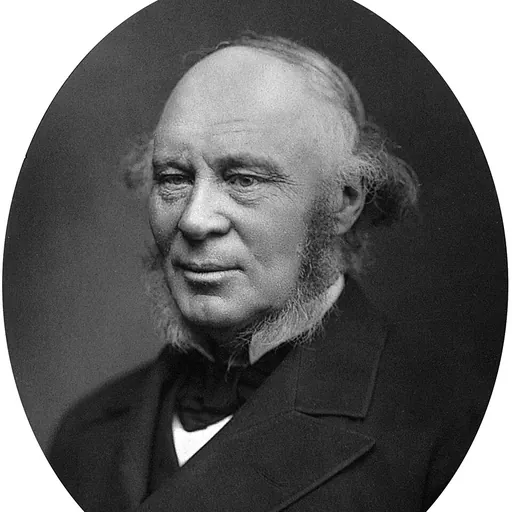
Sir John Fowler, 1st Baronet
Civil engineer (born 1817)
About Sir John Fowler, 1st Baronet
Lived 1817 – 1898 (aged 81). Sir John Fowler, 1st Baronet was a British engineer, civil engineer, railway engineer and architect.
Sir John Fowler, 1st Baronet, KCMG, LLD, FRSE (15 July 1817 – 20 November 1898) was an English civil engineer specialising in the construction of railways and railway infrastructure. In the 1850s and 1860s, he was engineer for the world's first underground railway, London's Metropolitan Railway, built by the "cut-and-cover" method under city streets. In the 1880s, he was chief engineer for the Forth Bridge, which opened in 1890. Fowler's was a long and eminent career, spanning most of the 19th century's railway expansion, and he was engineer, adviser or consultant to many British and foreign railway companies and governments. He was the youngest president of the Institution of Civil Engineers, between 1865 and 1867, and his major works represent a lasting legacy of Victorian engineering.
Early life Fowler was born in Wadsley, Sheffield, Yorkshire, England, to land surveyor John Fowler and his wife Elizabeth (née Swann). He was educated privately at Whitley Hall near Ecclesfield. He trained under John Towlerton Leather, engineer of the Sheffield waterworks, and with Leather's uncle, George Leather, on the Aire and Calder Navigation and on railway surveys. From 1837 he worked for John Urpeth Rastrick on railway projects including the London and Brighton Railway and the unbuilt West Cumberland and Furness Railway. He then worked again for George Leather as resident engineer on the Stockton and Hartlepool Railway and was appointed engineer to the railway when it opened in 1841. Fowler initially established a practice as a consulting engineer in the Yorkshire and Lincolnshire area, but, a heavy workload led him to move to London in 1844. He became a member of the Institution of Mechanical Engineers in 1847, the year the Institution was founded, and a member of the Institution of Civil Engineers in 1849. On 2 July 1850 he married Elizabeth Broadbent (died 19 November 1901), daughter of J. Broadbent of Manchester. The couple had four sons.
Other railways that Fowler consulted for were the London Tilbury and Southend Railway, the Great Northern Railway, the Highland Railway and the Cheshire Lines Railway. Following the death of Isambard Kingdom Brunel in 1859, Fowler was retained by the Great Western Railway. His various appointments involved him in the design of Victoria station in London, Sheffield Victoria station, St Enoch station in Glasgow, Liverpool Central station and Manchester Central station.
Fowler's consulting work extended beyond Britain including railway and engineering projects in Algeria, Australia, Belgium, Egypt, France, Germany, Portugal and the United States. He travelled to Egypt for the first time in 1869 and worked on a number of, mostly unrealised, schemes for the Khedive, In 1870 he provided advice to an Indian Government inquiry on railway gauges where he recommended a narrow gauge of for light railways. Later in his career, he was also a consultant with his partner Benjamin Baker and with James Henry Greathead on two of London's first tube railways, the City and South London Railway and the Central London Railway.
He is credited with the design of the Victoria Bridge at Upper Arley, Worcestershire, constructed between 1859 and 1861, and the near identical Albert Edward Bridge at Coalbrookdale, Shropshire built from 1863 to 1864. Both remain in use today carrying railway lines across the River Severn.
Following the collapse of Sir Thomas Bouch's Tay Bridge in 1879, Fowler, William Henry Barlow and Thomas Elliot Harrison were appointed in 1881 to a commission to review Bouch's design for the Forth Bridge.
On opening, the Metropolitan Railway's trains were provided by the Great Western Railway, but these were withdrawn in August 1863. After a period hiring trains from the Great Northern Railway, the Metropolitan Railway introduced its own, Fowler-designed, tank engines with a 4-4-0 wheel arrangement in 1864. The design of condensing steam locomotives, known as the A class and, with minor updates, the B class, was so successful that the Metropolitan and District Railways eventually had 120 of the engines in use and they remained in operation until electrification of the lines in the 1900s. He built the substantial Braemore House (since demolished), where he entertained at the highest levels of politics and society. He developed a hydro-electric scheme, fed from the artificial Home Loch, planted extensive woodlands on the steep valley sides, and created 12 km of recreational walks through them, including suspension footbridges over the Corrieshalloch and Strone Gorges (the former now an NTS property). He also developed a network of stalkerpaths. He was appointed a Justice of the Peace and a Deputy Lieutenant of the county.
He listed his recreations in Who's Who as yachting and deerstalking and was a member of the Carlton Club, St Stephen's Club, the Conservative Club and the Royal Yacht Squadron. He was also President of the Egyptian Exploration Fund.
In 1887 he was elected a Fellow of the Royal Society of Edinburgh. #tag:ref|His proposers were Sir James Falshaw, James Leslie, George Miller Cunningham and Alexander Crum Brown. Along with Benjamin Baker, he received an honorary degree of Doctor of Laws from the University of Edinburgh in 1890 for his engineering of the bridge. In 1892, the Poncelet Prize was doubled and awarded jointly to Baker and Fowler.
Fowler died in Bournemouth, Hampshire, at the age of 81 and is buried in Brompton Cemetery, London. He was succeeded in the baronetcy by his son John Arthur Fowler, 2nd Baronet (died 25 March 1899). The baronetcy became extinct in 1933 on the death of Reverend Montague Fowler, 4th Baronet, the first baronet's third son.
Don’t just read it —
keep it.
Full-length biographies made to live with: read them, listen on the way to work, watch them tonight.
- E-book
- Audio
- Video
Instant download · yours to keep · every purchase keeps this site free
Important facts
People in Sir John Fowler, 1st Baronet's life
Named in this biography and alive at the same time




Related people
Same field, nearest in time


Contemporaries
People whose lives overlapped Sir John Fowler, 1st Baronet's




Frequently asked questions
Who was Sir John Fowler, 1st Baronet?
civil engineer (born 1817)
When was Sir John Fowler, 1st Baronet born?
Sir John Fowler, 1st Baronet was born on 15 July 1817 in Wadsley.
When did Sir John Fowler, 1st Baronet die?
Sir John Fowler, 1st Baronet died on 20 November 1898 in Bournemouth.
What was Sir John Fowler, 1st Baronet's occupation?
Sir John Fowler, 1st Baronet was an engineer, civil engineer, railway engineer and architect.
What nationality was Sir John Fowler, 1st Baronet?
Sir John Fowler, 1st Baronet was British.
Sources & further reading
· Wikipedia: Sir John Fowler, 1st Baronet
· DBpedia: Sir John Fowler, 1st Baronet
Cite this page
APA: Biography.guide. (2026). Sir John Fowler, 1st Baronet. https://biography.guide/sir-john-fowler-1st-baronet/
MLA: "Sir John Fowler, 1st Baronet." Biography.guide, https://biography.guide/sir-john-fowler-1st-baronet/.
Chicago: "Sir John Fowler, 1st Baronet." Biography.guide. https://biography.guide/sir-john-fowler-1st-baronet/.
Data last updated: 2026-09-20 · Spot an error? Report a correction.
Page generated 2026-09-27 05:10 UTC