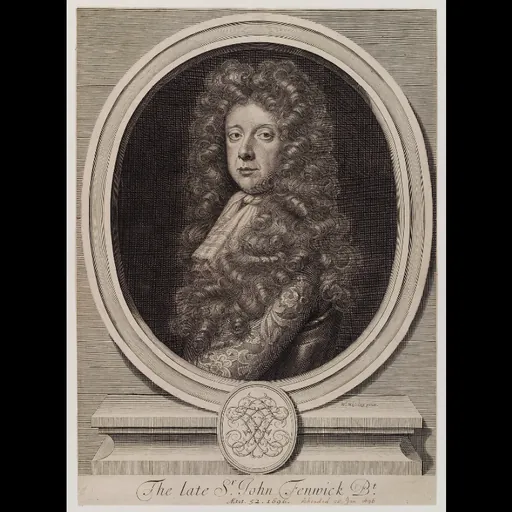
About Sir John Fenwick, 3rd Baronet
Lived 1645 – 1697 (aged 51–52). Sir John Fenwick, 3rd Baronet was a British politician and sir John Fenwick.
Sir John Fenwick, 3rd Baronet ( – 28 January 1697) was an English Army officer and politician. He succeeded to the Fenwick baronetcy after the death of his father, Sir William Fenwick, in 1677 and became a court-supporting Tory member of parliament. After the Glorious Revolution in 1688, he became a supporter of the Jacobite cause. Fenwick was involved in the Fenwick plot and implicated in an associated conspiracy to assassinate William III of England, and he was executed by beheading in 1697 as a result. He was the last person to be executed under an act of attainder in England.
Early life Fenwick was the eldest son of Sir William Fenwick, or Fenwicke, a member of an old Northumberland family, and Jane (née Stapilton). He was raised without a formal education. Soon after arriving in London as a young man, on 14 July 1663 he married Lady Mary Howard, a daughter of Charles Howard, 1st Earl of Carlisle.
Jacobite conspirator
After the Glorious Revolution, Fenwick began to plot against the new King William, and he was in regular correspondence with the exiled Stuart court at Château de Saint-Germain-en-Laye. He was in the north of England fomenting Jacobite agitation in late 1688 and early 1689, for which he underwent a short imprisonment in the Tower of London in 1689 from May to October.
As such, it is practically certain that he was aware of the schemes for capturing or assassinating William which came to light in 1695 and 1696.
William III then ordered the Duke of Devonshire to obtain a confession from Fenwick; the king also declined to consider granting a pardon until he had heard the nature of Fenwick's revelations. To save himself and stall for time, Fenwick offered to reveal all he knew about the Jacobite conspiracies; but his confession was a farce, being confined to charges of Jacobitism against some of the leading Whig noblemen. These accusations, which implicated both Godolphin and Marlborough, were damaging, but not conclusive.
Attainder and execution
A long and acrimonious debate then ensued in parliament. Among the Tories, especially, there was profound unease about proceedings that mimicked a trial but lacked any legal safeguards. At the first reading of the bill in the Commons, the majority to proceed was 92; by the time of the third reading on 25 November, the majority had reduced to 33. The controversial bill passed the Commons by 189 votes to 156, and then passed the Lords by 68 votes to 61, with members of both houses voting largely along party lines.
Fenwick was beheaded at Tower Hill on 28 January 1697, with the same formalities as were usually observed at the execution of a peer owing to Fenwick's close connection with several noble families. Following the act of attainder, what remained of Fenwick's property was granted to his nephew, Charles Howard, 3rd Earl of Carlisle. The horse purportedly stumbled when it stepped on a molehill. In recognition of this, the Jacobites' secret toast was to "The little Gentleman in Black Velvet." He is also commemorated in the folk tune Sir John Fenwick's The Flower Among Them All.
His wife had a memorial created for Fenwick, their children, and her father in York Minster, and she was buried there after she died on 27 October 1708.
Don’t just read it —
keep it.
Full-length biographies made to live with: read them, listen on the way to work, watch them tonight.
- E-book
- Audio
- Video
Instant download · yours to keep · every purchase keeps this site free
Important facts
Family & relationships
People in Sir John Fenwick, 3rd Baronet's life
Named in this biography and alive at the same time
Related people
Same field, nearest in time



Contemporaries
People whose lives overlapped Sir John Fenwick, 3rd Baronet's




Frequently asked questions
Who was Sir John Fenwick, 3rd Baronet?
English Jacobite conspirator (1645-1697)
When was Sir John Fenwick, 3rd Baronet born?
Sir John Fenwick, 3rd Baronet was born in 1645.
When did Sir John Fenwick, 3rd Baronet die?
Sir John Fenwick, 3rd Baronet died on 28 January 1697 in London.
What was Sir John Fenwick, 3rd Baronet's occupation?
Sir John Fenwick, 3rd Baronet was a politician and sir John Fenwick.
What nationality was Sir John Fenwick, 3rd Baronet?
Sir John Fenwick, 3rd Baronet was British.
Sources & further reading
· Wikipedia: Sir John Fenwick, 3rd Baronet
· DBpedia: Sir John Fenwick, 3rd Baronet
Cite this page
APA: Biography.guide. (2026). Sir John Fenwick, 3rd Baronet. https://biography.guide/sir-john-fenwick-3rd-baronet/
MLA: "Sir John Fenwick, 3rd Baronet." Biography.guide, https://biography.guide/sir-john-fenwick-3rd-baronet/.
Chicago: "Sir John Fenwick, 3rd Baronet." Biography.guide. https://biography.guide/sir-john-fenwick-3rd-baronet/.
Data last updated: 2026-09-22 · Spot an error? Report a correction.
Page generated 2026-09-27 05:09 UTC