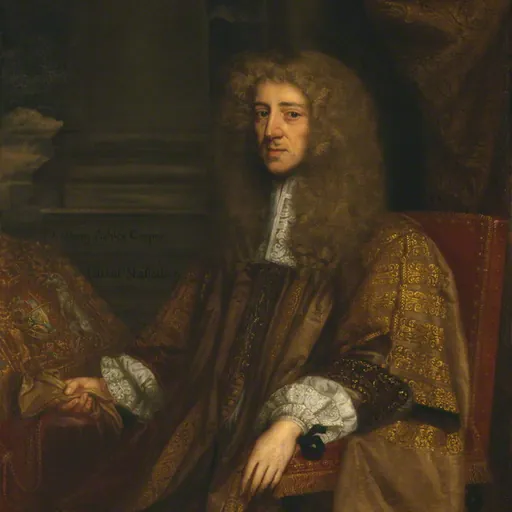
Anthony Ashley Cooper, 1st Earl of Shaftesbury
English politician and founder of the Whig party
About Anthony Ashley Cooper, 1st Earl of Shaftesbury
Lived 1621 – 1683 (aged 61). Anthony Ashley Cooper, 1st Earl of Shaftesbury was an English politician, judge, writer and jurist.
Anthony Ashley Cooper, 1st Earl of Shaftesbury (22 July 1621 – 21 January 1683), was an English statesman. He held senior political office under both the Commonwealth of England and Charles II, serving as Chancellor of the Exchequer from 1661 to 1672 and Lord Chancellor from 1672 to 1673. During the Exclusion Crisis (1679–1681), Shaftesbury headed the movement to bar the Catholic heir, James II, from the royal succession, which is often seen as the origin of the Whig party. He was the first patron of John Locke, who, when they met was a quiet Oxford don and practising physician; as part of Shaftesbury's household and retinue for 15 years, Locke became a major political philosopher.
During the Wars of the Three Kingdoms, Shaftesbury initially supported the Royalists, before joining the Parliamentarians in 1644. He served on the English Council of State under the English Commonwealth, although he opposed Oliver Cromwell's attempt to rule without Parliament during the Rule of the Major-Generals (1655–1657). He backed the Stuart Restoration in May 1660, and was raised to the peerage of England as Lord Ashley by Charles II.
After the political fall in 1667 of Edward Hyde, 1st Earl of Clarendon, Lord Ashley became one of five members of the so-called Cabal ministry and was created Earl of Shaftesbury in 1672. In 1673, it became widely known that Charles's brother and heir James had secretly converted to Catholicism. As with many English Protestants of the period, Shaftesbury saw Catholicism as closely linked to "arbitrary government", and thus the prospect of a Catholic monarch as a threat to the rule of Parliament.
His sponsorship of the Exclusion Bill in 1679 led to two years of political struggle, but ultimately ended in defeat. During the subsequent Tory reaction in 1681, Shaftesbury was arrested for high treason, a prosecution dropped several months later. Fearing re-arrest and execution, which was the fate of other opponents of the King, in 1682 he went into exile in Amsterdam, where he died in January 1683.
Biography
Early life and first marriage, 1621–1640 Location of Dorset in England. Anthony Ashley Cooper was born in Dorset in 1621, and he would maintain important links with the county throughout his political career. Cooper was the eldest son and successor of Sir John Cooper, 1st Baronet, of Rockbourne in Hampshire, and his mother was the former Anne Ashley, daughter and sole heiress of Sir Anthony Ashley, 1st Baronet. He was born on 22 July 1621, at the home of his maternal grandfather Sir Anthony Ashley in Wimborne St Giles, Dorset. He was named Anthony Ashley Cooper because of a promise the couple had made to Sir Anthony. where he studied under its master, the Regius Professor of Divinity, John Prideaux, a Calvinist with vehemently anti-Arminian tendencies. through the influence of Lord Coventry.
Little is known of Cooper's activities in the late 1640s. It is often assumed that he supported the Presbyterians against the Independents, and, as such, opposed the regicide of Charles I in January 1649. at Exeter House in London, where he served as consulting physician during several novel surgical procedures and recoveries. Beginning in 1667, Shaftesbury and Locke worked closely on the Grand Model for the Province of Carolina and its centrepiece, the Fundamental Constitutions of Carolina.
When Southampton died in May 1667, Ashley, as under-treasurer, was expected to succeed Southampton as Lord High Treasurer.
After the fall of Lord Clarendon in 1667, Lord Ashley became a prominent member of the Cabal, in which he formed the second "A". As Lord Chancellor, he addressed the opening of a new session of the Cavalier Parliament on 4 February 1673, calling on parliament to vote funds sufficient to carry out the war, arguing that the Dutch were the enemy of the monarchy and England's only major trade rival, and therefore had to be destroyed (at one point he exclaimed "Delenda est Carthago"); defending the Great Stop of the Exchequer; and arguing in support of the Royal Declaration of Indulgence. The Letter argued that since the time of the Restoration, "the High Episcopal Man, and the Old Cavalier" (now led by Danby) had conspired to make "the Government absolute and arbitrary."
Danby's Test Oath proposal was merely the latest, most nefarious attempt to introduce divine right monarchy and episcopacy on the country. The Letter went on to describe the debates of the House of Lords during the last session, setting forth the arguments that Shaftesbury and other lords used in opposition to Danby and the bishops. This letter was published anonymously in November 1675, and quickly became a best-seller, in no small part because it was one of the first books ever to inform the public about the debates that occurred within the House of Lords.
The government's case against Shaftesbury was particularly weak – most of the witnesses brought forth against Shaftesbury were witnesses whom the government admitted had already perjured themselves, and the documentary evidence was inconclusive. Although an early leader of the Whigs, "later generations disowned Shaftesbury," but they did uphold the principle he defended in Parliament's case for Exclusion, that "in the last resort the interests of the nation tak precedence over those of the Crown."
In North America, the Cooper River and the Ashley River which merge in Charleston, South Carolina are named in his honour. The Ashley was given its current name by explorer Robert Sandford.
In popular culture, Shaftesbury has been portrayed on screen by Frederick Peisley in The First Churchills (1969), by Martin Freeman in Charles II: The Power and The Passion, and by Murray Melvin in England, My England (1995).
Don’t just read it —
keep it.
Full-length biographies made to live with: read them, listen on the way to work, watch them tonight.
- E-book
- Audio
- Video
Instant download · yours to keep · every purchase keeps this site free
Important facts
People in Anthony Ashley Cooper, 1st Earl of Shaftesbury's life
Named in this biography and alive at the same time



Related people
Same field, nearest in time

Contemporaries
People whose lives overlapped Anthony Ashley Cooper, 1st Earl of Shaftesbury's






Frequently asked questions
Who was Anthony Ashley Cooper, 1st Earl of Shaftesbury?
English politician and founder of the Whig party (1621-1683)
When was Anthony Ashley Cooper, 1st Earl of Shaftesbury born?
Anthony Ashley Cooper, 1st Earl of Shaftesbury was born on 22 July 1621 in Dorset.
When did Anthony Ashley Cooper, 1st Earl of Shaftesbury die?
Anthony Ashley Cooper, 1st Earl of Shaftesbury died on 21 January 1683 in Amsterdam.
What was Anthony Ashley Cooper, 1st Earl of Shaftesbury's occupation?
Anthony Ashley Cooper, 1st Earl of Shaftesbury was a politician, judge, writer and jurist.
What nationality was Anthony Ashley Cooper, 1st Earl of Shaftesbury?
Anthony Ashley Cooper, 1st Earl of Shaftesbury was English.
Sources & further reading
· Wikipedia: Anthony Ashley Cooper, 1st Earl of Shaftesbury
· DBpedia: Anthony Ashley Cooper, 1st Earl of Shaftesbury
Cite this page
APA: Biography.guide. (2026). Anthony Ashley Cooper, 1st Earl of Shaftesbury. https://biography.guide/anthony-ashley-cooper-1st-earl-of-shaftesbury/
MLA: "Anthony Ashley Cooper, 1st Earl of Shaftesbury." Biography.guide, https://biography.guide/anthony-ashley-cooper-1st-earl-of-shaftesbury/.
Chicago: "Anthony Ashley Cooper, 1st Earl of Shaftesbury." Biography.guide. https://biography.guide/anthony-ashley-cooper-1st-earl-of-shaftesbury/.
Data last updated: 2026-09-22 · Spot an error? Report a correction.
Portrait: Wikimedia Commons · author & licence
Page generated 2026-09-27 05:03 UTC