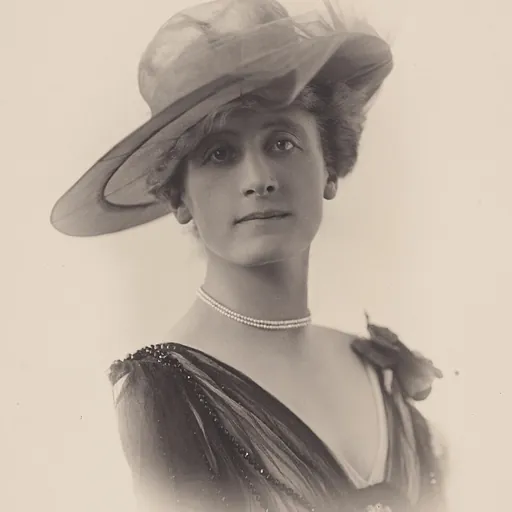
About Sidonie Nádherny von Borutin
Lived 1885 – 1950 (aged 64). Sidonie Nádherny von Borutin was an Austrian and Czech writer.
Baroness Sidonie Nádherny von Borutin, later Countess Sidonie von Thun und Hohenstein (; 1 December 1885 – 30 September 1950) was a Bohemian noblewoman known for hosting literary salons and her correspondence with Rainer Maria Rilke and Karl Kraus.
Early life and ancestry
Born at her family residence, a castle in Vrchotovy Janovice, into a family that belonged to the Bohemian nobility, Sidonie Amálie Vilemína Karolína Julie Marie Nádherná von Borutín was the youngest child of a landowner, Karel Boromejský Jan Ludvík Baron Nádherný von Borutín (1849–1895), and his wife, Baroness Amalie Klein von Wisenberg (1854–1910), youngest daughter of the Bohemian businessman of German origin Albert Baron Klein von Wisenberg (1807–1877).
Her older brothers were Jan Karel Ludvík Sidonius Adalbert Julius Otmar Maria (1884–1913) and Karel Maria Ludvík Hubert Adalbert Nádherný von Borutín (1885–1931).
Biography Nádherná gained literary fame through her friendship with the poet Rainer Maria Rilke, with whom she corresponded from 1906 until his death in 1926, and her friendship and later romantic relationship with the writer Karl Kraus. Nádherná met Kraus on 8 September 1913, in Vienna's Café Imperial. Their relationship, often filled with intensity and conflict, lasted until his death in 1936. Kraus would likely have married her, but Rilke objected to Kraus' "inextinguishable difference" (a reference to his Jewish heritage).
In 1914, Nádherná sought to make an influential marriage to a count that could have helped hinder World War I. She reconciled with Kraus in 1915, who wrote much of his drama The Last Days of Humanity at her residence, castle in Vrchotovy Janovice, but they separated again at the end of the war.
In 1920, Nádherná married the Austrian physician, Count Maximilian von Thun und Hohenstein (1887–1935) at Heiligenkreuz Abbey, but the relationship did not last. They separated a year later, and divorced in 1933. Nádherná and Kraus reunited and split several more times, eventually reconciling one last time in 1927, although their relationship was no longer romantic.
Sidonie von Nádherná's correspondence with Rilke and Kraus, now published, reveals her significance as a discussion partner, "creative listener," and as a representative of late Habsburg culture.
Nádherná is not solely defined by her relationships with influential men; she was also an independent and culturally invested woman. She organized many political and cultural salons at her family's estate near Prague.
In addition to Rilke and Kraus, her circle also included the architect Adolf Loos, the writer Karel Čapek, the composer Dora Pejačević, and the painter Max Švabinský.
In 1942, Janowitz Castle was seized by German troops and converted into the SS-Truppenübungsplatz Böhmen, training grounds for the Waffen-SS. After the war, Nádherná tried to reclaim her family's property, but was unsuccessful. The castle continued to be used by the army, and in 1948 was confiscated by the Communist Party of Czechoslovakia. Nádherná was briefly arrested before fleeing to Great Britain through Bavaria. In 1950 she died impoverished while still in exile.
In 1999, Nádherná's remains (which had been buried at St Mary's Church in Denham, Buckinghamshire and where a tombstone still remains) were brought back to Janovice Castle and buried on the grounds. The castle and its surrounding lands were restored between 2000 and 2007, in a cooperative effort between the Czech Republic and Germany. Today it has become a cultural and scientific meeting place, much as it was during Nádherná's lifetime.
Literature
Biography Alena Wagnerová: Das Leben der Sidonie Nádherný. Eine Biographie. Europäische Verlagsanstalt, Hamburg 2003.
Correspondence Elke Lorenz: Sei Ich ihr, sei mein Bote'. Der Briefwechsel zwischen Sidonie Nádherný und Albert Bloch, Iudicium, Munich 2002, (German / English). Karl Kraus: Briefe an Sidonie Nádherný von Borutin. 1913–1936, 2 volumes, published by Friedrich Pfäfflin, Wallstein, Göttingen 2005. Rainer Maria Rilke – Sidonie Nádherný von Borutin, Briefwechsel 1906–1926, published by Joachim W. Storck in collaboration with Waltraud und Friedrich Pfäfflin, Wallstein, Göttingen 2007. Friedrich Pfäfflin, Alena Wagnerová (ed.): Gartenschönheit oder Die Zerstörung von Mitteleuropa: Sidonie Nádherný – Briefe an Václav Wagner 1942–1949 Wallstein, Göttingen 2015.
Don’t just read it —
keep it.
Full-length biographies made to live with: read them, listen on the way to work, watch them tonight.
- E-book
- Audio
- Video
Instant download · yours to keep · every purchase keeps this site free
Important facts
People in Sidonie Nádherny von Borutin's life
Named in this biography and alive at the same time



Related people
Same field, nearest in time



Contemporaries
People whose lives overlapped Sidonie Nádherny von Borutin's



Frequently asked questions
Who was Sidonie Nádherny von Borutin?
Czech noblewoman (1885–1950)
When was Sidonie Nádherny von Borutin born?
Sidonie Nádherny von Borutin was born on 1 December 1885 in Vrchotovy Janovice.
When did Sidonie Nádherny von Borutin die?
Sidonie Nádherny von Borutin died on 30 September 1950 in London Borough of Hillingdon.
What was Sidonie Nádherny von Borutin's occupation?
Sidonie Nádherny von Borutin was a writer.
What nationality was Sidonie Nádherny von Borutin?
Sidonie Nádherny von Borutin was Austrian and Czech.
Sources & further reading
· Wikipedia: Sidonie Nádherny von Borutin
· DBpedia: Sidonie Nádherny von Borutin
Cite this page
APA: Biography.guide. (2026). Sidonie Nádherny von Borutin. https://biography.guide/sidonie-nadherny-von-borutin/
MLA: "Sidonie Nádherny von Borutin." Biography.guide, https://biography.guide/sidonie-nadherny-von-borutin/.
Chicago: "Sidonie Nádherny von Borutin." Biography.guide. https://biography.guide/sidonie-nadherny-von-borutin/.
Data last updated: 2026-09-23 · Spot an error? Report a correction.
Portrait: Wikimedia Commons · author & licence
Page generated 2026-09-27 05:05 UTC