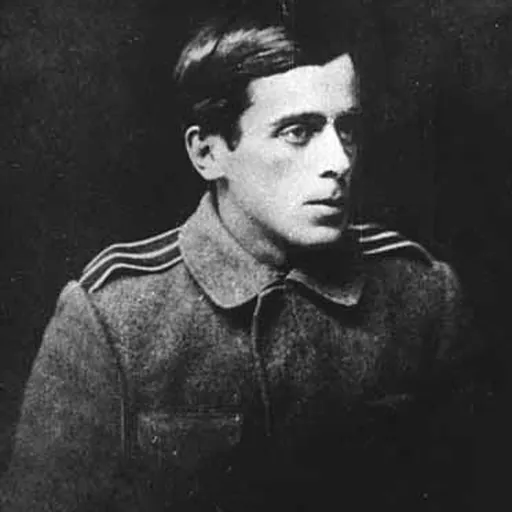
Sergei Efron
Officer of the White Army; Russian and Soviet publicist, writer, NKVD agent
About Sergei Efron
Lived 1893 – 1941 (aged 48). Sergei Efron was a Russian poet, philosopher, writer and political prisoner.
Sergei Yakovlevich Efron (; 8 October 1893 – 11 October 1941 ) was a Russian poet, White Army officer, and the husband of fellow poet Marina Tsvetaeva. While in exile, he was recruited by the Soviet NKVD. After returning to the USSR from France, he was executed.
Family life Sergei was born in Moscow on 8 October 1893. He was the sixth of nine children born to Elizaveta Durnovo (1853–1910) and Yakov Konstantinovich Efron (1854–1909). Both were Russian revolutionaries and members of the Black Repartition. Yakov worked as an insurance agent and died of cancer in 1909. The following year, one of Sergei's brothers died by suicide and his mother soon followed suit. Yakov was from a Jewish family, while Elizaveta came from a line of Russian nobility and merchants; Yakov converted to the Lutheran faith to marry Elizaveta.
Efron contracted tuberculosis as a teenager and his mental and physical health was strained further upon learning of his mother's death. After becoming a student at Moscow University, Sergei volunteered for the military as a nurse. Due to his poor health, though, he was unable to serve in that capacity. Instead, he enrolled in the officer cadet academy.
When Efron was a 17-year-old cadet in the officers' academy, he met 19-year-old Marina Tsvetaeva on 5 May 1911 at Koktebel ("Blue Height"), a well-known Crimean haven for writers, poets and artists. They fell in love and were married in January 1912. While they had an intense relationship, Tsvetaeva had affairs, such as those with Osip Mandelstam and poet Sofia Parnok.
Tsvetaeva and her husband spent summers in the Crimea until the revolution. They had two daughters: Ariadna, or Alya, (born 1912) and Irina (born 1917), and one son, Georgy. while Tsvetaeva returned from the Crimea to Moscow hoping to be reunited with her husband. There, in May 1922, Efron was reunited in Berlin with his wife, Tsvetaeva, and daughter Ariadna who had left the Soviet Union. In August 1922, the family moved to Prague. Living in unremitting poverty, unable to afford living accommodation in Prague itself, with Efron studying politics and sociology at the Charles University and living in hostels, Tsvetaeva and Ariadna found rooms in a village outside the city. She writes "we are devoured by coal, gas, the milkman, the baker... the only meat we eat is horse-meat".
In summer 1924, Efron and Tsvetaeva left Prague for the suburbs, living for a while in Jíloviště, before moving on to Všenory, where Tsvetaeva conceived their son, Georgy, whom she was to later nickname 'Mur'.
NKVD agent While still in Paris, Efron was homesick for Russia. and fled with his wife and child to the remote village of Finhaut, Valais canton, Switzerland, to hide. After they had been hiding for a month, they were contacted by a refugee member of the Communist Party of Germany Gertrude Schildbach under orders from Roland Lyudvigovich Abbiate, alias Francois Rossi, alias Vladimir Pravdin, codename LETCHIK ("Pilot"), a Russian expatriate, citizen of Monaco, and an NKVD agent. Schildbach wrote to Reiss to request a meeting and ask his advice. On 4 September 1937, Reiss agreed to meet Schildbach in Lausanne. Reiss, who was using the alias Eberhardt, was lured by Gertrude Schildbach onto a side road near Lausanne where Roland Abbiate was waiting for him with a Soviet PPD-34 sub-machine gun. Reiss was hit by twelve bullets and killed instantly. The two then dumped Reiss's body on the side of the road. Schildbach was never seen again.
Efron was allegedly in the car with the two assassins.
After Efron fled Paris, the police interrogated Tsvetaeva She was confused by their questions, answered incoherently, but is quoted as saying that in September he had been fighting in Spain and that "His trust might have been abused—my trust in him remains unchanged." The French police concluded that she was deranged and knew nothing of the murder. His daughter, however, confessed under beatings that her father was a Trotskyite spy, which led to his execution.
Don’t just read it —
keep it.
Full-length biographies made to live with: read them, listen on the way to work, watch them tonight.
- E-book
- Audio
- Video
Instant download · yours to keep · every purchase keeps this site free
Important facts
People in Sergei Efron's life
Named in this biography and alive at the same time



Related people
Same field, nearest in time

Contemporaries
People whose lives overlapped Sergei Efron's


Frequently asked questions
Who was Sergei Efron?
officer of the White Army; Russian and Soviet publicist, writer, NKVD agent (1893–1941)
When was Sergei Efron born?
Sergei Efron was born on 29 September 1893 in Moscow.
When did Sergei Efron die?
Sergei Efron died on 16 October 1941 in Moscow.
What was Sergei Efron's occupation?
Sergei Efron was a poet, philosopher, writer and political prisoner.
What nationality was Sergei Efron?
Sergei Efron was Russian.
Sources & further reading
Cite this page
APA: Biography.guide. (2026). Sergei Efron. https://biography.guide/sergei-efron/
MLA: "Sergei Efron." Biography.guide, https://biography.guide/sergei-efron/.
Chicago: "Sergei Efron." Biography.guide. https://biography.guide/sergei-efron/.
Data last updated: 2026-09-24 · Spot an error? Report a correction.
Portrait: Wikimedia Commons · author & licence
Page generated 2026-09-27 05:09 UTC