
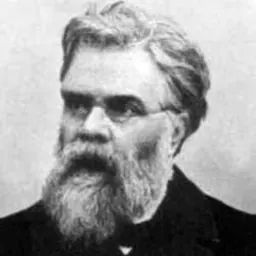
Serafim Ostroumov
Russian Orthodox bishop and saint New Martyr
About Serafim Ostroumov
Lived 1880 – 1937 (aged 57). Serafim Ostroumov was a Russian eastern Orthodox priest and university teacher.
Serafin, secular name Mikhail Ostroumov (born 6 November 1880 in Moscow, died 8 December 1937 in Katyn forest) was a Russian Orthodox bishop and saint New Martyr.
The son of a church psalmist, he graduated from the Moscow Theological Seminary and later the Moscow Theological Academy. From 1906 to 1914, he served as the superior of the St. Onuphrius Monastery in Jabłeczna, contributing to its development as a religious and educational center. In 1914, he briefly led the in Chełm before evacuating to Moscow in 1915.
On 3 April 1916, he was consecrated as Bishop of Biała Podlaska, vicar of the Eparchy of Chełm. In 1917, he became the ordinary of the Eparchy of Oryol. From 1922 to 1924, he was imprisoned for opposing the confiscation of Russian Orthodox Church property. From 1927 to 1936, he served as the ordinary of the Diocese of Smolensk, where he unsuccessfully resisted the anti-religious policies of the Soviet authorities. Arrested in 1936 and accused of leading a counter-revolutionary group, he was initially sentenced to imprisonment. In 1937, after a renewed investigation, he was sentenced to death and executed, likely in the Katyn forest.
In 2001, the Russian Orthodox Church canonized him as a saint New Martyr.
Biography Early life Serafin was born into the family of church psalmist Mitrofan Ostroumov, who served in a parish church in Moscow. He completed lower theological education at the Monastery of the Holy Mandylion, followed by the Moscow Theological Seminary in 1900 and the Moscow Theological Academy in 1904. On 14 September 1904, he took monastic vows before Bishop Tryphon Turkestanov at the Epiphany Monastery in Moscow.
In September 1904, he was successively ordained as a hierodeacon and then a hieromonk.
In October 1907, Hieromonk Serafin became the director of a two-grade parish school at the monastery and newly established teacher training courses, preparing educators for one-year church-affiliated schools. At the courses' inauguration, he emphasized the need for local teachers familiar with the region's culture, as outsiders often misunderstood its specifics. He successfully secured donors for the monastery's renovations and expansions, with significant financial support from Father Nikolai Kopiev of Moscow. This funding enabled the reconstruction and major renovation of the monastery's main church, the Cathedral of St. Onuphrius, with Hieromonk Serafin overseeing the renovation committee.
In November 1907, Archimandrite Joseph, the monastery's superior, was transferred to the Eparchy of Novgorod by the Most Holy Synod. On 1 December, Hieromonk Serafin became acting superior, and two weeks later, he was elected permanent superior by the monastic community – the first such election in decades, as the Most Holy Synod typically appointed superiors.
During his tenure, the monks opened a two-grade school in Otoki village, educating 62 children, and a one-grade school in Jabłeczna for 60 students. A separate trade school offered practical courses in agriculture, horticulture, veterinary science, forestry, dairy production, and beekeeping. The monastery regained its status as a major pilgrimage center. Monks were invited to preach in various parishes of the Eparchy of Chełm or worked to promote Orthodoxy in Austrian Galicia. Serafin also documented the monastery's history, working on a research paper before World War I, though the manuscript was likely lost during the war.
Rector of the Orthodox Theological Seminary in Chełm Building of the Orthodox Theological Seminary in Chełm. Serafin Ostroumov was its last rector before its closure in 1915 On 28 January 1914, the Most Holy Synod appointed Archimandrite Serafin as rector of the in Chełm. He also joined the eparchy's academic council and the Brotherhood of the Most Holy Theotokos. He contributed to editing eparchial publications, including the main journal, Chołmskaja Jeparchialnaja Żizn, He relocated to Moscow, where he supported refugees from the Chełm Land and worked to improve their conditions in exile. He participated in the Local Council of the Russian Orthodox Church from 1917 to 1918. His veneration emerged in the early 21st century in the Diocese of Lublin and Chełm of the Polish Orthodox Church, in areas where he served a century earlier. In 2014, Archbishop Abel Popławski of Lublin and Chełm established a parish in his name in Biała Podlaska.
Don’t just read it —
keep it.
Full-length biographies made to live with: read them, listen on the way to work, watch them tonight.
- E-book
- Audio
- Video
Instant download · yours to keep · every purchase keeps this site free
Important facts
Related people
Same field, nearest in time



Contemporaries
People whose lives overlapped Serafim Ostroumov's




Frequently asked questions
Who was Serafim Ostroumov?
Russian Orthodox bishop and saint New Martyr
When was Serafim Ostroumov born?
Serafim Ostroumov was born on 6 November 1880 in Moscow.
When did Serafim Ostroumov die?
Serafim Ostroumov died on 8 December 1937 in Katyn.
What was Serafim Ostroumov's occupation?
Serafim Ostroumov was an eastern Orthodox priest and university teacher.
What nationality was Serafim Ostroumov?
Serafim Ostroumov was Russian.
Sources & further reading
· Wikipedia: Serafim Ostroumov
Cite this page
APA: Biography.guide. (2026). Serafim Ostroumov. https://biography.guide/serafim-ostroumov/
MLA: "Serafim Ostroumov." Biography.guide, https://biography.guide/serafim-ostroumov/.
Chicago: "Serafim Ostroumov." Biography.guide. https://biography.guide/serafim-ostroumov/.
Data last updated: 2026-09-20 · Spot an error? Report a correction.
Page generated 2026-09-27 05:27 UTC