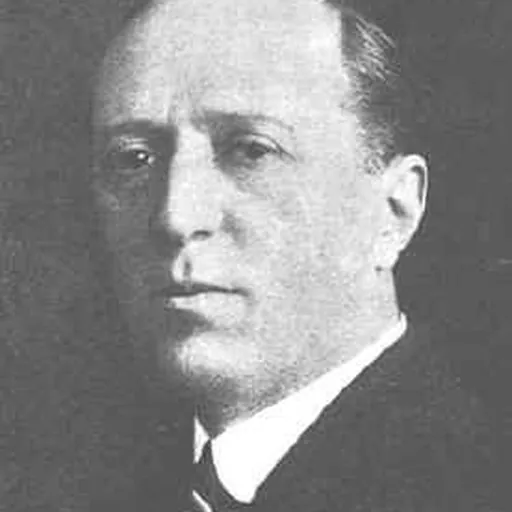
About Sebastiano Visconti Prasca
Lived 1883 – 1961 (aged 77). Sebastiano Visconti Prasca was an Italian military personnel.
Sebastiano Visconti Prasca (27 February 1883, Rome – 25 February 1961, Monte Porzio Catone) was an Italian general. A veteran of the Italo-Turkish War of 1911–1912 and he led the initial offensive of the Greco-Italian War in 1940 during World War II, but was relieved of his command after two weeks for incompetence and relieved by General Ubaldo Soddu.
Biography Early life and ancestry Sebastiano Visconti Prasca was born in Rome on 27 February 1883. He was a member of the noble family of the House of Visconti, patricians of Alessandria.
Career Early career and World War I Visconti Prasca joined the Italian Royal Army (Regio Esercito) and began studies at the Royal Military Academy of Infantry and Cavalry in Modena, from which he graduated in 1904. He was commissioned with the rank of sottotenente on 5 September 1904. Promoted to tenente on 5 September 1907, Visconti Prasca was recalled to Italy on 20 April 1930 He returned briefly to the general staff while awaiting orders, then assumed command of the 36th Infantry Regiment on 1 October 1930. Mussolini himself read the book, which may have decisively influenced many of the events that led to the outbreak of the Second Italo-Ethiopian War of 1935–1936. In April 1934, as an envoy of Badoglio, Visconti Prasca made a reconnaissance visit to the Colony of Eritrea. After his return to Italy, he drew up a report which helped to organize the operational plans for the Italian invasion of Ethiopia, which were implemented in 1935.
Visconti Prasca received a promotion to generale di brigata for "exceptional merit" on 18 October 1934, or on 11 July 1935, On 9 September 1937 he was promoted to the rank of generale di divisione (divisional general), with seniority from 1 July 1937,
Visconti Prasca was recalled to Italy on 15 December 1939, when he was appointed to the Ministry of War for "special duties." as Italy made preparations to enter the war on the side of the Axis powers. Sources also disagree on the date of his promotion to the rank of army corps general , giving it as 15 October 1939, with seniority from 1 July 1939, following a suggestion by the Minister of Foreign Affairs, Galeazzo Ciano, and the Deputy Chief of the General Staff of the Army, General Ubaldo Soddu, Visconti Prasca was appointed to replace General Carlo Geloso as commander-in-chief of the Italian armed forces in Albania, Upon his arrival in Albania, he took command on 5 June 1940 of Higher Forces Command Albania (XXVI Army Corps),
The Italian Army General Staff proceeded to organize an invasion plan, which was known as "Esigenza G" or "Emergenza G." Following an order from Mussolini, General Geloso drew up the initial operational plan after his return from Albania. It provided for the invasion of the Epirus region using an Italian force of 11 divisions, two cavalry regiments, and a grenadier regiment, but also required the Bulgarian Army to attack Western Thrace, forcing part of the Greek forces to withdraw from the Epirus front. The next plan provided for the use of 20 Italian divisions Ciano summoned Visconti Prasca to Rome, where Ciano informed him of the decision to invade the Chameria region, to attack Greece and conveyed it to Badoglio during a summit meeting attended by Mussolini, Badoglio, Ciano, and Francesco Giacomoni di San. Savino, with the date for the start of military operations set for 26 October 1940. Badoglio, after learning of Ciano's meeting with Visconti Prasca, ordered Visconti Prasca to obey only the orders that came from the Italian Army General Staff.
Visconti Prasca's personal assurances that the initial forces under his command would prove sufficient, and that the Italian invasion would meet feeble Greek resistance, had helped to convince Mussolini to launch the invasion and was one of the factors leading to the disaster. Overly confident in Greek weakness and the perfection of his invasion plan, Visconti Pracsa had done little to prepare his troops for combat and failed to ensure their logistical support, even neglecting such basic requirements as the provision of mules to carry supplies through the mountains, leaving the Italians not only in danger of failing to conquer Greek territory but of losing territory in Albania. Mussolini, outraged at Visconti Prasca's handling of the invasion, removed him from command of the troops on 8 November 1940, the same day the initial Italian advance halted, replacing him with General Ubaldo Soddu. Upon arriving in Albania, Soddu deemed the initial attack a failure and ordered Italian forces to shift immediately to a defensive stance. from which he was released in April or May 1945 along with a number of senior officers of the Soviet Red Army. He subsequently witnessed the entry of Soviet troops into Berlin during the Battle of Berlin. World War II ended in Europe with Germany's surrender to the Western Allies on 8 May 1945 and to the Soviet Union on 9 May.
After his return to Italy in October 1945, Visconti Prasca published his autobiography under the title Io ho aggredito la Grecia (Rizzoli, 1946), a contrived effort on his part for personal rehabilitation in which he tried to diminish his personal responsibility for the defeat of the Italian army on the Greek front and justify his personal errors in command. On several occasions after the war he tried unsuccessfully to return to active duty, asking the President of Italy, Luigi Einaudi, to reconsider his appeal against the decision to retire him in 1940, but he never returned to active service.
Personal life Visconti Prasca was married to Angelica Zoppi, the sister of generale designato and Senator Octavio Zoppi.
Visconti Prasca was Grand Master of the Synodal Military Order of the Knights of Omonia. From 1951 until his death, he was Grand Master of the Sovereign Military Order of St. George of Carinthia.
Death Visconti Prasca died in Monte Porzio Catone, Italy, near Rome, on 25 February 1961.
Honors and awards SOURCE
Visconti Prasca received his first Bronze Medal of Military Valor for his actions in 1912 during the Italo-Turkish War, the citation reading, "Responsible for conveying orders and briefings to the various military units, despite being slightly wounded at the start of the fighting, he continued his work with courage and bravery throughout the day. Merkeb, January 27, 1912."
His second award of the bronze medal for Military Valor was for his actions from 1915 to 1917 on the Italian front during World War I, the citation reading, "During more than two years of war, in a number of different situations, he carried out daring reconnaissance missions along the front, while as an officer he relayed orders between the different military units, displaying determination and ignorance of danger. Medio Izontso, May 1915 - September 1917."
Don’t just read it —
keep it.
Full-length biographies made to live with: read them, listen on the way to work, watch them tonight.
- E-book
- Audio
- Video
Instant download · yours to keep · every purchase keeps this site free
Important facts
People in Sebastiano Visconti Prasca's life
Named in this biography and alive at the same time


Related people
Same field, nearest in time





Contemporaries
People whose lives overlapped Sebastiano Visconti Prasca's

Frequently asked questions
Who was Sebastiano Visconti Prasca?
Italian general (1883–1961)
When was Sebastiano Visconti Prasca born?
Sebastiano Visconti Prasca was born on 27 February 1883 in Rome.
When did Sebastiano Visconti Prasca die?
Sebastiano Visconti Prasca died on 25 February 1961 in Monte Porzio Catone.
What was Sebastiano Visconti Prasca's occupation?
Sebastiano Visconti Prasca was a military personnel.
What nationality was Sebastiano Visconti Prasca?
Sebastiano Visconti Prasca was Italian.
Sources & further reading
· Wikipedia: Sebastiano Visconti Prasca
· DBpedia: Sebastiano Visconti Prasca
Cite this page
APA: Biography.guide. (2026). Sebastiano Visconti Prasca. https://biography.guide/sebastiano-visconti-prasca/
MLA: "Sebastiano Visconti Prasca." Biography.guide, https://biography.guide/sebastiano-visconti-prasca/.
Chicago: "Sebastiano Visconti Prasca." Biography.guide. https://biography.guide/sebastiano-visconti-prasca/.
Data last updated: 2026-09-22 · Spot an error? Report a correction.
Portrait: Wikimedia Commons · author & licence
Page generated 2026-09-27 05:04 UTC