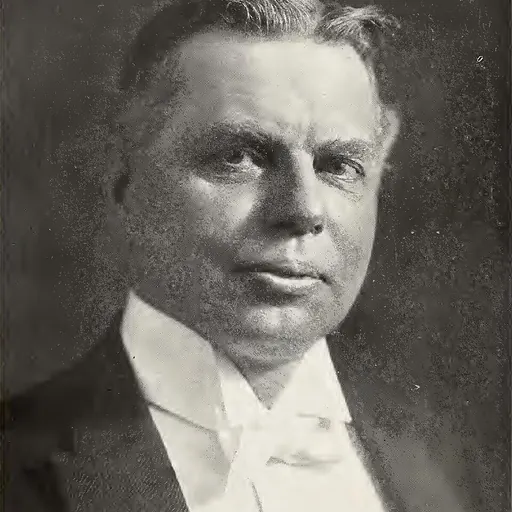
Schuyler Wheeler
American inventor of the two-blade electric fan
About Schuyler Wheeler
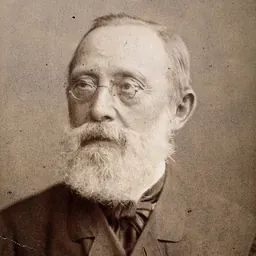
Lived 1860 – 1923 (aged 62). Schuyler Wheeler was an American physicist, inventor and electrical engineer.
Schuyler Skaats Wheeler (May 17, 1860 – April 20, 1923) was an American electrical engineer and manufacturer who invented the electric fan, an electric elevator design, and the electric fire engine. He is associated with the early development of the electric motor industry, especially to do with training the blind in this industry for gainful employment. He helped develop and implement a code of ethics for electrical engineers and was associated with the electrical field in one way or another for over thirty years.
Early life and genealogy Wheeler was born in New York City on May 17, 1860. He acted as general manager of the underground distribution system at Newburgh, New York. He was afterwards in charge to lay the Edison underground systems in other cities.
Wheeler worked for Herzog Teleseme Company as electrician for a short time between 1884 and 1885. Alongside F. Benedict Herzog, Wheeler was granted a patent for an "Electric Signaling Apparatus" in 1896. Then in 1886 he was part of developing and organizing the C and C Electric Motor Company with Charles G. Curtis and Francis B. Crocker. They organized the electrical engineering firms of Crocker-Wheeler Motor Company of New York state and the Crocker-Wheeler Company of the state of New Jersey. Wheeler was president of both the firms from 1889. During his tenure with Crocker-Wheeler, he was particularly important in development of the electric motors and applying it to machine tool drives. He was for seven years (1888–1895) the electrical expert consultant specialist of the Board of Electrical Control of New York.
In 1900, he purchased the library of Josiah Latimer Clark, which contained the largest collection of rare electrical works then known.
Wheeler invented the use of the electric motor in connection the Gatling gun which reduced the work of the operator when firing to simply pressing a button. It is one of the earliest applications of electricity to machine guns. He invented paralleling of dynamos and series multiple motor control.
Electrical balloting apparatus Wheeler devised an electrical voting device in 1907. This came about through the Automobile Club of America membership application process of the time. Formerly the board of governors made use of an old-fashioned method of dropping a small colored ball into a ballot box to determine their approval or disapproval of the applicant. The black and white ball plan of indicating a yes or no vote was good as long as there were not many applicants for membership. The balloting became very time consuming when the list of applicants became large. This was due to the mechanical handling of the little balls and the repository ballot box.
A new technology was invented by Wheeler that used electricity for instantaneous voting and immediate results. He was the club's first vice president and the consulting engineer. His innovation was to have each club member just sit in his chair and press a button for their vote. This would transmit their vote electrically to the central ballot box. Each voter had in his hand a small block of wood in which were two push buttons, one black and the other white. If the member had no objection to the applicant becoming an official member he pressed the white button. Their vote was recorded instantly then at the central location ballot box that received all the member votes electrically. If they thought the club would be better off without the applicant, the voting member pressed the black button for an instant tabulation. These votes, in either case, were in secret and securely tabulated an immediate result. One of their duties at first was the taping of wire coils which were on the armatures of electric motors. This was easily learned and advanced work was soon taught of winding wire coils for electric motors and transformers. The trainees were given a minimum wage at the beginning and then promoted to the regular wage earned by sighted employees. Wheeler traveled to Europe in 1918 to explain to the French and British governments this system he used for the blind.
The superintendent of the main factory suggested that some of the more talented blind trainees could work at the main factory. The result of that idea was that these blind people were given the opportunity to work side by side with the regular employees in the main factory. This plan proved satisfactory and resulted in the testing of processes not known to the normal electrical trade. Special drills and punch presses were used in Wheeler's experiments. He allowed his main factory to be used as a workshop and research facilities in which the blind could test these various unconventional manufacturing techniques.
Personal life Wheeler was married in 1898 to Ella Adams Peterson, daughter of Richard N. Peterson of New York City. She died in 1900 and he married again in 1901 to Amy Sutton, daughter of John Joseph Sutton of Rye, New York. He was a member of the American Society of Civil Engineers; the American Society of Mechanical Engineers; the American Institute of Electrical Engineers (President, 1905–1906; Vice President for three years); He wrote several technical articles related to electricity in various journals. He wrote articles for Harper's Weekly under the title, "The Cheap John in Electrical Engineering." In 1894 he joint authored a book titled "The Practical Management of Dynamos and Motors" with Professor Francis B. Crocker. He died of angina pectoris at his home in Manhattan on April 20, 1923. At the time of his death, he chaired the IEEE committee on "code of principles of professional conduct."
Don’t just read it —
keep it.
Full-length biographies made to live with: read them, listen on the way to work, watch them tonight.
- E-book
- Audio
- Video
Instant download · yours to keep · every purchase keeps this site free
Important facts
People in Schuyler Wheeler's life
Named in this biography and alive at the same time


Related people
Same field, nearest in time



Contemporaries
People whose lives overlapped Schuyler Wheeler's


Frequently asked questions
Who was Schuyler Wheeler?
American inventor of the two-blade electric fan
When was Schuyler Wheeler born?
Schuyler Wheeler was born on 17 May 1860 in Manhattan.
When did Schuyler Wheeler die?
Schuyler Wheeler died on 20 April 1923 in Manhattan.
What was Schuyler Wheeler's occupation?
Schuyler Wheeler was a physicist, inventor and electrical engineer.
What nationality was Schuyler Wheeler?
Schuyler Wheeler was American.
Sources & further reading
Cite this page
APA: Biography.guide. (2026). Schuyler Wheeler. https://biography.guide/schuyler-wheeler/
MLA: "Schuyler Wheeler." Biography.guide, https://biography.guide/schuyler-wheeler/.
Chicago: "Schuyler Wheeler." Biography.guide. https://biography.guide/schuyler-wheeler/.
Data last updated: 2026-09-22 · Spot an error? Report a correction.
Portrait: Wikimedia Commons · author & licence
Page generated 2026-09-27 05:04 UTC