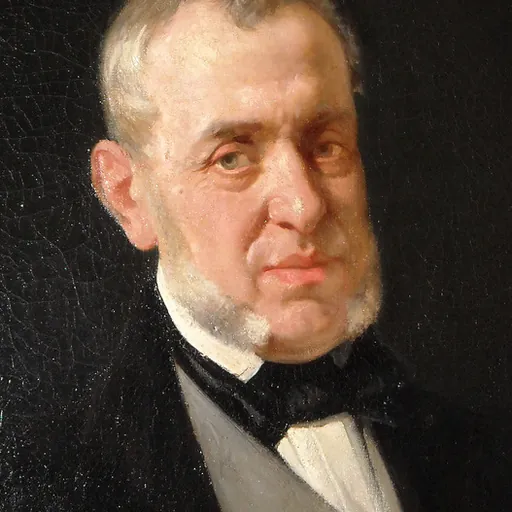
About Saverio Mercadante
Lived 1795 – 1870 (aged 75). Saverio Mercadante was an Italian composer, musicologist, chapelmaster, director and conductor.
Giuseppe Saverio Raffaele Mercadante (baptised 17 September 179517 December 1870) was an Italian composer, particularly of operas. While Mercadante may not have retained the international celebrity of Vincenzo Bellini, Gaetano Donizetti or Gioachino Rossini beyond his own lifetime, he composed as prolifically as any of them, and his development of operatic structures, melodic styles and orchestration contributed significantly to the foundations upon which Giuseppe Verdi built his dramatic technique.
Biography Early years Mercadante was born out of wedlock in Altamura, near Bari in Apulia; his precise date of birth has not been recorded, but he was baptised on 17 September 1795. Mercadante studied flute, violin and composition at the conservatory in Naples, and organized concerts among his compatriots. The opera composer Gioachino Rossini said to the conservatory Director, Niccolo Zingarelli, "My compliments, Maestro – your young pupil Mercadante begins where we finish". an ascendancy which did not end until censorship problems with the latter's Poliuto caused a final break. But Mercadante's style began to shift with the presentation of I Normanni a Parigi at the Teatro Regio in Turin in 1832: "It was with this score that Mercadante entered on the process of development in his musical dramaturgy which, in some aspects, actually presaged the arrival of Verdi, when he launched, from 1837 on, into master works of his artistic maturity: the so-called "reform operas".
In the period after 1831 he composed some of his most important works. These included Il giuramento which was premiered at La Scala on 11 March 1837. One striking and innovative characteristic of this opera has been noted: ..it marks the first successful attempt in an Italian opera premiered in Italy of depriving the prima donna, or some other star singer, of her until-then inalienable right of having the stage to herself at the end. By doing this, Mercadante sounded what was to be the death knell of the age of bel canto.
Early in following year, while composing Elena da Feltre (which premiered in January 1839), Mercadante wrote to Francesco Florimo, laying out his ideas about how opera should be structured, following the "revolution" begun in his previous opera: I have continued the revolution I began in Il giuramento: varied forms, cabalettas banished, crescendos out, vocal lines simplified, fewer repeats, more originality in the cadences, proper regard paid to the drama, orchestration rich but not so as to swamp the voices, no long solos in the ensembles (they only force the other parts to stand idle to the detriment of the action), not much bass drum, and a lot less brass band.
These temporarily put him in the forefront of composers then active in Italy, although he was soon passed by Giovanni Pacini with Saffo and Giuseppe Verdi with several operas, especially Ernani.
Later works
Some of Mercadante's later works, especially Orazi e Curiazi, were also quite successful. Many performances of his operas were given throughout the nineteenth century and it has been noted that some of them received far more than did Verdi's early operas over the same period of time.
Throughout his life he generated more instrumental works than most of his contemporary composers of operas due to his lifelong preoccupation with orchestration, and, from 1840, his position as the Director of the Naples conservatory for the last thirty years of his life. From 1863 he was almost totally blind and dictated all his compositions.
In the decades after his death in Naples in 1870, his output was largely forgotten, but it has been occasionally revived and recorded since World War II, although it has yet to achieve anything like the present-day popularity of the most famous compositions by his slightly younger contemporaries: see Donizetti's compositions and Bellini's compositions.
The French soloist Jean-Pierre Rampal notably recorded several Mercadante concertos for flute and string orchestra, including the grand and romantic E minor concerto, which has since gained some popularity among concert flautists.
Operas
Don’t just read it —
keep it.
Full-length biographies made to live with: read them, listen on the way to work, watch them tonight.
- E-book
- Audio
- Video
Instant download · yours to keep · every purchase keeps this site free
Important facts
People in Saverio Mercadante's life
Named in this biography and alive at the same time



Related people
Same field, nearest in time




Contemporaries
People whose lives overlapped Saverio Mercadante's




Frequently asked questions
Who was Saverio Mercadante?
Italian composer
When was Saverio Mercadante born?
Saverio Mercadante was born on 16 September 1795 in Altamura.
When did Saverio Mercadante die?
Saverio Mercadante died on 17 December 1870 in Naples.
What was Saverio Mercadante's occupation?
Saverio Mercadante was a composer, musicologist, chapelmaster, director and conductor.
What nationality was Saverio Mercadante?
Saverio Mercadante was Italian.
Sources & further reading
· Wikipedia: Saverio Mercadante
Cite this page
APA: Biography.guide. (2026). Saverio Mercadante. https://biography.guide/saverio-mercadante/
MLA: "Saverio Mercadante." Biography.guide, https://biography.guide/saverio-mercadante/.
Chicago: "Saverio Mercadante." Biography.guide. https://biography.guide/saverio-mercadante/.
Data last updated: 2026-09-20 · Spot an error? Report a correction.
Page generated 2026-09-27 05:10 UTC