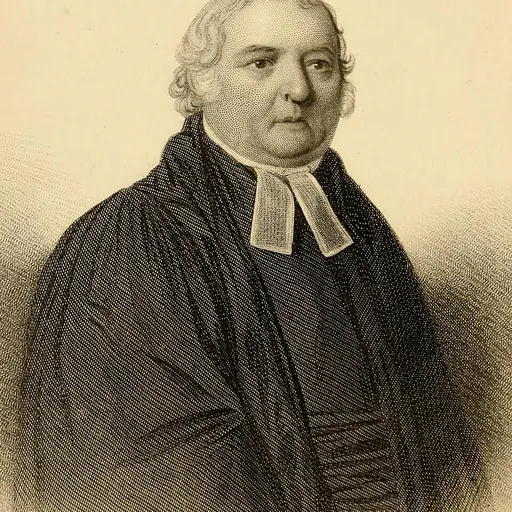
Samuel Marsden
Church of England chaplain, missionary, agriculturalist, magistrate.
About Samuel Marsden
Lived 1764 – 1838 (aged 73). Samuel Marsden was a British deacon, christian minister, chaplain, missionary, explorer and farmer.
New South Wales Rapid rise in power and wealth Marsden travelled as a passenger on the convict ship, to New South Wales, his first child Anne being born en route. He arrived in the colony on 10 March 1794, and the Lieutenant-Governor, Francis Grose gave him the position of assistant chaplain at Parramatta, inland from the main Port Jackson settlement. Marsden was advised to be "submissive and corteous" to the military government of the New South Wales Corps, and was quickly rewarded by Grose with a 100-acre land grant at Marsfield, supplemented with free convict labourers.
However, Marsden took issue with the extortion and the alcohol-driven economy of the officers, and in 1795 sided with the newly appointed Governor John Hunter to attempt to reform the system. In return, Hunter gave Marsden significant political and social power by naming him as the magistrate for Parramatta and also giving him a further land grant of 374 acres. with the historical record showing he handed down severe punishments (notably extended floggings), even by the standards of his day on the accused. The Australian historian, Robert Hughes in his book, The Fatal Shore, describes Marsden as, "a grasping Evangelical missionary with heavy shoulders and the face of a petulant ox". Hughes declares that Marsden's "hatred for the Irish Catholic convicts knew no bounds".
In 1800, ten Irish prisoners were interrogated and tortured after rumours surfaced of an Irish plot for insurrection in New South Wales. Marsden was one of several magistrates who ordered 100 to 500 lashes to be given as a means to extort information. Marsden himself described his interrogation of Paddy Galvin to Governor Philip Gidley King: "Mr Atkins and I ordered him to be punished very severely in hopes of making him inform...punished on his back and also his bottom when he could receive no more on his back. Galvin was just in the same mood when taken to the Hospital as when he was tied up... I am sure he will die before he will reveal anything"
Marsden's attitudes to Irish Roman Catholic convicts were illustrated in a memorandum which he sent to his church superiors during his time at Parramatta:
Despite Marsden's opposition to Catholicism being practised in Australia, Governor King permitted monthly Catholic masses in Sydney from May 1803 under police surveillance. When the Irish convicts actually organised a brief rebellion in 1804 at Castle Hill, Marsden fled Parramatta with the loyalist women and children to the safer location of Sydney until the uprising was over.
Marsden was also the originator of the New South Wales Female Register which classed all women in the colony as either "married" or "concubine". Only marriages within the Church of England were recognised as legitimate on this list; women who married in Roman Catholic or Jewish ceremonies were automatically classed as concubines.
Visit to England and planning for a New Zealand mission
In 1807 he returned to England to report on the state of the colony to the government, and to solicit further assistance of clergy and schoolmasters. He promoted the need for secular and religious educators to be sent to New South Wales and encouraged his associates to donate quality books so that he could establish a public library. He also organised the purchase of premium sheep and Suffolk cattle to add to his herds in the colony. Marsden and Ruatara returned to New South Wales together on the convict transport Ann, where Marsden discussed establishing a Christian mission at Ruatara's homeland at Rangihoua in the Bay of Islands of New Zealand. They arrived in Sydney in February 1810 and Ruatara, who was accepting of the plan for the mission at Rangihoua, later travelled with Marsden on his voyage to establish the mission in 1814.
Views and interactions with Aboriginal Australians Only months after his arrival at Parramatta in 1794, Marsden acquired an Indigenous Australian boy aged around three years old. The boy's mother had been shot by the whites and Marsden wrote that the child had been taken from the dead mother's breast. Marsden named the boy Tristan Maumby and he was brought up in the Marsden household, attending school and trained in the ways of a house servant. At the age of 16, Tristan accompanied the Marsden family on a voyage to England. While the vessel was anchored at Rio de Janeiro, Marsden beat Tristan for drinking alcohol. Tristan subsequently robbed Marsden of a considerable sum of money and absconded into the streets of Rio. Marsden made no attempt to find Tristan and proceeded with his journey to England.
During the late 1790s and early 1800s, the Hawkesbury and Nepean Wars between the colonists and the local Aboriginal people were at their height. As a magistrate, Marsden was central in organising operations against the Aborigines. He regularly used the ruthless tactics of interrogation, hostage taking and forcing young tribesmen to guide soldiers to capture or kill the supposed leaders of the Aboriginal resistance. By these methods Marsden was able to capture notable figures such as Tedbury and Musquito, and kill others such as Talloon. During the conflict, he also obtained another Aboriginal child whose mother was axed to death. Marsden named the boy John Rickaby but he died soon after. While trying to arrange a punitive expedition against "the natives", Marsden was quoted as saying "there never would be any good done until there was clear riddance of them", and that "the Aborigines are the most degraded of the human race".
This attitude to the original inhabitants continued throughout his life. During the 1820s, as the British pushed into the interior of the continent, Marsden received large land grants on the country of the Wiradjuri people. His economic interests far outweighed any concern for the Wiradjuri in the subsequent Bathurst War, with his stock-keepers participating in the conflict which resulted in the Indigenous people being forced off the land.
When a proposal for a 10,000 acre reserve to provide for the displaced Wiradjuri was raised, Marsden objected as he thought it would interfere with the colonists' ability to access land. He again dismissed the Aborigines as "degraded and idle" who would be "submerged and destroyed" by superior Europeans. Marsden also actively sabotaged another Aboriginal reserve run by the evangelist Lancelot Threlkeld for the Awabakal people of Lake Macquarie. Marsden refused to provide funding for the mission, despite Threlkeld making pioneering inroads into the study of Awabakal language.
With Macquarie's departure, the colony shifted more toward a plantation economy, where large landholders like Marsden benefited by being provided with priority access to further land allocations and cheap convict labour. Together with other wealthy colonists, Marsden helped form the Agricultural Society, which lobbied for further reactionary policies such as abolishing duties and taxes and reducing convict labourers to serfdom. By 1828, Marsden had increased his wealth, owning around 5,000 acres of land, worked by 80 convict servants. Marsden also formed the short-lived "Philanthropic Society" to fund the mission, but ultimately it was his own resources and £500 per annum from the CMS that initially financed the scheme.
Preliminary excursion to New Zealand CMS missionary Thomas Kendall, along with mariner Peter Dillon and tradesmen William Hall and John King, were chosen by Marsden to lead an investigative journey to the Bay of Islands. In March 1814, they proceeded from Sydney on board Marsden's brig Active, which he had purchased for £1,400.
Establishment of the mission at Rangihoua
As a result of the successful initial investigatory voyage, Marsden quickly organised a second journey, led by himself, to establish the mission settlement. The Active departed from Sydney on 14 November 1814, with Marsden, Kendall, King and Hall, together with other prospective settlers, their supplies and several of Marsden's horses. Also on board were the three Maori chiefs who had been given military uniforms to wear, which Marsden surmised would assist him to wield influence at the Bay of Islands. He also offered to pay the Maori crewmen on the Active equal rates to white men, the extra cost being covered by the CMS. Interestingly, before leaving Sydney, Ruatara was informed that the mission was just a front for British colonisation which would lead to the Maori being displaced and degraded just like the Aboriginal Australians. The service from the Church of England Book of Common Prayer was read in English but it is likely that, having learnt the language from Ruatara, Marsden preached his sermon in the Māori language. Ruatara was prevailed upon to explain those parts of the sermon the 400-strong Māori congregation did not understand.
Marsden later visited the neighbouring tribal areas, including the Okuratope Pā in Hongi Hika's territory. He also secured a cargo of timber to sell in Sydney. Marsden, who believed in the principle of "commerce before conversion", reckoned that trade brought back on the Active would earn around £1,000 per year. before sailing to England in the Kangaroo where he visited Professor Samuel Lee at Cambridge University and assisted him in the 1820 publication of First Grammar and Vocabulary of the New Zealand Language.
Weapons trade and the Musket Wars Almost immediately, the fledging settlement at Rangihoua struggled to survive as the whites there had little that the Maori leaders wanted, except guns. Marsden had already given Hongi Hika a musket on his first trip to New Zealand, and the Europeans remaining at mission site found themselves having to compete with visiting whalers and merchants to provide weapons and ammunition in order to trade with the Maori for food and resources such as flax and timber. Marsden countered by suing the Gazette and making a statement that weapons trade at the mission sites was forbidden.
Marsden did not make another visit to check on the operations at Rangihoua until 1819. Despite witnessing first-hand the effects of the gun trade, he still kept Kendall and Hall employed as missionaries. Marsden did however place a new chaplain, John Gare Butler, in charge of the mission. On this visit, Marsden traded 48 axes with Hongi Hika for 13,000 acres of land at Kerikeri for a new mission site. In a baffling move, Marsden also offered Hongi Hika a shotgun if he would cease buying guns from Kendall.
Meanwhile, Hongi Hika travelled with Kendall to England on the whaling ship . where he met King George IV, who gifted him a suit of armour. They also obtained further muskets when passing through Sydney on the return to New Zealand. Kendall's continued weapons trade, opposed in words but not actions by Marsden, was an important means of support for the new Kerikeri mission station.
Managing issues associated with the mission Marsden came under pressure from within the Church Missionary Society to do something about the scandalous operations occurring at the mission. In addition to the weapons trade, news arrived that Thomas Kendall had abandoned his wife for the daughter of a Māori tohunga (priest), and had also flirted with Maori traditional religion. The CMS also tried to establish a committee to investigate financial irregularities at the mission, but Marsden quickly had it dissolved. Furthermore, his appointee, John Butler, had written to Governor Macquarie outlining Marsden's hypocritical attitude to the gun trade.
The CMS subsequently sacked Kendall in 1822 and Marsden sailed to New Zealand the following year to remove both him and Butler from their positions. On the return voyage, they survived after their ship the Brampton was wrecked. Marsden later went to some trouble talking to all Australian printers to prevent Kendall from publishing a Māori grammar book, apparently largely out of spite. Marsden appointed Henry Williams as the new leader of the mission who concentrated on religious instruction instead of trafficking guns.
The mission would struggle on in competition with nearby Wesleyan and Catholic missions. In the 1820s, Kerikeri became the main mission in New Zealand (where the mission house and stone store can still be seen). Ultimately a model farming village was built at Te Waimate. By the 1830s the houses of the mission at the old Rangihoua site had deteriorated and some buildings were moved to Te Puna, further to the west in Rangihoua Bay. The mission finally closed in the 1850s.
Death
Marsden was on a visit to the Reverend Henry Stiles at St Matthew's Church at Windsor, New South Wales when he succumbed to an incipient chill and died at the rectory on 12 May 1838.
Marsden is buried in the cemetery near his old church at Parramatta, St John's.
During his life, Marsden had amassed 29 farms and properties amounting to 11,724 acres, which included several mansions and homesteads. His overall worth upon his death was £30,000, equivalent to a multi-millionaire in today's currency. Marsden Point in New Zealand was also named in his honour.
Marsden Street, Parramatta, is named after him.
Samuel Marsden Collegiate School in Karori, Wellington was named after Marsden. Houses at King's College, Auckland, King's School, Auckland and at Corran School for Girls are also named after him.
The Marsden Cross, erected near Rangihoua Bay in 1907, marks the place where Marsden delivered the first sermon on New Zealand soil.
Rangihou Reserve in Parramatta is named after the mission site in New Zealand, and is where Marsden established his short-lived Parramatta Maori Seminary.
There are approximately 135 sermons written by Marsden in various collections around the world. The largest collection is in the Moore Theological College Library in Sydney, Australia. These sermons reveal Marsden's attitudes to some of the controversial issues he faced, including magistrates, the Aboriginal people and wealth. A transcription of the Moore College collection can be found online.
Family Marsden and his wife, Elizabeth Fristan, had several surviving daughters and a son. Two other sons died in infancy, one from an incident involving a wheelbarrow, and the other was scalded to death in a kitchen accident. His wife also suffered a hemiplegic stroke during childbirth in 1811 and was partially paralysed for the rest of her life.
In fiction and popular culture The Australian poet Kenneth Slessor wrote a satirical poem criticising the parson, "Vesper-Song of the Reverend Samuel Marsden".
New Zealand reggae band 1814 took their name from the year that Marsden held the first sermon in the Bay of Islands.
Bryan Bruce's 2001 documentary, Workhorse to Dreamhorse includes a story about Marsden's stallion.
A portrait of Marsden based on Robert Hughes' The Fatal Shore appears in Patrick O'Brian's book The Nutmeg of Consolation.
In the 1978 Australian television series Against the Wind, Marsden was portrayed by David Ravenswood.
In the 1980 television adaptation of Eleanor Dark's 1941 novel The Timeless Land, Marsden is portrayed by John Cousins.
Don’t just read it —
keep it.
Full-length biographies made to live with: read them, listen on the way to work, watch them tonight.
- E-book
- Audio
- Video
Instant download · yours to keep · every purchase keeps this site free
Important facts
People in Samuel Marsden's life
Named in this biography and alive at the same time
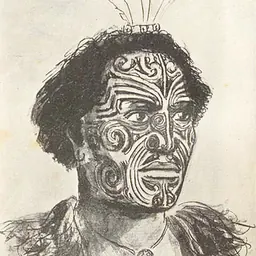
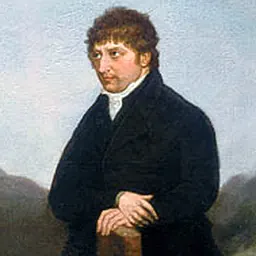

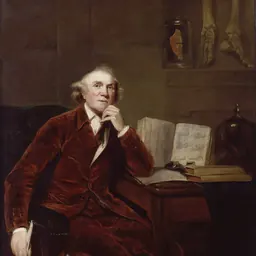
Related people
Same field, nearest in time


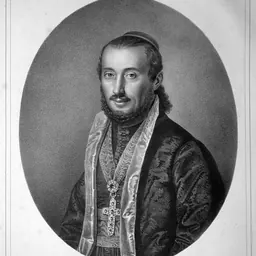
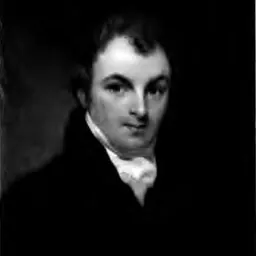

Contemporaries
People whose lives overlapped Samuel Marsden's






Frequently asked questions
Who was Samuel Marsden?
Church of England chaplain, missionary, agriculturalist, magistrate.
When was Samuel Marsden born?
Samuel Marsden was born on 28 July 1764 in Farsley.
When did Samuel Marsden die?
Samuel Marsden died on 12 May 1838 in Windsor.
What was Samuel Marsden's occupation?
Samuel Marsden was a deacon, christian minister, chaplain, missionary, explorer and farmer.
What nationality was Samuel Marsden?
Samuel Marsden was British.
Sources & further reading
Cite this page
APA: Biography.guide. (2026). Samuel Marsden. https://biography.guide/samuel-marsden-deacon/
MLA: "Samuel Marsden." Biography.guide, https://biography.guide/samuel-marsden-deacon/.
Chicago: "Samuel Marsden." Biography.guide. https://biography.guide/samuel-marsden-deacon/.
Data last updated: 2026-09-20 · Spot an error? Report a correction.
Page generated 2026-09-27 05:09 UTC