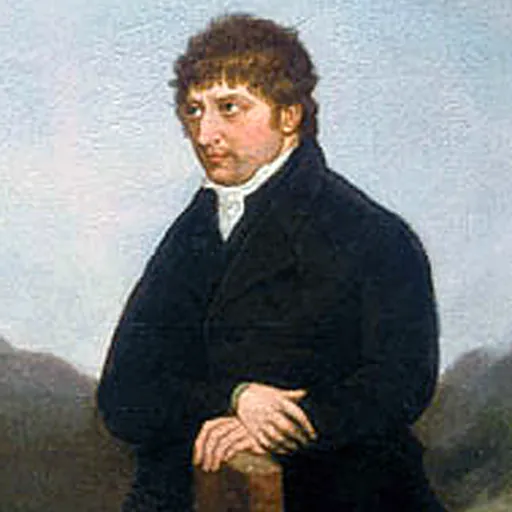
About Thomas Kendall
Lived 1778 – 1832 (aged 53). Thomas Kendall was a New Zealand linguist and missionary.
Thomas Kendall (13 December 1778 – 6 August 1832) was a schoolmaster, an early missionary to Māori people in New Zealand, and a recorder of the Māori language. An evangelical Anglican, he and his family were in the first group of missionaries to New Zealand, accompanied to the Bay of Islands by Samuel Marsden in December 1814 and settling there. He wrote the first book in Māori, published in 1815. By 1821 he felt it necessary to accede to local Māori demands for guns in order to ensure their continued protection of the mission, and the Church Missionary Society dismissed him in 1822 for gun dealing. Marsden visited New Zealand to dismiss him in person in 1823, after learning that he had committed adultery with a Māori woman. Kendall left New Zealand in 1825 and died in a ship sinking in Australia in 1832.
Early life: Lincolnshire and London, 1778–1813 A younger son of farmer Edward Kendall and Susanna Surflit, Thomas Kendall was born in 1778. He grew up in North Thoresby, Lincolnshire, England, where he was influenced by his local minister Reverend William Myers and the evangelical revival within the Anglican Church. Dates of his early careers are disputed. While a teenager he moved with Myers to North Somercotes, where he was assistant schoolmaster and also helped run Myers's farm. Kendall also tutored a gentleman's children in Immingham, where he met Jane Quickfall. On 21 November 1803, he married her and set up business as a draper and grocer. The business did not prosper.
In 1805, while attempting to sell a cargo of hops in London, Kendall visited Bentinck Chapel, Marylebone. Preaching of Basil Woodd and William Mann changed his outlook. He sold his business and moved his family to live in London, joining the congregation of that church and taking a job as a schoolmaster.
Church Missionary Society In 1808, he decided to become a missionary and applied to the Anglican Church Missionary Society to go to New Zealand. The governor also presumed to extend his own powers over New Zealand, issuing a proclamation that "natives are not to be carried off from New Zealand or the Bay of Islands by masters of vessels, or seamen or other persons without permission of chiefs, made in writing under hand of Revd Thomas Kendall, resident magistrate".
Kendall, Hall and King and their families, accompanied by Marsden, left Sydney in November 1814 and arrived in the Bay of Islands on 22 December. They established the mission there at Rangihoua. the first book written in Māori, which was published in Sydney. He started a school in August 1816 and it ran for over two years until it closed at the end of 1818 due to a lack of supplies. He sent off the manuscript of another book of Māori, but Samuel Lee, a linguist at the University of Cambridge, cast doubts on its accuracy. To defend his work Kendall decided to make an unauthorised trip to England. It is possible that Hongi wished to visit Britain and from his perspective Kendall was accompanying him. Although the Church Missionary Society disapproved of the trip, Hongi and Waikato were a social success. Kendall was ordained a priest on 12 November 1820 by the Bishop of Ely (though limited to New Zealand because of his lack of classical languages). Hongi and Kendall spent five months in Britain, mostly working with Lee in Cambridge, where Kendall's views about the language were justified (if some of his other theories were not; for example, Kendall believed the Māori were descended from Egyptians). Lee and Kendall's A grammar and vocabulary of the language of New Zealand was published in 1820. Kendall, Hongi, and Waikato travelled to New South Wales aboard the convict transport Speke. The 500 muskets, powder, ball, swords and daggers were uplifted from Port Jackson (Sydney) on their return voyage on (Captain Potton). In the following years, the guns helped him conquer a significant northern portion of the North Island in the Musket Wars and made him a man of considerable importance.
Return to New Zealand, then dismissal from the Church Missionary Society Kendall returned to New Zealand in July 1821. Kendall relied upon his friendship with Hongi Hika to assert leadership among other settlers, but it was a friendship bought in part by supporting the trade in firearms for Hongi's warriors, a trade Kendall himself profited by. The Church Missionary Society were understandably opposed, but Kendall felt they failed to understand the practicality of the situation, where the Anglican mission existed at Hongi's pleasure. On 27 September 1821 all the missionaries signed a letter written by Kendall defending the gun trade, saying he could not dictate what was sold to Māori: "They dictate to us! It is evident that ambition and self interest are amongst the principal causes of our security amongst them."
Around this time Kendall had begun an affair with Tungaroa, one of his school pupils who worked as a servant in his household. She was the daughter of a Rakau, a prominent Māori tohunga or priest and wise man. When the affair was discovered the pair eloped, living among nearby Māori. However, the relationship had ended by April 1822. His wife, Jane, took Kendall back, although he was unapologetic. One sailor wrote his rationalisation of the relationship with a Māori woman was "in order to obtain accurate information as to their religious opinions and tenets, which he would in no other way have obtained". Kendall indeed began a serious flirtation with Māori religious beliefs, an exploration he set out in a series of seven letters between 1822 and 1824. In 1822 he wrote that the "sublimity" of Māori spirituality saw him "almost completely turned from a Christian to a Heathen".
As a result of the letter of 27 September 1821 the Church Missionary Society dismissed Kendall in August 1822. Samuel Marsden, who also knew of Kendall's affair and his close relationship with Hongi, returned to New Zealand in August 1823 to sack him in person. When the Kendalls' ship, the Brampton, ran aground while leaving, Kendall decided to stay, claiming divine intervention. In a letter of 25 July 1824 to the Church Missionary Society, Kendall confessed his past "errors".
Chile and Australia, 1825–1832 The Kendall family remained living in the Bay of Islands until 1825, when he accepted a position as clergyman at the British consulate at Valparaíso, Chile. This job did not last, and his family settled in New South Wales, where he obtained a grant of , including large stands of red cedar at Yackungarrah Creek, Yatte Yattah. His son Thomas Surfleet Kendall acquired the neighbouring farm. He bought the cutter Brisbane.
In the decade after Hongi Hika died and Kendall left in 1825, widescale conversion of Māori to Christianity occurred. Kendall attempted to continue his work on the Māori language in Australia, having drafted a substantially improved Māori grammar, but Marsden prevented its publication.
Thomas Kendall died in 1832 when the Brisbane sank with all hands off Cape St. George (some 200km south of Sydney) while bringing wood and cheese from his farm to market.
Family
Suzannah (?1804–1881) Elizabeth Jane (?1805–1870) Thomas Surfleet (1807–1883) Basil (1809–1852) Joseph (1811–1865) John (1813–1813) Samuel (1816–1827) John (1818–1895) Lawrence (1819–1881) Edward (1822–1902)
One of his grandsons, Henry Kendall, was an Australian poet.
A biography is The Legacy of Guilt: a life of Thomas Kendall by Judith Binney.
Don’t just read it —
keep it.
Full-length biographies made to live with: read them, listen on the way to work, watch them tonight.
- E-book
- Audio
- Video
Instant download · yours to keep · every purchase keeps this site free
Important facts
People in Thomas Kendall's life
Named in this biography and alive at the same time


Related people
Same field, nearest in time



Contemporaries
People whose lives overlapped Thomas Kendall's





Frequently asked questions
Who was Thomas Kendall?
New Zealand missionary (1778-1832)
When was Thomas Kendall born?
Thomas Kendall was born on 13 December 1778 in Lincolnshire.
When did Thomas Kendall die?
Thomas Kendall died on 6 August 1832 in Jervis Bay.
What was Thomas Kendall's occupation?
Thomas Kendall was a linguist and missionary.
What nationality was Thomas Kendall?
Thomas Kendall was New Zealand.
Sources & further reading
Cite this page
APA: Biography.guide. (2026). Thomas Kendall. https://biography.guide/thomas-kendall/
MLA: "Thomas Kendall." Biography.guide, https://biography.guide/thomas-kendall/.
Chicago: "Thomas Kendall." Biography.guide. https://biography.guide/thomas-kendall/.
Data last updated: 2026-09-22 · Spot an error? Report a correction.
Portrait: Wikimedia Commons · author & licence
Page generated 2026-09-27 05:04 UTC