
About Sam Stoller
Lived 1915 – 1985 (aged 69). Sam Stoller was an American athletics competitor.
Sam Stoller (August 8, 1915 – May 29, 1985) was an American athlete who specialized in sprinting and long jumping. He tied the world record in the 60-yard dash in 1936. Stoller is best known for his exclusion from the American 4 × 100 relay team at the 1936 Summer Olympics in Berlin. The 2-man substitution triggered widespread speculation that he and Marty Glickman—the only two Jews on the U.S. track team—were excluded because U.S. Olympic Committee chairman Avery Brundage wanted to avoid embarrassing Adolf Hitler by having two Jewish athletes win gold medals. Stoller vowed at the time that he would never run again, but he returned in 1937 to win both the Big Ten Conference and NCAA championships in the 100-yard dash. After graduating from the University of Michigan in 1937, Stoller briefly went into a singing and acting career as "Singin' Sammy Stoller."
Champion sprinter
Competition with Jesse Owens A native of Cincinnati, Ohio where he attended Hughes High School, Stoller was one of the best sprinters the state had ever produced, but he had the misfortune of attending high school in Ohio at the same time as Jesse Owens. The two raced on rival teams in high school, and Owens always won, except once. They continued as rivals in college, Owens running for Ohio State and Stoller for Michigan. They competed against each other more than twenty times, and although Owens typically finished first, one writer noted: "As often as not, only a breather separated them." He also joked, "I'm the fellow you see in the movies of Jesse's foot races."
Accomplishments prior to 1936 Olympics Stoller worked his way through the University of Michigan by washing dishes and sweeping floors at a fraternity house. During the 1936 track season, Stoller proved himself to be one of America's top sprinters and long jumpers. At the Big Ten championship in March 1936, Stoller tied the world indoor record in the 60-yard dash with a time of 6.1 seconds. Stoller was also one of the USA's top long-jumpers in 1936 with a 23-foot, 10-inch jump. Though he failed to make the Olympic team as a long jumper, he qualified for the Olympic team as a member of the 4 × 100 meter relay team along with Jesse Owens, Frank Wykoff, Marty Glickman, and Foy Draper.
1936 Summer Olympics in Berlin
Exclusion of Stoller and Glickman
On the morning that the 4 x 100 relay competition began, U.S. track coach Lawson Robertson called a meeting and informed Stoller and Glickman that they had been pulled from the event and that they would be replaced by Owens and Ralph Metcalfe. Glickman later recalled that all the sprinters were called into a special meeting by Robertson and his assistant, Dean Cromwell. "We were informed by the coaches that the Germans were hiding their best sprinters to make an all-out effort to win the 400-meter relay, and consequently, Jesse Owens and Ralph Metcalfe were to replace Stoller and me." Glickman responded by immediately questioning the premise, challenging Robertson by asserting "Coach, you can't hide world-class sprinters."
Controversy surrounding the decision Glickman immediately went public with a charge that the decision to pull him and Stoller was the product of "politics." After the heats failed to reveal Germany's hidden sprinters, Glickman told the press in Berlin, "The heats failed to show the necessity for shaking up the line-up after Stoller and myself long practiced the stick-work. We did not know until this morning's conference with Head Coach Robertson just who would run. It looks like politics to us." Glickman charged that "this talk about the Germans and the Dutch being so tough looks like a false alarm on the basis of today's trials." Columnist Braven Dyer noted that Robertson's decision had been "panned" and had "angered a lot of folks" when he "jerked" Stoller and Glickman from the team. Dyer asserted that "Glickman and Stoller had good reason to believe that when they qualified to represent the United States in the baton-passing event that nothing less than physical deterioration would prevent them from running. Apparently the boys were in good shape. Their conduct had offended no member of the brass hat brigade." And when the U.S. team arrived in New York, press accounts indicated that "an internal battle" loomed in the Olympic organization over "the dropping of two Jewish sprinters, Sam Stoller and Marty Glickman."
Historical perspective on the exclusion In his official report after the 1936 Olympics, Avery Brundage rejected the suggestion that Stoller and Glickman had been excluded due to their religion. He wrote, "An erroneous report was circulated that two athletes had been dropped from the American relay team because of their religion. This report was absurd." An investigation in 1998 by the Los Angeles Times rebutted the coaches' claim that more speed was needed and concluded that "history points to something darker." The Times found no evidence to support the claim that the Germans were "sandbagging some super sprinters for the race" and noted that "reports have persisted almost from the moment of the change that religion was behind it." 400 m runner Hal Smallwood also did not compete, but he had undergone an appendectomy. After the Nazis banned Jews from competing in German sports in 1934, American Olympic Committee chairman Avery Brundage "made a brief, Nazi-controlled inspection of Germany and declared that the country's Jews were being allowed to participate."
Big Ten and NCAA championships in 1937
After vowing in 1936 never to run again, Stoller recanted and chose to compete in the 1937 track season. Newspapers predicted that, with Jesse Owens turning professional, Stoller would find his place in the limelight. An Associated Press story in February 1937 noted:"Fleet Sammy Stoller has discarded that second fiddle. The University of Michigan ace sprinter, until now generally finding the track summaries in sprints reading: 'Second, Stoller,' has darted ahead, at this date, of the country's leading sprinters." The press observed that, in a career "heretofore frustrated alone by Owens," 1937 was Stoller's "bid for national recognition." He dominated the 100-yard dash through the 1937 track season, winning both the Big Ten and NCAA championships. His best official time in 1937 was 9.6, Screen comedian Joe E. Brown was instrumental in getting Stoller bit parts in several 1937 motion pictures, and registration with the Screen Actors Guild. His first part was in a crowd scene at a New York cafe in Mae West's Every Day's a Holiday. He appeared as a singer and actor in several Hollywood motion pictures. Hollywood reporter Bill Henry wrote in November 1937:"Sam, who is something of a singer, decided to stay out here after the National Intercollegiates which finished his rah-rah sprint career last June. Joe E. Brown introduced him to a couple of people and Sam talked and sung over half the radios in California and has appeared in nine — count 'em — pictures. They are 'Navy Blue and Gold,' 'Rosalie,' 'Tom Sawyer,' 'Nothing Sacred,' 'She's Got That Swing,' 'The Thrill of a Lifetime,' 'Taking the Town,' 'Blossoms Broadway,' and 'Every Day's a Holiday.' In five months Sam has dashed from one studio to another to appear in these super-colossals — and not a blamed one of 'em has been released yet." In January 1938, Louella Parsons wrote about Stoller in her Hollywood column. She noted that, although the Michigan track star had thus far rated only "bit" parts, the stars were being photographed with him. "So far Sammy's been photographed with Fredric March, Carole Lombard, Errol Flynn, Bette Davis and many others and now all his pals back east who see the pictures think he's a big shot, making thousands in the movies and chumming with the stars. One of his pals went so far as to borrow $1,000 from him — and the most Sammy has earned is $10 per day — some days!"
In 1938, Stoller participated in a two-month exhibition tour of the Philippine Islands as part of a four-man team competing under the name, The Southern California Sportsmen's Association.
In 1940, columnist Pat Robinson commented on Stoller's extraordinary year:"Sammy Stoller ... Michigan '37 ... who was clocked in 9.4 for the century .. is going to make a comeback on the boards this winter ... The chunky speedster has had a short but hectic career since leaving Michigan ... He's been in the movies .. sung on the radio ... and in night clubs ... travelled 70,000 miles for athletic competition .. and got himself married ... none of which ... he says ... has slowed him down."
Posthumous honors and medal from Olympic Committee Stoller died on May 29, 1985, at age 69.
In 2007, Stoller was posthumously awarded the "Pillar of Achievement" award by the International Jewish Sports Hall of Fame.
Don’t just read it —
keep it.
Full-length biographies made to live with: read them, listen on the way to work, watch them tonight.
- E-book
- Audio
- Video
Instant download · yours to keep · every purchase keeps this site free
Important facts
People in Sam Stoller's life
Named in this biography and alive at the same time






Related people
Same field, nearest in time
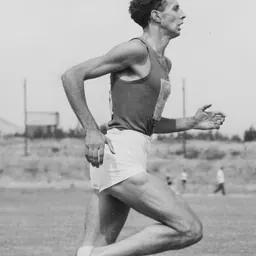

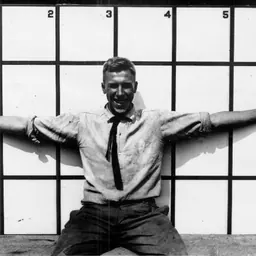
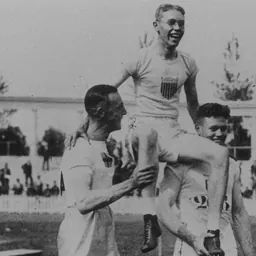
Contemporaries
People whose lives overlapped Sam Stoller's
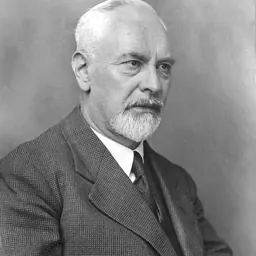




Frequently asked questions
Who was Sam Stoller?
American sprinter
When was Sam Stoller born?
Sam Stoller was born on 8 August 1915 in Cincinnati.
When did Sam Stoller die?
Sam Stoller died on 29 May 1985 in Broward County.
What was Sam Stoller's occupation?
Sam Stoller was an athletics competitor.
What nationality was Sam Stoller?
Sam Stoller was American.
Sources & further reading
Cite this page
APA: Biography.guide. (2026). Sam Stoller. https://biography.guide/sam-stoller/
MLA: "Sam Stoller." Biography.guide, https://biography.guide/sam-stoller/.
Chicago: "Sam Stoller." Biography.guide. https://biography.guide/sam-stoller/.
Data last updated: 2026-09-20 · Spot an error? Report a correction.
Page generated 2026-09-27 05:31 UTC