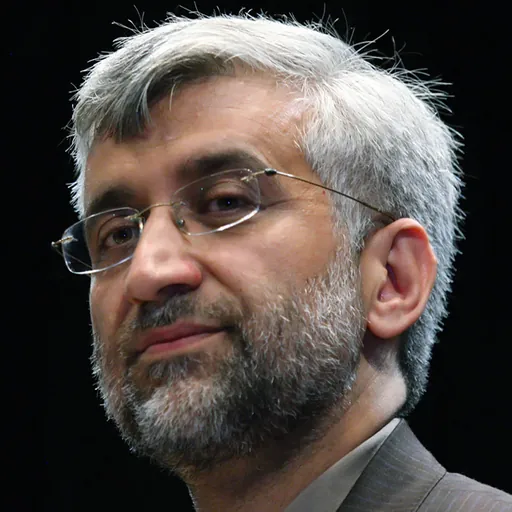
About Saeed Jalili
Born 1965. Saeed Jalili is an Iranian politician, diplomat and university teacher.
Saeed Jalili (; born 6 September 1965) is an Iranian principlist politician and diplomat, who has been a member of the Expediency Discernment Council of the System since 2013. He was both chief nuclear negotiator for Iran and secretary of the Supreme National Security Council from 2007 to 2013. His tenure as chief negotiator on Iran's nuclear program was characterized by his uncompromising approach.
He was deputy foreign minister for European and American Affairs from 2005 to 2007. Jalili was later an unsuccessful candidate for president of Iran three times; in the 2013 Iranian presidential election (placing third), in 2021 (he ultimately withdrew), and in 2024 (he was defeated by Masoud Pezeshkian in a runoff election).
Jalili was a soldier with the Basij volunteers of the Islamic Revolutionary Guard Corps in the Iran–Iraq War, and lost part of his right leg during the Siege of Basra. This earned him the nickhame of "Living Martyr" among his supporters. He holds a PhD in political science, and taught the "Prophet's diplomacy" at Imam Sadiq University. In 2009, Jalili was named as one of the 500 most influential people in the Muslim world.
Jalili is known for his staunch ultra-hardline positions and confrontational rhetoric against the West. At the same time he has pushed for stronger relations with Russia and China. He strongly advocates women being required to wear the mandatory hijab, and the government enforcing the requirement. Backed by the fundamentalist Iranian Principlist Paydari Front, he attributes Iran's economic troubles to international sanctions, and rejects social liberalization. This has earned him significant influence, as well as discomfort among the more pragmatic factions within the Iranian establishment. His father, Mohammad Hasan Muallem, was the principal of Nawab Safavi Primary School in Mashhad. Jalili's brother Vahid is a fundamentalist who is the deputy for cultural affairs at Iran’s state broadcaster, IRIB. Jalili married Fatemeh Sajjadi, a doctor of internal medicine, in 1992. They have one child, a son named Sajjad. Jalili was a resident of Karaj until 2004.
Jalili holds a PhD in political science from Imam Sadeq University, and his doctoral thesis entitled "The Paradigm (Foundation) of Political Thought of Islam in the Qur'an" was later developed into a book by the name of "The Foreign Policy of the Prophet (Prophet Muhammad)." He has taught political science as a lecturer since 2000 at different intervals at Imam Sadeq University. Jalili is familiar with English and Arabic.
Military career
Jalili served as a member of the Basij paramilitary volunteers of the Islamic Revolutionary Guard Corps in the Iran–Iraq War. During the fighting, he was injured severely while acting as a forward observer, and the lower portion of his right leg was amputated in 1986. Thereafter, he served in administrative positions.
Political career Following the war, Jalili began working as a university lecturer at his alma mater. In 1989 he started working at the ministry of foreign affairs in addition to his teaching post. In 2001, he was appointed senior director of policy planning in the office of the Supreme Leader, Ayatollah Ali Khamenei.
On 20 October 2007, Jalili replaced Ali Larijani as secretary of the council and became responsible for international negotiations over Iran's nuclear program. However, he was described as uncompromising even among Iranian representatives, and was considered "impossible" by European officials. A nuclear deal was struck only after Jalili was dismissed as secretary of the council on 10 September 2013, and Ali Shamkhani was appointed to replace him. Immediately after being dismissed from the office, Jalili was appointed by Supreme Leader Ali Khamenei to the Expediency Discernment Council of the System as a member.
Activities and views Jalili is a leading figure of the hardline "Iranian neo-Principalist" group in the Iranian political scene, and a protégé of Mojtaba Khamenei. The New York Times reported that an Iranian analyst described him in 2013 as "the perfect follower of [Ali] Khamenei" who "doesn’t care about foreign relations, the economy or anything," and that his speeches reflect the worldview "of an Iran engaged in a multifaceted battle with the West", maintained by Iran's Supreme Leader. Jalili was known for his loyalty to Ali Khamenei.
He strongly advocates women being required to wear the mandatory hijab, and believes that the Iranian government should not hesitate to enforce the hijab law. Jalili says that Iranian women should focus their lives on home and family, instead of pursuing careers, and that the state must regulate Iran's cultural and social life so as to ensure that it remains “pure.”
In 2014 Jalili participated in an international gathering of Holocaust deniers in Tehran, hosted by the regime.
During his tenure as chief negotiator for Iran on its nuclear program, he elicited the following views:
Mohammad Marandi, a professor at Tehran University closely linked to the Iranian government, described him as a tough negotiator who "believes strongly in Iran's nuclear program and its sovereign rights. He's not the sort of person to give major concessions."
During presidential campaign debates in 2024, Jalili declared that he would "make the enemy regret" the sanctions on Iran, and stated that he had a plan of action to do so once he became president.
Ministry of Foreign Affairs
Jalili worked for the Ministry of Foreign Affairs from the age of 26, when he was named head of the Inspection Department, rigorously screening applicants for ideological nonconformity and perceived lack of religious devotion.
Secretary of the Supreme National Security Council, and chief nuclear negotiator (2007-2013)
In 2007, Supreme Leader Ali Khamenei chose Jalili as his representative and the secretary of the Supreme National Security Council.
The peak of Jalili's activity in the Supreme National Security Council was his heading of the negotiations concerning Iran's development of nuclear technology. His hardline negotiations did not yield any positive results, and multilateral sanctions were imposed on Iran by the United Nations Security Council during his tenure.
2013 presidential candidacy
Jalili was a candidate in the 2013 presidential elections, announcing his candidacy on 22 March 2013. He was supported by the Front of Islamic Revolution Stability and also by Kamran Bagheri Lankarani, the party's main candidate who declined his candidacy in favour of Jalili.
His campaign slogans were "No compromise. No submission. Only Jalili." and "A Pleasant Life". He opposed “détente a hundred percent”, and promised that he would not agree to any compromise “whatsoever” with the West over Iran’s nuclear program and Iran's involvement in Syria. He held several meetings to criticise the government and offer a solution, and opposed any new nuclear negotiations by Iran with the West.
In early 2021, he met 19 members of parliament and discussed his suggestions to reform the budget structure. They also took a petrochemical refinery development plan to the Larijani parliament (right-wing political opposition) and approved it, and the plan was communicated to the Rouhani government (left-wing political opposition) for implementation. Jalili said that the Shadow Cabinet was neither a party nor an organisation, but a discourse and it meant that everyone must follow the process of developments, shadow by shadow to have a positive impact on the path of the Islamic Revolution, and that media must be marshalled to win the war that Iran is in.
2021 presidential candidacy
Before the last day of registration for the presidential election, he was considered one of the most likely candidates. Although Jalili had said he would not register if Ebrahim Raisi entered the election, with the flood of members and supporters of the established government such as Jahangiri, Larijani, Shariatmadari, Akhundi and Hemmati, it is conflict that he registered in the election individually or to support Raisi.
2024 presidential candidacy
Jalili ran for president in the 2024 presidential election. On 29 June, he secured 40% of the votes during the first round of the election, taking second place behind reformist candidate Masoud Pezeshkian, and thus qualifying for a runoff, which he then lost. Jalili received support from unsuccessful candidate Mohammad Bagher Ghalibaf, who placed third, as well as from politicians Alireza Zakani and Amir-Hossein Ghazizadeh, who had both previously dropped out.
Electoral history
Books Foreign Policy of the Prophet of Islam The Paradigm of Islamic Political Thought in Quran
Don’t just read it —
keep it.
Full-length biographies made to live with: read them, listen on the way to work, watch them tonight.
- E-book
- Audio
- Video
Instant download · yours to keep · every purchase keeps this site free
Important facts
People in Saeed Jalili's life
Named in this biography and alive at the same time

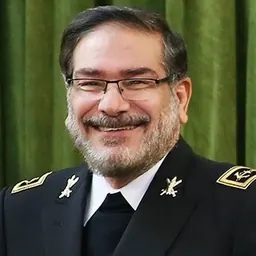


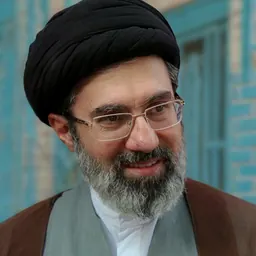
Related people
Same field, nearest in time
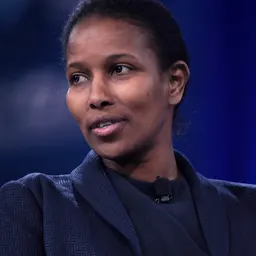




Contemporaries
People whose lives overlapped Saeed Jalili's



Frequently asked questions
Who is Saeed Jalili?
Iranian politician
When was Saeed Jalili born?
Saeed Jalili was born on 6 September 1965 in Mashhad.
What is Saeed Jalili's occupation?
Saeed Jalili is a politician, diplomat and university teacher.
What nationality is Saeed Jalili?
Saeed Jalili is Iranian.
Sources & further reading
Cite this page
APA: Biography.guide. (2026). Saeed Jalili. https://biography.guide/saeed-jalili/
MLA: "Saeed Jalili." Biography.guide, https://biography.guide/saeed-jalili/.
Chicago: "Saeed Jalili." Biography.guide. https://biography.guide/saeed-jalili/.
Data last updated: 2026-09-23 · Spot an error? Report a correction.
Portrait: Wikimedia Commons · author & licence
Page generated 2026-09-27 05:06 UTC