About Sachin Dev Burman
Lived 1906 – 1975 (aged 69). Sachin Dev Burman was an Indian composer, singer, music director, film score composer and writer.
Sachin Dev Burman (1 October 1906 – 31 October 1975) was an Indian music director and singer. He was a member of the Tripura royal family.
Background
S. D. Burman was born on 1 October 1906, the royal princess of Manipur and Nabadwipchandra Dev Burman of Tripura, son of Ishan Chandra Manikya, the Maharaja of Tripura. Sachin was the youngest of the five sons of his parents, who had nine children in all. His mother died when he was just two years of age.
Education S. D. Burman's first school was at Kumar Boarding in Agartala, Tripura. It was a boarding school for sons of the royalty and the very rich. Burman's father, Raja Nabadweepchandra Deb Burman noticed the teachers were more busy with pampering the sons of the nobility than educating them. Burman's father took him from Kumar Boarding and admitted him at Yusuf School in Comilla, He started his formal music education by training under the musician K. C. Dey from 1925 to 1930; thereafter in 1932 he came under the tutelage of Bhishmadev Chattopadhyay, who was only three years his senior. This was followed by training from Khalifa Badal Khan, the sarangi maestro, and Ustad Allauddin Khan, the sarod player.
He built a house in Southend Park, Ballygunge, Kolkata. He married his student, Meera Das Gupta (1920–2007), the granddaughter of Magistrate Raibahadur Kamalnath Dasgupta from Dhaka on 10 February 1938 in Calcutta (now Kolkata), though according to some, having married a non-royal, created a furore within the royal family, and subsequently he severed ties with his family, and forfeited his inheritance. According to some others, S.D. Burman severed ties with his royal family because he was frustrated with the unjust and unfair treatment meted out to his father and his brothers by the royal family of Tripura. The couple's only child, Rahul Dev Burman was born in 1939, and later, both Meera Devi and Rahul assisted S.D. Burman with some of the musical compositions. S. D. Burman also did a singing role in the Urdu film Selima (1934) and another role in Dhiren Ganguli's film Bidrohi (1935).
As a music composer, he started with the Bengali plays Sati Tirtha and Janani, and eventually gave his first score in the film Rajgee. In 1937, his second film Rajkumarer Nirbashan (1940) became a hit. He gave music in Bengali films such as Protishodh (1941), Avayer Biye (1942) and Chaddobeshi (1944) and only one Bengali film in 1969/70 after he permanently moved to Mumbai in 1946. He composed for over 20 Bengali films and 89 Hindi films in all.
1950s Disillusioned with the materialism of Bombay, Burman left the Ashok Kumar-starrer Mashaal (1950) incomplete, and decided to board the first train back to Calcutta. Fortunately, he was dissuaded from doing so.
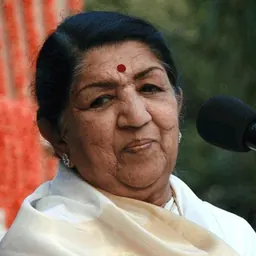
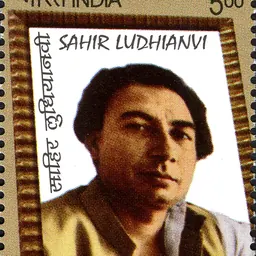
In the 1950s, Burman teamed up with Dev Anand's Navketan Films to create musical hits like Taxi Driver, Nau Do Gyarah (1957) and Kala Pani (1958). In addition, he gave music for Munimji (1955) and Paying Guest (1957). His songs sung by Kishore Kumar and Mohammed Rafi became popular. Burman composed the music for Afsar (1950). With the success of their second film Baazi (1951), he made it to the top and a long association with Navketan and Dev Anand was on its way. Baazis jazzy musical score revealed a new facet of singer Geeta Dutt, who was mainly known for melancholy songs and bhajans. One song from the film stood out; "Tadbeer Se Bigdi Hui Taqdeer", a ghazal that was occidentalised into a seductive song. The Jaal song "Yeh Raat Yeh Chandni" sung by Hemant Kumar is an all-time great classic. The song "Thandi Hawain" from the film Naujawan (1951) sung by Lata Mangeshkar was one of his first major hits. It made Lata very famous as also poet Sahir Ludhianvi
In 1957, S. D. Burman fell out with Lata Mangeshkar and adopted her younger sister Asha Bhosle as his lead female singer. The team of S. D. Burman, Kishore Kumar, Asha Bhosle and lyricist Majrooh Sultanpuri became popular for their duet songs. Bhosle later became his daughter-in-law after her marriage to R. D. Burman. S. D. Burman often took inspiration from folk music, Hindustani classical music as well as the more mundane day to day sounds of life. For example, in a later interview, he discussed how he had composed the Kala Pani tune for the Majrooh Sultanpuri and Md. Rafi song "Hum Bekhudi Mein Tum" based upon the Hindustani Raga "Raag Chayyanat" and the Muslim Muezzin's call for prayers that one hears daily near a mosque.
1960s
Early on in his career, Burman refused to allow his voice to be lip-synced on film by actors; Dev Anand and S. D. Burman continued their musical partnership in Prem Pujari (1970).
The singer and mimicry artist Sudesh Bhonsle frequently parodies the nasal high-pitched voice and quixotic singing style of S. D. Burman.
Burman paired with tabla maestro late Brajen Biswas for his Bengali songs. The beats or "thekas" created by Brajen Babu for these songs are unique and no one in the world can sing these songs in the original "thekas". All the "thekas" are according to the mood of the songs. But recently, painter, sculptor and singer Ramita Bhaduri sang the tough songs of Burman such as "Ami chhinu aka", "Rangeela", "Aankhi Duti Jhare" etc. in the original "theka" on the taleem of Brajen Biswas. The CD from "Raga Music" (Symphony) was released at Kolkata Press Club. The CDs are available in M. Biswas & Symphony.
Burman had a unique style of composing film songs. While most of the composers used a harmonium or piano to compose the tune, he composed tunes using rhythm such as clapping hands. He was very fond of "Paan" which was specially made by his wife with a piece of dried orange peel and "kevda" flower (Odoratissimus flower) for flavour and taste. In addition, there were his chosen paanwalas (paan vendors) near Khar Station, his bungalow "The Jet" and Bharati Vidya Bhavan from where he could get paans to his liking. That was the reason that he would not share his paan with anyone as he will run short of his paans. He would carry only few extra paana which he would give as a reward to the one whom he appreciated for his work.
SD Burman's first biography in English was titled Incomparable Sachin Dev Burman. Written by HQ Chowdhury, it was published by Toitoomber from Dhaka, Bangladesh.
Commemorative postage stamp
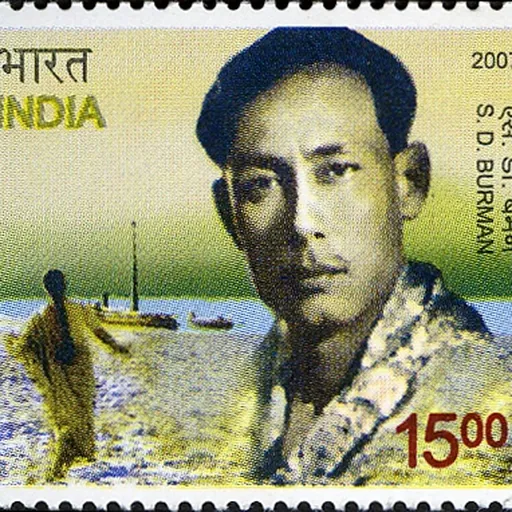
On 1 October 2007, marking his 101st birth anniversary, the Indian Postal Service released a commemorative postage stamp, in Agartala, where an exhibition on his life and work was also inaugurated; the state government of Tripura also confers the yearly "Sachin Dev Burman Memorial Award" in music.
Sachin Dev Barman Memorial Government Music college was built in Agartala, Tripura in memory of him which is also affiliated to Tripura University and recognised by University Grant Commission.
His song "Ye Duniya Agar Mil Bhi Jaye" from Pyaasa was re-used in the 2022 film Chup: Revenge of the Artist.
Filmography columns-list|colwidth=18em| Sudurer Priye (1935) Rajgee (1937) Jakher Dhan (1939) Amar Geeti (1940) Nari (1940) Rajkumarer Nirbashan (1940) Pratishodh (1941) Ashok (1942) Avayer Biye (1942) Jibon Sangini (1942) Mahakavi Kalidas (1942) Milan (1942) Jajsaheber Nathni (1943) Chhadmabeshi (1944) Maatir Ghar (1944) Pratikar (1944) Kalankini (1945) Matrihara (1946) Eight Days (1946) 1959: Asia Film Society Award 1964: Sant Haridas Award National Film Awards for 1970: National Film Award for Best Male Playback Singer: Aradhana: Safal Hogi Teri Aradhana 1974: National Film Award for Best Music Direction: Zindagi Zindagi 1969: Padma Shri Award International Jury on Folk Music 2007 A Postage Stamp (Face value Rs 15) released in his memory 1959: Filmfare Best Music Director Award: Sujata: Nomination 1965: Filmfare Best Music Director Award: Guide: Nomination 1969: Filmfare Best Music Director Award : Aradhana: Nomination 1970: Filmfare Best Music Director Award: Talaash: Nomination 1974: Filmfare Best Music Director Award: Prem Nagar : Nomination BFJA Awards 1965: Best Music (Hindi Section): Teen Devian 1966: Best Music (Hindi Section): Guide 1966: Best Male Playback Singer (Hindi Section): Guide 1969: Best Music (Hindi Section): Aradhana 1973: Best Music (Hindi Section): Abhimaan
Don’t just read it —
keep it.
Full-length biographies made to live with: read them, listen on the way to work, watch them tonight.
- E-book
- Audio
- Video
Instant download · yours to keep · every purchase keeps this site free
Important facts
People in Sachin Dev Burman's life
Named in this biography and alive at the same time





Related people
Same field, nearest in time




Contemporaries
People whose lives overlapped Sachin Dev Burman's
Frequently asked questions
Who was Sachin Dev Burman?
Indian singer and composer (1906–1975)
When was Sachin Dev Burman born?
Sachin Dev Burman was born on 1 October 1906 in Cumilla.
When did Sachin Dev Burman die?
Sachin Dev Burman died on 31 October 1975 in Mumbai.
What was Sachin Dev Burman's occupation?
Sachin Dev Burman was a composer, singer, music director, film score composer and writer.
What nationality was Sachin Dev Burman?
Sachin Dev Burman was Indian.
Sources & further reading
· Wikipedia: Sachin Dev Burman
Cite this page
APA: Biography.guide. (2026). Sachin Dev Burman. https://biography.guide/sachin-dev-burman/
MLA: "Sachin Dev Burman." Biography.guide, https://biography.guide/sachin-dev-burman/.
Chicago: "Sachin Dev Burman." Biography.guide. https://biography.guide/sachin-dev-burman/.
Data last updated: 2026-09-20 · Spot an error? Report a correction.
Page generated 2026-09-27 05:10 UTC