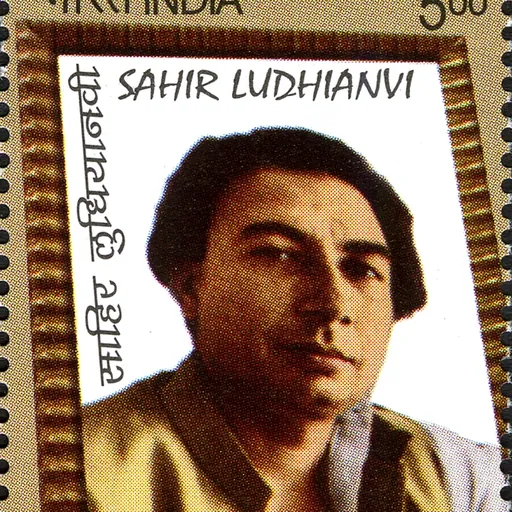
About Sahir Ludhianvi
Lived 1921 – 1980 (aged 59). Sahir Ludhianvi was an Indian poet, lyricist, songwriter and writer.
Abdul Hayee (8 March 1921 – 25 October 1980), popularly known by his pen name (takhallus) Sahir Ludhianvi, was an Indian poet who wrote primarily in Urdu in addition to Hindi. He is regarded as one of the greatest film lyricists and poets of 20th century India.
His work influenced Indian cinema, in particular Hindi language films. Sahir won a Filmfare Award for Best Lyricist for Taj Mahal (1963). He won a second Filmfare Award for Best Lyricist for his work in Kabhie Kabhie (1976). He was awarded the Padma Shri in 1971.
On 8 March 2013, the ninety-second anniversary of Sahir's birth, a commemorative stamp was issued in his honour by India Post.
Early life and education Sahir was born on 8 March 1921, in a Punjabi -speaking Gujjar family in Karimpura, Ludhiana, Punjab, British India. Sardar Begum required protection from Sahir's father and suffered financial deprivation. Sahir's place of birth in Ludhiana is marked with a small plaque on the building's arched entrance.
Sahir was educated at the Khalsa High School in Ludhiana. He then enrolled at the Government College, Ludhiana. The auditorium there is named after him. As a college student, Sahir was popular for his ghazals and nazms (poetry in Urdu) and impassioned speeches.
Sahir's work as a lyricist in the film industry gave him financial stability beyond his earnings as a poet. He made his debut with four songs in the film Azadi Ki Raah Par (1949). One of the songs was Badal Rahi Hai Zindagi. The film and its songs went unnoticed. However, after Naujawan (1951), with music by S.D. Burman, Sahir gained recognition. Sahir's major success was Baazi (1951) with composer Burman. Sahir was then considered part of Guru Dutt's team. The last film Sahir made with Burman was Pyaasa (1957). After this film, Sahir and Burman went their separate ways due to artistic and contractual differences.
Sahir worked with other composers including Ravi, Roshan, Khayyam and Datta Naik. Datta Naik also credited as N. Datta, a Goan, admired Sahir's poetry and their collaboration produced the score for Milap (1955), Chandrakanta (1956), Sadhna (1958), Dhool Ka Phool (1959), Dharamputra (1961) and Naya Raasta (1970). Sahir also worked with music director Laxmikant–Pyarelal in the films like Izzat (1968), Man Ki Aankhen (1970), Dastaan (1972) and Daag (1973). From about 1950 until his death, Sahir collaborated with Baldev Raj Chopra, a film producer and director. Sahir's last work for Chopra was for Insaaf Ka Tarazu (1980). Yash Chopra, both while directing for B R Films, and later as an independent director and producer, also engaged Sahir as the lyricist for his films, till Sahir's death.
In 1958, Sahir wrote the lyrics for Ramesh Saigal's film Phir Subah Hogi, based on Fyodor Dostoevsky's novel Crime and Punishment. The male lead was played by Raj Kapoor. Shankar–Jaikishan would be composing music for the film but Sahir demanded a composer with a more intimate knowledge of the novel. Consequently, Khayyam composed the film score. The song Woh Subah Kabhi Toh Aayegi with its minimal background music remains popular. Khayyam collaborated with Sahir in many films including Kabhie Kabhie (1976) and Trishul (1978).
Sahir was a controversial figure in that he was artistically temperamental. He insisted that the film score should be composed for his lyrics and not the other way around. He also insisted on being paid one rupee more than Lata Mangeshkar and this created a rift between them. He also insisted that All India Radio credit film song lyricists in its broadcasts.
Personal life Sahir was romantically involved with Amrita Pritam and later Sudha Malhotra. Sahir and Pritam's love story was to be the subject of a 2014 movie that was legally objected to by the latter's grandson.
Death On 25 October 1980, at the young age of fifty-nine, Sahir died of a sudden cardiac arrest.
Filmography
Books
Mahmood K. T. (2000) Kalām-i Sāḥir Ludhiyānvī. A collection of Ludhiavni's poetry with English translation. Abbas K. A. (1958) Shadows Speak: (Parchhaiyan). 29 pages. Hassan R. (1977) The Bitter Harvest: Selections from Sahir Ludhiavni's Verse. 169 pages. Gaata jaye Banjara (1992). A collection of film lyrics. Bitterness: Talkhiyan
In media The Hindi film, Pyaasa (1957), is said to be inspired by Sahir's unrequited affection for the Hindi novelist and poet, Amrita Pritam and features several famous songs with lyrics written by him. Sahir's life has been chronicled by Sabir Dutt and by Chander Verma and Dr. Salman Abid in "Main Sahir Hoon". The book also analyses Sahir's poetry and lyrics in the context of his personal life.
Awards and nominations"
Don’t just read it —
keep it.
Full-length biographies made to live with: read them, listen on the way to work, watch them tonight.
- E-book
- Audio
- Video
Instant download · yours to keep · every purchase keeps this site free
Important facts
Family & relationships
People in Sahir Ludhianvi's life
Named in this biography and alive at the same time





Related people
Same field, nearest in time




Contemporaries
People whose lives overlapped Sahir Ludhianvi's




Frequently asked questions
Who was Sahir Ludhianvi?
Indian Urdu and Hindi poet (1921–1980)
When was Sahir Ludhianvi born?
Sahir Ludhianvi was born on 8 March 1921 in Ludhiana.
When did Sahir Ludhianvi die?
Sahir Ludhianvi died on 25 October 1980 in Mumbai.
What was Sahir Ludhianvi's occupation?
Sahir Ludhianvi was a poet, lyricist, songwriter and writer.
What nationality was Sahir Ludhianvi?
Sahir Ludhianvi was Indian.
Sources & further reading
Cite this page
APA: Biography.guide. (2026). Sahir Ludhianvi. https://biography.guide/sahir-ludhianvi/
MLA: "Sahir Ludhianvi." Biography.guide, https://biography.guide/sahir-ludhianvi/.
Chicago: "Sahir Ludhianvi." Biography.guide. https://biography.guide/sahir-ludhianvi/.
Data last updated: 2026-09-23 · Spot an error? Report a correction.
Portrait: Wikimedia Commons · author & licence
Page generated 2026-09-27 05:05 UTC