
About Majrooh Sultanpuri
Lived 1919 – 2000 (aged 80). Majrooh Sultanpuri was an Indian poet, lyricist, songwriter, writer and film.
Early life Majrooh Sultanpuri was born as Asrar ul Hassan Khan in a Muslim Rajput family, in Sultanpur, Uttar Pradesh, where his father was posted in the Police Department in 1919/1920. His father was not too keen on his son receiving English education and Majrooh was therefore sent for traditional 'Madrasa education' which led to his obtaining the qualification first of Dars-e-Nizami – a seven-year course which concentrated on religious affairs along with proficiency in Arabic and Persian- and then the certificate of 'Alim. He thereafter joined Lucknow's Takmeel-ut-Tib College of Unani medicine. While Majrooh is popular as a film lyricist and is widely known in that capacity, be it known that he also created one of the best-known verses of Urdu poetry:
میں اکیلے ہی چلا تھا جانب منزل مگر
لوگ ساتھ آتے گئے اور کارواں بنتا گیا
maiñ akelā hī calā thā jānib-e-manzil magar
log sāth āte gaye aur kārvān bantā gayā
(I had set off alone towards the destination but people joined in and we became a caravan!)
Films In 1945, Majrooh visited Bombay to attend a mushaira at the Saboo Siddique Institute. Here his ghazals and poetry were highly appreciated by the audience. One of the impressed listeners was film producer A.R. Kardar.
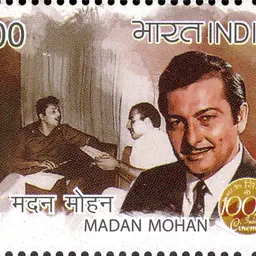
Majrooh Sultanpuri worked with many music directors like Anil Biswas, Naushad, Ghulam Mohammed, Madan Mohan, O. P. Nayyar, Roshan, Salil Chowdhury, Chitragupt, N. Datta, Kalyanji-Anandji, Laxmikant-Pyarelal and R. D. Burman.
His last film as a lyricist was One 2 Ka 4, which was released after his death in 2001.
Political leanings Film Shah Jehan (1946) was followed by S. Fazil's Mehndi, Doli (1947), Mehboob's Andaz (1949) and Shaheed Latif's Arzoo. Just as Majrooh was establishing himself as a lyricist and songwriter of repute, his leftist leanings got him into trouble. The government wasn't amused by his anti-establishment poems and he was jailed in 1949 along with other leftists like Balraj Sahni. Majrooh's arrest took place during a nationwide arrest of communists after the 2nd Congress of the Communist Party of India in 1948, in which the communists had decided to carry out a revolution against the Indian government. Majrooh was asked to apologise, but he refused and was sentenced to two years in prison.
Awards and recognitions
Majrooh went on to write lyrics for popular films throughout the 1950s. Along with Faiz Ahmed Faiz, Khumar Barabankvi, Majrooh was considered the most notable ghazal writer.
Majrooh won his only Filmfare Best Lyricist Award for the song "Chahunga Mein Tujhe Saanj Savere" from Dosti in 1965. He was also awarded the Dadasaheb Phalke Award in 1993
Discography
Don’t just read it —
keep it.
Full-length biographies made to live with: read them, listen on the way to work, watch them tonight.
- E-book
- Audio
- Video
Instant download · yours to keep · every purchase keeps this site free
Important facts
People in Majrooh Sultanpuri's life
Named in this biography and alive at the same time





Related people
Same field, nearest in time



Contemporaries
People whose lives overlapped Majrooh Sultanpuri's


Frequently asked questions
Who was Majrooh Sultanpuri?
Indian Urdu poet and Hindi language lyricist (1919-2000)
When was Majrooh Sultanpuri born?
Majrooh Sultanpuri was born on 1 October 1919 in Sultanpur.
When did Majrooh Sultanpuri die?
Majrooh Sultanpuri died on 24 May 2000 in Mumbai.
What was Majrooh Sultanpuri's occupation?
Majrooh Sultanpuri was a poet, lyricist, songwriter, writer and film.
What nationality was Majrooh Sultanpuri?
Majrooh Sultanpuri was Indian.
Sources & further reading
· Wikipedia: Majrooh Sultanpuri
Cite this page
APA: Biography.guide. (2026). Majrooh Sultanpuri. https://biography.guide/majrooh-sultanpuri/
MLA: "Majrooh Sultanpuri." Biography.guide, https://biography.guide/majrooh-sultanpuri/.
Chicago: "Majrooh Sultanpuri." Biography.guide. https://biography.guide/majrooh-sultanpuri/.
Data last updated: 2026-09-20 · Spot an error? Report a correction.
Page generated 2026-09-27 05:18 UTC