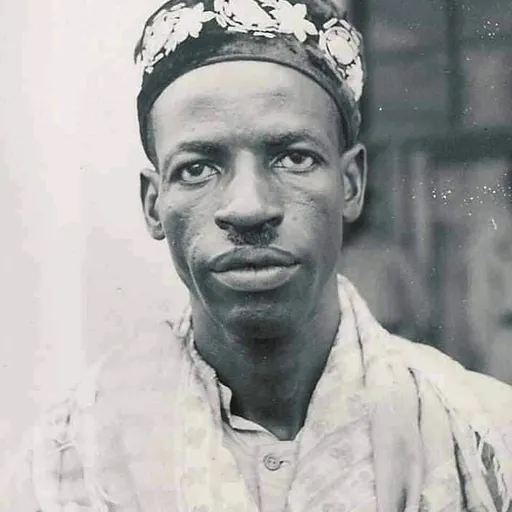
About Sa'adu Zungur
Lived 1915 – 1958 (aged 42–43). Sa'adu Zungur was a Nigerian poet, activist and writer.
Mallam Sa'adu Zungur (1914 – 28 January 1958) was a Nigerian revolutionary, poet, jurist and nationalist who played an important role in Nigeria's independence movement particularly in Northern Nigeria. He is generally regarded as the father of 'radical politics' in Northern Nigeria. Zungur's political writings criticising the colonial government of Northern Nigeria, especially the emirate system, helped in laying the foundation for the principle of self-determination in Nigeria. His literary and political endeavors influenced a number of the leaders of the independence movement in Northern Nigeria, notably Aminu Kano and Isa Wali.
Zungur also founded a number of political organisations, including the Zaria Friendly Society and Northern Elements Progressive Association, which later played an important role in shaping the region's political landscape and later influenced the establishment of subsequent political parties and movements. At various times in the late 1940s and 1950s, he was active in other prominent political parties like the National Council of Nigeria and the Cameroons, the Northern People's Congress and the Northern Elements Progressive Union.
Early life and education Zungur is a Fulani born in 1914 in Ganjuwa, Bauchi province (modern-day Bauchi state) to then Imam of Bauchi Muhammadu Bello.
Despite his religious upbringing, his father also encouraged him to pursue a western education, a rarity in 1920s colonial Northern Nigeria. In 1920, he was enrolled in Bauchi Provincial School, and in 1929, he furthered his education at Katsina Higher College (now known as Barewa College), which was one of the pioneering college institutions in Northern Nigeria. He also founded the Northern Provinces General Improvement Union (NPGIU) during the time. He was later stricken with a lung disorder (possibly tuberculosis) which led to take a break from teaching and to return to his home in Bauchi to rest.
Politics While at Bauchi, Zungur together with Abubakar Tafawa Balewa, Aminu Kano and some Northern elites formed the Bauchi General Improvement Union (BGIU), one of the first political organisations in Northern Nigeria and the Bauchi Discussion Circle (BDC).
He regularly espoused "a secular national state based on "progressive" principles" while utilizing metaphors adapted from his religious heritage.
Political activities with Azikiwe In 1946, Nnamdi Azikiwe extended an invitation to Zungur to join his West African Pilot newspaper, which was dedicated to advocating for independence from British colonial rule. Zungur accepted the invitation and assumed the role of the Bauchi Province Correspondent for the newspaper. Around this time, he led the first public mass demonstration in Northern Nigeria which was a response to the itinerary of Governor John Macpherson's tour, which excluded Bauchi perhaps of the activities of Zungur's BGIU. He was later promoted to the position of North-East Zone correspondent and eventually assumed the role of Chief Correspondent for the Northern Provinces in the West African Pilot in 1947. Later that year, Zungur, alongside Raji Abdullah and Abubakar Zukogi, founded the Jam'iyyar Al'umman Najeriya ta Arewa or the Northern Elements Progressive Association (NEPA) which later became Northern Elements Progressive Union (NEPU) in 1950.
They held meetings where they discussed issues regarding the region. One of such meetings included a discussion they held regarding the wording of the proposed constitution. Zungur was particularly interested in this discussion which was said he "dominated". It lasted from 4 p.m. to 4 a.m. the next morning with a two-hour recess. Another was regarding the eligibility of women for membership into the Congress. The members were equally divided on this matter and, as the Adviser on Muslim Law, Zungur was called upon to provide his insights. He drew upon the writings of Usman dan Fodio, the founder of the Sokoto Caliphate and an advocate for women's education, to advocate for the inclusion of women in matters of importance and emphasizing the importance of their participation in various aspects of societal affairs.
However, due to the sensitive nature of his content, many of his radical political poems were heavily censored in Northern Nigeria. Particularly, works that directly criticized the emirs or the British colonial rule faced severe restrictions. The publication of such works could lead to legal consequences for both the poet and the publisher, resulting in a stifling environment for the dissemination of dissenting views. As a result, many of Zungur's poems were not published. The compilation was eventually published called Wakokin Sa'adu Zungur. It was later republished by the Northern Nigerian Publishing Company. His poems are still being taught in secondary schools in northern Nigeria.
Arewa Jumhuniya ko Mulkiya
One of his most renowned works, Arewa Jumhuniya ko Mulkiya ("The North: Republic or Monarchy?"), was composed in 1950 just after his break with the NCNC.
Zungur's perspective on the emirate system underwent a significant transformation during the years between 1951 and 1954. His initial hope that the emirs could be reformed to better align with modern political ideals and the changing landscape of Nigeria was quickly soured as his efforts to bring about reform met with resistance from the emirs, which left him disillusioned with the possibility of meaningful change within the existing system. His view on the emirate system shifted from reform to complete destruction.
Don’t just read it —
keep it.
Full-length biographies made to live with: read them, listen on the way to work, watch them tonight.
- E-book
- Audio
- Video
Instant download · yours to keep · every purchase keeps this site free
Important facts
People in Sa'adu Zungur's life
Named in this biography and alive at the same time




Related people
Same field, nearest in time

Contemporaries
People whose lives overlapped Sa'adu Zungur's




Frequently asked questions
Who was Sa'adu Zungur?
Nigerian poet
When was Sa'adu Zungur born?
Sa'adu Zungur was born in 1915 in Bauchi.
When did Sa'adu Zungur die?
Sa'adu Zungur died on 28 January 1958 in Bauchi.
What was Sa'adu Zungur's occupation?
Sa'adu Zungur was a poet, activist and writer.
What nationality was Sa'adu Zungur?
Sa'adu Zungur was Nigerian.
Sources & further reading
Cite this page
APA: Biography.guide. (2026). Sa'adu Zungur. https://biography.guide/sa-adu-zungur/
MLA: "Sa'adu Zungur." Biography.guide, https://biography.guide/sa-adu-zungur/.
Chicago: "Sa'adu Zungur." Biography.guide. https://biography.guide/sa-adu-zungur/.
Data last updated: 2026-09-23 · Spot an error? Report a correction.
Portrait: Wikimedia Commons · author & licence
Page generated 2026-09-27 05:07 UTC