
Rudolf Pfeiffer
German classical philologist
About Rudolf Pfeiffer
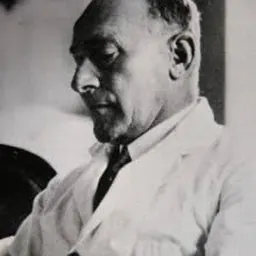
Lived 1889 – 1979 (aged 89). Rudolf Pfeiffer was a German university teacher, classical philologist, hellenist, literary historian and librarian.
Rudolf Carl Franz Otto Pfeiffer (20 September 1889 – 5 May 1979) was a German classical philologist. He is known today primarily for his landmark, two-volume edition of Callimachus and the two volumes of his History of Classical Scholarship, in addition to numerous articles and lectures related to these projects and to the fragmentary satyr plays of Aeschylus and Sophocles.
Early life and education Pfeiffer was born in Augsburg on 20 September 1889. His parents were Carl Pfeiffer, the proprietor of a print-shop, and Elise . The boy's grandfather Jakob, also a printer, had purchased the house of the humanist Konrad Peutinger, and Pfeiffer would later consider it a special stroke of fate that he had been born and bred in the former home of a central figure from the golden age of humanism in Augsburg. A Roman Catholic,
Upon passing the Abitur in 1908, Pfeiffer moved on to Munich where he was inducted into the Stiftung Maximilianeum and began studying classical and German philology at the Ludwig-Maximilians-Universität München (LMU). There he studied under the Germanist Hermann Paul and Hellenist Otto Crusius. He dedicated his dissertation as an uxori carissimae sacrum, Latin for (roughly) "a gift of devotion to a wife most dear"—namely, Lili , a Jewish painter from Hungary whom he had married earlier in 1913. bears the dedication . I renew the words of the dedication with still deeper feeling for all that she has done for me in the course of more than half a century.
Lili died the next year; the couple had no children. The following year Pfeiffer was habilitated into the Ludwig-Maximilians-Universität München under the chairmanship of Eduard Schwartz, the successor to his former mentor Crusius. The work that earned him his Habilitation, (1921), was soon followed by an edition of all the Callimachus papyri available at that time, entitled (1923).
Recognition of Pfeiffer's early work on Callimachus was swift, and in 1923, with Wilamowitz's endorsement, he was appointed to the professorship at the Friedrich Wilhelm University of Berlin that had been vacated by Eduard Fraenkel when he moved on to Kiel University. and a colleague of Schwartz, at the Ludwig-Maximilians-Universität München. Eduard Fraenkel had already been driven from Germany to Corpus Christi, and with the addition of Pfeiffer The Oxford Magazine declared, "Once more, Oxford gains what Nazi Germany has lost." That edition of fragments, the first volume of Pfeiffer's magnum opus (1949), would be followed four years later by a second volume comprising the Hymns, Epigrams and testimonia.
Pfeiffer was restored to his chair at the Ludwig-Maximilians-Universität München in 1951, from which he would retire in 1957. In the History of Classical Scholarship, which he published in English despite having returned to the Ludwig-Maximilians-Universität München, Pfeiffer drew parallels between the intellectual world of Hellenistic Greece and that of his fellow German exiles, particularly in the case of the scholars who fled Alexandria following the accession of Ptolemy VIII Physcon in 210 BCE. This book was followed in 1976 by a volume treating the period from 1350–1800. He had intended to publish a third volume to cover the intervening period, but his interests in Hellenistic scholarship and the high humanist period (and the urging of Fraenkel) drew him to the bookends of his history.
Select works Callimachus Principal works
Callimachus, vol. i: Fragmenta (Oxford: Clarendon Press, 1949) . Callimachus, vol. ii: Hymni et epigrammata (Oxford: Clarendon Press, 1953) .
Lesser and occasional works
Kallimachosstudien. Untersuchungen zur Arsinoe und zu den Aitia des Kallimachos (Munich: Hüber, 1922). Callimachi fragmenta nuper reperta (Bonn: Marcus & Weber, 1923). Edition of the papyrus finds to the point of publication. "Arsinoe Philadelphos in der Dichtung", Antike 2 (1926) 161–174. "Kallimachoszitate bei Suidas", in: Stephaniskos. Festschrift für Ernst Fabricius (Freiburg im Breisgau, 1927) 40–46. "Ein neues Altersgedicht des Kallimachos", Hermes 63 (1928) 302–342. "Βερενίκης πλόκαμος", Philologus 87 (1932) 179–228. "Ein Epodenfragment aus dem Jambenbuche des Kallimachos", Philologus 88 (1933) 265–271. Die neuen διηγήσις zu Kallimachos Gedichten (Munich: Beck, 1934). Short monograph. "Zum Papyrus Mediolanensis des Kallimachos", Philologus 92 (1934) 483–485. "Neue Lesungen und Ergänzungen zu Kallimachos-Papyri", Philologus 93 (1938) 61–73. "The measurements of the Zeus at Olympia", Journal of Hellenic Studies 61 (1941) 1–5. "Callimachus", Proceedings of the Classical Association (1941) 7-11. "A fragment of Parthenios' Arete", Classical Quarterly 37 (1943) 23–32. "The image of the Delian Apollo and Apolline ethics", Journal of the Warburg and Courtauld Institutes 15 (1952) 20–32. "Morgendämmerung", in: Thesaurismata. Festschrift für I. Kapp zum 70. Geburtstag (Munich: Beck, 1954) 95–104. "The future of studies in the field of Hellenistic poetry", Proceedings of the Classical Association 51 (1954) 43-45. "The future of studies in the field of Hellenistic poetry", JHS 75 (1955) 69–73.
History of classical scholarship Principal works
History of Classical Scholarship: From the Beginnings to the End of the Hellenistic Age (Oxford: Clarendon Press, 1968) . History of Classical Scholarship: 1300–1850 (Oxford: Clarendon Press, 1976)
Lesser and occasional works
"Zum 200. Gebursttag von Chr. G. Heyne", Forschungen und Fortschritte 5 (1929) 313. Humanitas Erasmiana (Leipzig: Teubner, 1931). Pamphlet. "Wilhelm von Humboldt der Humanist", Antike 12 (1936) 35–48. "Von den geschichtlichen Begegnungen der kritischen Philologie mit dem Humanismus. Eine Skizze", Archiv für Kulturgeschichte 28 (1938) 191–209. "Erasmus und die Einheit der klassischen und der christlichen Renaissance", Historisches Jahrbuch 74 (1954) 175–188. "Conrad Peutinger und die humanistische Welt", in: H. Rinn (ed.) Augusta: 955–1955 (Munich, 1955) 179–186. "Dichter und Philologen im französischen Humanismus", Antike und Abendland 7 (1958) 73–83. Philologia perennis : Festrede gehalten in der öffentlichen Sitzung der Bayerischen Akademie der Wissenschaften in München am 3. Dezember 1960 (Munich: Beck, 1961). Published lecture. "Augsburger Humanisten und Philologen", Gymnasium 71 (1964) 190–204.
Tragedians "Die Skyrioi des Sophokles", Philologue 88 (1933) 1–15. "Die Niobe des Aischylos", Philologus 89 (1934) 1–18. Die Netzfischer des Aischylos und der Inachos des Sophokles. Zwei Satyrspiel-Funde. (München: Beck, 1938). Short monograph. "Ein syntaktisches Problem in den Diktyulkoi des Aischylos", in: H. Krahe (ed.) Corolla linguistica. Festschrift F. Sommer zum 80. Geburtstag (Wiesbaden: Harrassowitz, 1955) 177–180. Ein neues Inachos-Fragment des Sophokles (Munich: Beck, 1958). Short monograph. "Sophoclea", Wiener Studien 79 (1966) 63–66.
Other works Die Meistersingerschule in Augsburg und der Homercbersetzer Johannes Spreng (Duncker & Humblot: Munich, 1919). A revised version of his dissertation. "Gottheit und Individuum in der frühgriechischen Lyrik", Philologus 84 (1928) 137–152. "Küchenlatein", Philologus 86 (1931) 455–59. Die griechische Dichtung und die griechische Kultur (Munich: Hüber, 1932). Pamphlet. "Wisdom and vision in the Old Testament", Zeitschrift für Alttestimentntliche Wissenschaft 52 (1934) 93–101. "Hesiodisches und Homerisches", Philologus 92 (1937) 1–18. "Vier Sappho-Strophen auf einem ptolemäischen Ostrakon", Philologus 92 (1937) 117–125. "A Greek anecdote in Shakespeare's life", Proceedings of the Cambridge Philological Society 172–174 (1939) 5–6. "Die goldene Lampe der Athene (Odyssee XIX,34)", Studi italiani di filologia classica 27/28 (1956) 426–433. "Vom Schlaf der Erde und der Tiere (Alkman, fr. 58 D.)", Hermes 87 (1959) 1–6.
Honours During his career, Pfeiffer received the following honours:
1934 Member, Bavarian Academy of Sciences and Humanities 1949 Fellow, British Academy 1953 Member, German Archaeological Institute 1955 Corresponding member, Austrian Academy of Sciences (made honorary member in 1972) 1960 Honorary Fellow, Corpus Christi College, Oxford 1961 Honorary Member, Society for the Promotion of Hellenic Studies 1965 Honorary doctorate, University of Vienna 1971 Corresponding member, Académie des Inscriptions et Belles-Lettres 1971 Honorary doctorate, Aristotle University of Thessaloniki
Don’t just read it —
keep it.
Full-length biographies made to live with: read them, listen on the way to work, watch them tonight.
- E-book
- Audio
- Video
Instant download · yours to keep · every purchase keeps this site free
Important facts
People in Rudolf Pfeiffer's life
Named in this biography and alive at the same time




Related people
Same field, nearest in time


Contemporaries
People whose lives overlapped Rudolf Pfeiffer's




Frequently asked questions
Who was Rudolf Pfeiffer?
German classical philologist (1889–1979)
When was Rudolf Pfeiffer born?
Rudolf Pfeiffer was born on 20 September 1889 in Augsburg.
When did Rudolf Pfeiffer die?
Rudolf Pfeiffer died on 5 May 1979 in Dachau.
What was Rudolf Pfeiffer's occupation?
Rudolf Pfeiffer was a university teacher, classical philologist, hellenist, literary historian and librarian.
What nationality was Rudolf Pfeiffer?
Rudolf Pfeiffer was German.
Sources & further reading
Cite this page
APA: Biography.guide. (2026). Rudolf Pfeiffer. https://biography.guide/rudolf-pfeiffer/
MLA: "Rudolf Pfeiffer." Biography.guide, https://biography.guide/rudolf-pfeiffer/.
Chicago: "Rudolf Pfeiffer." Biography.guide. https://biography.guide/rudolf-pfeiffer/.
Data last updated: 2026-09-20 · Spot an error? Report a correction.
Page generated 2026-09-27 05:11 UTC