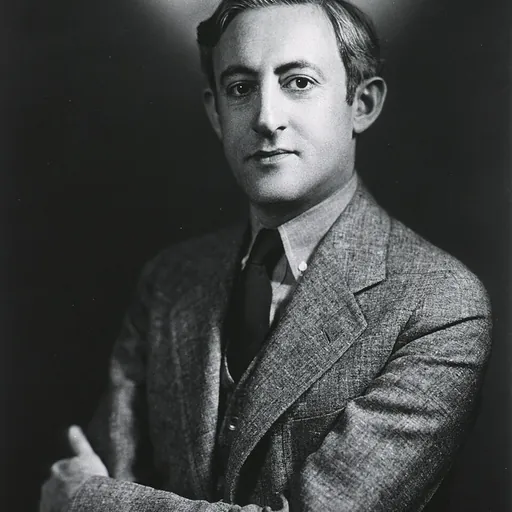
About Abel Wolman
Lived 1892 – 1989 (aged 96). Abel Wolman was an American university teacher and ecologist, known for Water chlorination.
Abel Wolman (June 10, 1892 – February 22, 1989) was an American engineer, educator and pioneer of modern sanitary engineering. His professional career left impacts in academia, sanitary engineering research, environmental and public health services, engineering professional societies, and journal publications. Wolman is best known for his research with Linn Enslow in the chlorination of Baltimore's municipal water supply, which has contributed to the distribution of safe municipal water supplies globally.
Biography
Early life and education Abel Wolman was born to Louis and Rose Wachsman Wolman on June 10, 1892 in Baltimore, Maryland. He was the fourth eldest child of Polish-Jewish immigrants. Wolman received his high school education from the Baltimore City College in 1909. Following his high school education, Wolman received his Bachelor of Arts in 1913 as a pre-med major. Although Wolman was interested in becoming a doctor, his mother's insistence on studying engineering led him to pursue a degree in engineering. He then went on to complete a Bachelor of Science in Engineering at the Johns Hopkins University, graduating in 1915 as the fourth person to receive a degree at the newly-established Whiting School of Engineering. Although Wolman did not complete a doctorate degree, his work in the field of sanitary engineering led to him being awarded an honorary Doctor of Engineering in 1937. Wolman was also awarded a Doctor of Humane Letters from the Maryland Institute College of Arts and a Doctor of Law by the Johns Hopkins University in 1969.
Career
Public health Wolman served an extensive career in sanitary engineering, working in both environmental and public health services as well as in academics. In 1914, he started his long career in public health as an assistant engineer working for the United States Public Health Service. In 1922, Wolman became the Chief Engineer of the Maryland State Department of Health, where he served for 18 years until 1939. He also held various consultancy positions as an consulting engineer for public health organizations, including but not limited to the United States Public Health Service and the United States Army Corps of Engineers from 1927 to 1944 and the United States delegate to the International Health Conference from 1946 to 1950.
While working in the public health sector, Wolman conducted research related to sanitation and public health. He is best known for his 1919 contribution, with chemist Linn Enslow, in the standardization of chlorinating Baltimore's drinking-water supply. His efforts there helped develop the plan for Baltimore's water supply so thoroughly and effectively that it remains well-provided for growth through the 21st century. His work also benefited water systems in New York, Detroit and Columbus, Ohio.
Academia In 1937, Wolman started his official academic career at Johns Hopkins University when he was made Professor of Sanitary Engineering at the Whiting School of Engineering and the Johns Hopkins School of Hygiene and Public Health, and his academic career did not end until his death in 1989 at the age of 96. At that same time, he served as the Department of Sanitary Engineering's chairman until his official retirement in 1962. During his time as a sanitary engineering lecturer, he was asked to lecture at many prestigious universities, including Harvard University, Princeton University, University of Southern California, and University of Chicago. He was appointed Professor Emeritus in 1962, but had no desire to retire from professional life, so he continued his teaching and research in addition to serving as a consultant to the many governments and municipalities that requested his advice and assistance.
Professional societies Supplementing his professional life, Wolman also held many important positions in the committees of professional societies and journal publications. In 1916, he joined the American Public Health Association as an associate editor of the organization's monthly publication, American Journal of Public Health, where he eventually became the editor in 1955 until 1957. Within the American Public Health Association, Wolman served as Chairman of the Public Health Engineering Section and Chairman of the Committee on Research and Standards. He was also involved heavily with the American Water Works Association, a close affiliate with the American Public Health Association, where Wolman served as the editor of the organization's journal, the Journal of the American Water Works Association, from 1921 to 1937 and eventually became the President of the organization in 1942.
Personal life and death Wolman married Anna Gordon in 1919. Through their marriage, Wolman had one son, named Markley (M.) Gordon Wolman. Maintaining a lively and witty personality, Wolman was favorable amongst many of the students he interacted with as a professor. From colleagues and family members that knew Wolman well, he has been described as being very well-organized and always perceptive towards his problems and analyses related to work. Wolman's wife Anna died December 31, 1983. Wolman died at his home in Baltimore, Maryland on February 22, 1989, aged 96 years old. In 1960, he was awarded the Albert Lasker Special Award in Public Health, which is an award "for outstanding contributions in research related to diseases which are the main causes of death and disability and for distinguished service in the field of public health administration. In 1967, Wolman was awarded the William Procter Prize for Scientific Achievement for his contributions in the field of science. In 1968, Wolman was awarded the first Lewis L. Dollinger Pure Environment Award. In 1973, Wolman was awarded the Milton Stover Eisenhower Medal. In regards to professional societies, Wolman was awarded with honorary memberships in the American Society of Civil Engineers, the American Academy of Environmental Engineers, the Water Pollution Control Federation, the American Water Resources Association, the American Academy of Environmental Engineers, the Franklin Institute, and the Technion of Haifa Board of Directors.
Legacy Academic and social tributes Wolman Hall is a dormitory building for first-year students at The Johns Hopkins University. Following the death of Wolman, multiple tributes were created in his honor. For individuals that work in the water industry, the American Water Works Association annually presents the Abel Wolman Award of Excellence since 1985. In May 1966, the Johns Hopkins University named a newly acquired dormitory Wolman Hall, which continues to house first year students. In 1986, the City of Baltimore renamed its public works building to the Abel Wolman Municipal Building, honoring his years of service to the city. Today, the Abel Wolman Municipal Building is where citizens of Baltimore come to pay their property taxes, parking fines and metered water bills.
Don’t just read it —
keep it.
Full-length biographies made to live with: read them, listen on the way to work, watch them tonight.
- E-book
- Audio
- Video
Instant download · yours to keep · every purchase keeps this site free
Important facts
People in Abel Wolman's life
Named in this biography and alive at the same time



Related people
Same field, nearest in time

Contemporaries
People whose lives overlapped Abel Wolman's

Frequently asked questions
Who was Abel Wolman?
American scientist (1892–1989)
When was Abel Wolman born?
Abel Wolman was born on 10 June 1892 in Baltimore.
When did Abel Wolman die?
Abel Wolman died on 22 February 1989 in Baltimore.
What was Abel Wolman's occupation?
Abel Wolman was a university teacher and ecologist.
What was Abel Wolman known for?
Abel Wolman was known for Water chlorination.
What nationality was Abel Wolman?
Abel Wolman was American.
Sources & further reading
Cite this page
APA: Biography.guide. (2026). Abel Wolman. https://biography.guide/abel-wolman/
MLA: "Abel Wolman." Biography.guide, https://biography.guide/abel-wolman/.
Chicago: "Abel Wolman." Biography.guide. https://biography.guide/abel-wolman/.
Data last updated: 2026-09-22 · Spot an error? Report a correction.
Portrait: Wikimedia Commons · author & licence
Page generated 2026-09-27 05:02 UTC