
About Rudolf Eisler
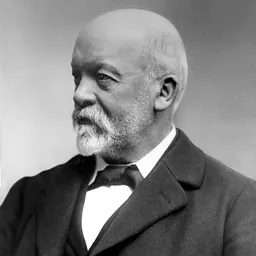
Lived 1873 – 1926 (aged 53). Rudolf Eisler was an Austrian philosopher, sociologist, writer and translator.
Rudolf Eisler (7 January 1873 – 14 December 1926) was an Austrian philosopher.
Biography Rudolf Eisler was born in Vienna to a family of wealthy Jewish merchants.
As a student of Wilhelm Wundt, Rudolf Eisler studied philosophy at Leipzig University and earned his Ph.D. there. In addition to Immanuel Kant, his philosophical writings, particularly those concerning phenomenalism, were largely influenced by Wundt, as well as Hermann Cohen and Edmund Husserl.
Upon moving back to Vienna in 1901, he and his family settled in the "Matzos Quarter," a section of the city largely composed of working-class Jews. Due to his atheism, he was denied a teaching position at the University of Vienna.
Marriage and children Ida Maria Fischer, the daughter of a Lutheran butcher, lived with Rudolf Eisler during his studies in Leipzig. She herself was an "irregular" student at the University of Leipzig. She became known locally as a journalist and poet. They were married and had three children:
Ruth Fischer (11 December 1895 – 13 March 1961): politician and co-founder of the Austrian Communist Party Gerhart Eisler (20 February 1897 – 21 March 1968): politician and prominent member of the Communist Party of Germany Hanns Eisler (6 July 1898 – 6 September 1962): composer of the national anthem of East Germany
Rudolf Eisler was cremated at Feuerhalle Simmering, where also his ashes are buried.
Published works Wörterbuch der philosophichen Begriffe und Ausdrücke, 3 volumes (Dictionary of Philosophical Terms and Expressions, 1899, 1927, 1930). Nietzsche's Erkenntnistheorie und Metaphysik. Darstellung und Kritik (Nietzsche's Theory of Cognition and Metaphysics: Explanation and Criticism, 1902). Wilhelm Wundts Philosophie und Psychologie. In ihren Grundlehren dargestellt (Wilhelm Wundt's Philosophy and Psychology: An Outline of Its Basic Teachings, 1902). Leib und Seele. Darstellung und Kritik der neueren Theorien des Verhältnisses zwischen physischem und psychischem Dasein (Body and Soul: Explanation and Criticism of New Theories of Relationships Between Physical and Psychic Being, 1906). Einführung in die Erkenntnistheorie (Introduction to Cognition Theory, 1907). Geschichte des Monismus (History of Monism, 1910). Grundlagen der Philosophie des Geisteslebens (Foundations of the Philosophy of the Spiritual Life, 1908). Philosophen-Lexikon: Leben, Werke, und Lehren der Denker (Philosopher Lexikon: Life, Works, and Lessons of Thinkers, 1912). Kant-Lexicon: Nachschlagewerke zu Kants sämtlichen Schriften, Briefen, und handschriftlichem Nachlass (Kant Lexicon: A Reference of Kant's Collected Writings, Letters, and Handwritten Accounts, 1930). Allgemeine Kulturgeschichte (Leipzig: Weber Verlag 1905)
Don’t just read it —
keep it.
Full-length biographies made to live with: read them, listen on the way to work, watch them tonight.
- E-book
- Audio
- Video
Instant download · yours to keep · every purchase keeps this site free
Important facts
People in Rudolf Eisler's life
Named in this biography and alive at the same time


Related people
Same field, nearest in time




Contemporaries
People whose lives overlapped Rudolf Eisler's

Frequently asked questions
Who was Rudolf Eisler?
Austrian philosopher (1873-1926)
When was Rudolf Eisler born?
Rudolf Eisler was born on 7 January 1873 in Vienna.
When did Rudolf Eisler die?
Rudolf Eisler died on 13 December 1926 in Vienna.
What was Rudolf Eisler's occupation?
Rudolf Eisler was a philosopher, sociologist, writer and translator.
What nationality was Rudolf Eisler?
Rudolf Eisler was Austrian.
Sources & further reading
Cite this page
APA: Biography.guide. (2026). Rudolf Eisler. https://biography.guide/rudolf-eisler/
MLA: "Rudolf Eisler." Biography.guide, https://biography.guide/rudolf-eisler/.
Chicago: "Rudolf Eisler." Biography.guide. https://biography.guide/rudolf-eisler/.
Data last updated: 2026-09-20 · Spot an error? Report a correction.
Page generated 2026-09-27 05:17 UTC