
About Rudi Bass
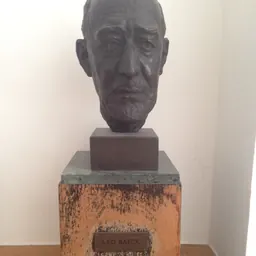
Lived 1914 – 2011 (aged 96). Rudi Bass was a graphic designer and illustrator.
Rudolf Bass (May 22, 1914 – January 6, 2011) was a graphic artist, illustrator, and writer. Bass was the art director of the Graphic Arts Department of CBS News during the 1960s, during which time he pioneered the production of a legible typography. He worked in many aspects of print media including posters, books, magazines, before, during and after his work with television, and was the recipient of an EMMY award. Bass was hired by Esquire two weeks after entering the U.S.A. Bass continued working at Esquire until his entry into the U.S. Army in 1943. Bass served during World War II until 1946, during which time he became a U.S. Citizen. Bass’ proclivity in writing extended to poetry as well, and a poem of his entitled, The Heroes was published in "The Best from Yank Army Weekly" (selected by the editors of Yank, published by E. P. Dutton & Co., Inc., New York 1945 p. 153).
Creative life Later, he was an art director in The New York Times Promotion Department, followed by employment with McCann Erickson, BBDO, and Columbia Records. In television, he was the first, and to date, the only Director of Graphic Arts for CBS. Rudi worked with the lead engineer who designed the Vidifont teaching him the basics of graphics design so that he would understand the nuances of the problem he was trying to solve.
During his career in the United States, Rudi Bass won several awards, at least 14 in all, including: an Emmy from the National Academy of Television Arts & Sciences; 3 Best of Industry awards from The Direct Mail Association of America (DMAA), predecessor of the present-day Direct Marketing Association; an award for Excellence in Typography from the Art Directors Club (1951) and others from the American Institute of Graphic Arts (AIGA), where his work can be found in their design archives.
Additionally, he was a visiting professor at Yale University's School of Art, Graphics Department (1969–1971), the Rhode Island School of Design, and the Philadelphia College of Art.
Later life At age 72, in 1986, he and his wife, Dr. Annette Lyons, moved to Paris, France, where he began to write and draw as a free-lance artist. Two published works from this period are How to Talk to a French Crocodile and Comment Parler au Crocodile Americaine.
Bass gifted his design and installation of the war memorial stone plaques in the Cloister area and the design of the wrought iron alms bowl in the entry of the American Cathedral in Paris.
From March 26 to April 21, 2002, he had a one-man show at The National Arts Club in NYC The National Arts Club in New York entitled "How We Got Where We Are: 42 Portraits and Stories by Rudi Bass of marriages and murders, myth and reality of the rights of women and the rites of men." These are portraits with calligraphic text depicting historical figures with a brief bio of each. He primarily used acrylics for the paintings and India ink for the calligraphy. This body of work had two additional showings in different venues and were very well received in their entirety both for their beauty and their interesting and educational data in the text.
During all their years in France and continuing in his studio at home in New York City until shortly before his death, Rudi continued turning out books, other artwork and more (see Published works). He painted, sketched, wrote, designed and created daily and was an inspiration for many much younger than he.
At the time of his death, at the age 96, he was working on a project creating a new alphabet to enhance texting on smartphones.
An oral history of his life was recorded by the Leo Baeck Institute in New York shortly before his death, and they have spoken for his work and manuscripts for their library.
Published works April Beker Steinbach, “A Traditional Shofar and an Ordinary Ram”, illustrations by Rudi Bass, printed in Switzerland, 2010 Thomas Hauser, “Mark Twain Remembers”, Barricade Books, New York, 1999 (book jacket design by Rudi Bass) "Behind Fanzine", first edition front cover illustration by Rudi Bass, Other World Books, 1985 Eve Smith, “Where Angels Fear to Trade”, illustrations and book cover by Rudi Bass, The Citadel Press, New York, 1971 America's Graphic Design Magazine, Jan./Feb. 1972 (Print), Rudi Bass, Type on TV (Type Design and its Precise Dimensions) pp. 48–55, written and illustrated by Rudi Bass Visible Language, Vol. V, No. 1, "The Development of Vidifont", Rudi Bass pp. 33–38 The Journal, 1971 Croton-Cortlandt News, "Happy New Year" text and illustrations by Rudi Bass, December 30, 1970 The Journal of Typographic Research, Vol.1, No.4, Oct 1967 pp. 357–372. The Development of CBS News 36 (Reprint from the Journal. Research results illustrated and discussed.) Warren J. Cox, Hugh Newell Jacobsen, The American Institute of Architects, “A Guide to the Architecture of Washington, D.C", book design by Rudi Bass McGraw-Hill, (0-07-013285-2) Paul Steiner, “Useless Information; how to know more and more about less and less", cover and illustrations by Rudi Bass, The Citadel Press, New York 1959, Library of Congress catalog no.: 59-11991 Paul Steiner, “More Useless Information”, cover and illustrations by Rudi Bass, The Citadel Press, New York 1960, Library of Congress catalog no.: 62-17827 Alan Abel, “Crazy Ads”, illustrations by Rudi Bass, The Citadel Press, New York, 1960 “20,000 Meiken in a U-Boat” by Kapten Hans Hugo Sokol, drawings by Rudi Bass, Copyright Wilhelm Frick GES. M.B.H., Wien 1938 Anton Tesarek and Wilhelm Börner, “The Children's Etiquette”, illustrations by Rudi Bass. Vienna, Saturn-Verlag, 1938 Rudi Bass, How to Talk to a French Crocodile, Opusline Ltd., London, 1994 Rudi Bass, Comment Parler au Crocodile Americane, Opusline Ltd., London 1994 America's Graphic Design Magazine, Jan./Feb. 1972 (Print), Rudi Bass, Type on TV (Type Design and its Precise Dimensions) pp. 48–55, written and illustrated by Rudi Bass Visible Language, Vol. V, No. 1, "The Development of Vidifont", Rudi Bass pp. 33–38 The Journal, 1971 "The Best from Yank the Army Weekly." Published by E. P. Dutton & Co., Inc., New York 1945 p. 153 Rudi Bass, “The Development of CBS News 36”, The Journal of Typographic Research, 1:No.4, October 1967, 4,357-372. Print Special Video Issue, guest editor Robert de Havilland, contributor, Rudi Bass, NY RC Publication, 1972 Jack Sonenberg, “Artists and writers protest against the war in Viet Nam: Poems” designed and produced by Rudi Bass, Artists & Writers Protest, Inc. New York 1967 LC NUMBER: PS595.V5 A78 PUB ID: 101-734-840 W.H. Allner, "Posters": Fifty artists and designers analyze their approach, their methods, and their solutions to poster design and poster advertising Reinhold Publishing Corporation, New York, 1952 pp. 14–15 Library of Congress Catalog Card No.: 52-10620 Frank A. Mercer and Rathbone Holme [Editors]: ART & INDUSTRY. London: The Studio Ltd., 1954. Original edition, Volume 56, Number 336: June 1954 Erich Rattner, "Zeitbild en Face", Poems Vienna: Krystall-Verlag, 1935, cover drawing and full page illustrations by Rudolf Bass. Dan Sorkin “The Blabbermouths” drawings by Rudi Bass, The Citadel Press, New York, 1960 Hugh Lofting "Die Wundermuschel” Copyright Wilhelm Frick GES. M.B.H., Wien 1938 with drawings by Rudi Bass Paul Steiner, "How to Be Offensive to Practically Everybody", cover and illustrations by Rudi Bass, The Citadel Press, New York 1960, Library of Congress catalog no.: 60-12352 Shula Hirsch "An American Housewife in Israel" jacket design by Rudi Bass, The Citadel Press, New York 1962, Library of Congress catalog no.: 62-17825 George Panetta "Viva Madison Avenue" cover by Rudi Bass, Harcourt, Brace and Company, New York 1957, Library of Congress catalog no.: 57-6213 Scott Seldin "Yes, Boss" designed by Rudi Bass. Blythe-Pennington, New York, New York, U.S.A., 1982. / 0-943778-01-8 Virginia Woolf "The Common Reader" Cover by Rudi Bass, Harcourt, Brace and Company, New York copyright renewed 1953 by Leonard Woolf HB10 Virginia Woolf "The Second Common Reader" Cover by Rudi Bass, Harcourt, Brace and Company, New York copyright renewed 1953 by Leonard Woolf HB24 "A Guide to The Architecture of Washington, D.C." Art Director, Rudi Bass, Washington Metropolitan Chapter of the Institute of Architects, 1965, Library of Congress catalog no.: 65-22758
Don’t just read it —
keep it.
Full-length biographies made to live with: read them, listen on the way to work, watch them tonight.
- E-book
- Audio
- Video
Instant download · yours to keep · every purchase keeps this site free
Important facts
People in Rudi Bass's life
Named in this biography and alive at the same time







Related people
Same field, nearest in time



Contemporaries
People whose lives overlapped Rudi Bass's




Frequently asked questions
Who was Rudi Bass?
American art director and designer (1914-2011)
When was Rudi Bass born?
Rudi Bass was born on 22 May 1914 in Vienna.
When did Rudi Bass die?
Rudi Bass died on 6 January 2011 in New York City.
What was Rudi Bass's occupation?
Rudi Bass was a graphic designer and illustrator.
Sources & further reading
Cite this page
APA: Biography.guide. (2026). Rudi Bass. https://biography.guide/rudi-bass/
MLA: "Rudi Bass." Biography.guide, https://biography.guide/rudi-bass/.
Chicago: "Rudi Bass." Biography.guide. https://biography.guide/rudi-bass/.
Data last updated: 2026-09-20 · Spot an error? Report a correction.
Page generated 2026-09-27 05:33 UTC