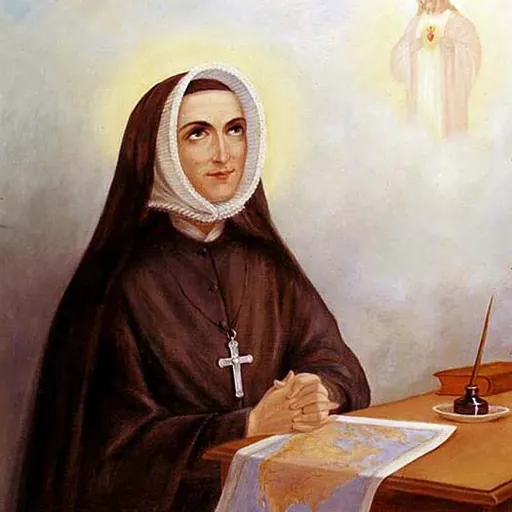
Rose Philippine Duchesne
French Catholic Religious Sister and missionary in the United States
About Rose Philippine Duchesne
Lived 1769 – 1852 (aged 83). Rose Philippine Duchesne was a nun, teacher, missionary and christian nun.
Rose Philippine Duchesne, RSCJ (; August 29, 1769 – November 18, 1852), was a French religious sister and educator whom Pope John Paul II canonized in 1988. A native of France, she immigrated as a missionary to America, and is recognized for her care and education of Indigenous American survivors of the United States Indian removal programs. Her mother, Rose-Euphrosine Périer (1743–1814), was the sister of Claude Périer, an industrialist who later helped finance the rise to power of Napoleon. Pierre-Francois and Rose-Euphrosine shared her parents' home in Grenoble with her brother, Claude Perier, and his wife – the two young couples living on separate floors. Claude Périer's son, Casimir, later a Prime Minister of France, was the grandfather of Jean Casimir-Perier, a President of France. She was raised in an enormous family home across from the Parliament building or Palace of Justice in Grenoble.
Monastery of the Visitation After surviving a bout of smallpox which left her slightly scarred, in 1781, Rose Duchesne and her cousin Josephine were sent to be educated in the Monastery of Sainte-Marie-d'en-Haut (known for the social status of its members), located on a mountainside near Grenoble, by the community of Visitandine nuns. When she began to show a strong attraction to the monastic life, her father withdrew her from the monastery school the following year and had her tutored with her cousins in the family home. In 1788 she decided to enter the Visitation of Holy Mary religious order, despite her family's opposition. She convinced an aunt to accompany her on a visit to the monastery, where she immediately requested admission, leaving her aunt to return home without her and to tell her father what happened.
In 1792, however, revolutionaries shut down the monastery during the French Revolution's Reign of Terror and dispersed the nuns. Duchesne returned to her family where she lived at their country home, along with two aunts, who had been Visitandines at Romans-sur-Isère. She attempted to continue living the Rule of Life of her Order while serving her family and those suffering from the Reign of Terror, including those imprisoned at the former monastery.
Missionary in America During her childhood, Duchesne had heard many stories in her parish church from missionary priests of life in Louisiana, founded as a colony of New France, and had long felt a desire to serve the Native Americans who lived there. In 1817, Louis DuBourg, Bishop of the Diocese of Louisiana and the Two Floridas, visited the convent in Paris. Bishop DuBourg was looking for a congregation of educators to help him evangelize the Indian and French children of his diocese. After meeting him, Duchesne, who had never lost her desire to serve as a missionary, begged permission from Barat to serve in the bishop's diocese.
Missouri In 1818, with Barat's blessing, Duchesne headed out to the United States with four other Sisters of the Society. After ten weeks at sea, they arrived in New Orleans. To their shock, however, the bishop had made no provisions for housing them. After they had rested briefly with the Ursuline nuns, they took advantage of the newly established steamboat service up the Mississippi River to travel to St. Louis, and finally settled in St. Charles, in what was then the Missouri Territory, a journey of seven weeks. She was later to describe the location as "the remotest village in the U.S."; nonetheless the community established a new Sacred Heart convent in a log cabin there, known as the Duquette Mansion, the first house of the Society ever built outside France, The following year DuBourg moved the community across the river to the town of Florissant, Missouri, where they opened a school and a novitiate.
The United States had purchased the area from France only fifteen years earlier, and settlers, many poor but others with money and slaves, were streaming in from the East. Their new foundation faced many struggles, including lack of funds, inadequate housing, hunger, and freezing weather, and the Sisters struggled to learn English. By 1828, the Society's first five members in America had grown to six communities, operating several schools. Other foundations in Louisiana followed: at Grand Coteau, near Opelousas, at Natchitoches, at Baton Rouge, at New Orleans, and at Convent, Louisiana. In 1826 Pope Leo XII, through a decretum laudis, formally approved the Society of the Sacred Heart, recognizing their work. The Jesuits acquired the Sisters' former school property in St. Charles in 1828, where they built a parish church, and asked the Sisters to returnto that same log cabin where they had lived because it was still the biggest house in townand conduct the parish school.
Kansas In 1841, Jesuit priest Pierre-Jean De Smet asked the Sisters to join the Jesuits in a new mission with the Potawatomi tribe in eastern Kansas, along Sugar Creek, where Christian Hoecken was taking charge. At age seventy-one, Duchesne was not among those initially selected for the trip. Peter Verhaegen insisted, "She may not be able to do much work, but she will assure success to the mission by praying for us." Since Duchesne was unable to master their language, she could not teach, so she would spend long periods in prayer. The children named her Quahkahkanumad, which translates as Woman Who Prays Always. According to Rachel L. Swarns, Duchesne wrote in 1822: “In spite of my repugnance for having Negro slaves, we may be obliged to purchase some.” A year later, the Sacred Heart Sisters in Grand Coteau purchased their first person, an enslaved man named Frank Hawkins, for $550."
Rose herself was given a slave by Bishop Louis DuBourg around 1821 or 1822. Upon discovering Duchesne's links to slavery, the University of Roehampton's Digby Stuart College, which was founded by the Sisters of the Sacred Heart, renamed the Duchesne Building after Nelson Mandela in 2018.
Death In 1842, after a year among the Potawatomi, it was clear that Duchesne's health could not sustain the regime of village life, and she returned to Saint Charles. She died on November 18, 1852, aged 83. The Holy See ordered in 1951 that she be buried more suitably. Construction was begun on a larger shrine, and her remains were moved there on June 13 of the following year. Pope John Paul II canonized her on July 3, 1988.
Don’t just read it —
keep it.
Full-length biographies made to live with: read them, listen on the way to work, watch them tonight.
- E-book
- Audio
- Video
Instant download · yours to keep · every purchase keeps this site free
Important facts
People in Rose Philippine Duchesne's life
Named in this biography and alive at the same time


Related people
Same field, nearest in time





Contemporaries
People whose lives overlapped Rose Philippine Duchesne's




Frequently asked questions
Who was Rose Philippine Duchesne?
French Catholic Religious Sister and missionary in the United States
When was Rose Philippine Duchesne born?
Rose Philippine Duchesne was born on 29 August 1769 in Grenoble.
When did Rose Philippine Duchesne die?
Rose Philippine Duchesne died on 18 November 1852 in St. Charles.
What was Rose Philippine Duchesne's occupation?
Rose Philippine Duchesne was a nun, teacher, missionary and christian nun.
Sources & further reading
· Wikipedia: Rose Philippine Duchesne
· DBpedia: Rose Philippine Duchesne
Cite this page
APA: Biography.guide. (2026). Rose Philippine Duchesne. https://biography.guide/rose-philippine-duchesne/
MLA: "Rose Philippine Duchesne." Biography.guide, https://biography.guide/rose-philippine-duchesne/.
Chicago: "Rose Philippine Duchesne." Biography.guide. https://biography.guide/rose-philippine-duchesne/.
Data last updated: 2026-09-23 · Spot an error? Report a correction.
Portrait: Wikimedia Commons · author & licence
Page generated 2026-09-27 05:08 UTC