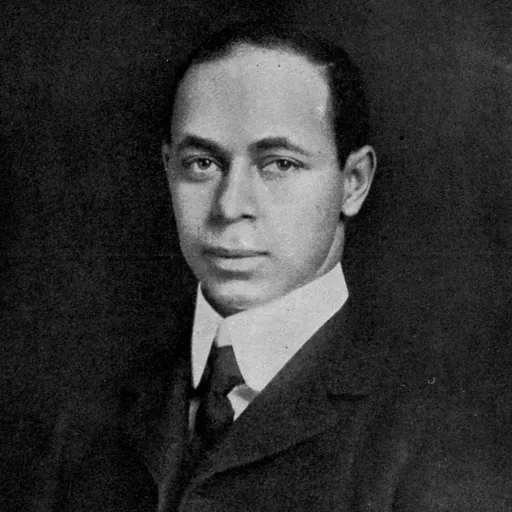
About Roscoe Conkling Bruce
Lived 1879 – 1950 (aged 71). Roscoe Conkling Bruce was an American educator and editor.
Roscoe Conkling Bruce, Senior (21 April 1879 – 16 August 1950) was an African-American educator who was known for stressing the value of practical industrial and business skills as opposed to academic disciplines. Later he administered the Dunbar Apartments housing complex in Harlem, New York City, and was editor in chief of the Harriet Tubman Publishing Company.
Birth and education
Roscoe Conkling Bruce was born on 21 April 1879 in Washington, D.C., the only son of U.S. Senator Blanche Bruce and his wife Josephine Beall Willson Bruce. His father was a Republican from Mississippi. Blanche Bruce was a former slave, the second African American to be elected to the U.S. Senate, and the first to serve a full six-year term. Josephine Beall Willson was the daughter of a Cleveland dentist. She had been an elementary school teacher. In 1899 Booker T. Washington hired her as lady principal at the Tuskegee Institute. In 1901 she ran unsuccessfully for election as President of the National Association of Colored Women.
Roscoe Conkling was their only child. He was named after Senator Roscoe Conkling of New York, who supported his father against anti-black prejudice in the Senate chamber. His secondary education was first at Washington's M Street High School and then at Phillips Exeter Academy, where he was one of the editors of The Exonian, the student newspaper. He went on to Harvard University in 1898. At Harvard in 1898 he won the Pasteur Medal for debating, in 1899 was chosen as one of three men to represent Harvard in a debate against Princeton University, in 1900 represented Harvard in the oratorical contest against Yale University and won the Coolidge debating prize. He graduated with an AB degree in 1902, magna cum laude, and became a member of Phi Beta Kappa society.
Educator
While visiting Josephine at Tuskegee, during the summer break of his senior year at Harvard, Bruce won a fan in Booker T. Washington and secured a position at Tuskegee as head of the Academic Department. Washington demoted James Dickens McCall to open the position for Bruce. However, Booker T. Washington's support, and a white-dominated school board, secured Bruce's position.
Bruce endured a tug-of-war for power within the D.C. education circles and became the focal point of philosophical and public relations opposition by those who supported W.E.B. du Bois. He managed to temper both sides by appearing to serve both ideologies—he was vocal about industrial education while also a member of the NAACP, which denounced such education. The controversy led to a scathing article in the influential Washington Bee, titled "Picture For Youth," written by former ally, Ralph W. Tyler. The piece labelled Bruce a failure during his tenure at Tuskegee. However, Bruce recovered and resumed his post until a scandal resulted, brought on by Herman M. Bernolet Moens, an obscure Dutch professor introduced to local black middle class circles by, none other than, W.E.B. du Bois. Unable to leave the United States due to the outbreak of World War I, Moens traveled throughout the country studying African American children. During this time, as an outspoken supporter of racial integration and equality, Moens had also become a target of the US Department of Justice, and was accused of being a German spy sent to rouse trouble within the United States.
Moens, who was introduced to D.C. black society by W.E.B. du Bois, said he was going to show that "white people had as much Negro blood in them as colored people" and "to correct the charge that colored people were inferior to white people".
Moens was charged with possession of eight obscene pictures for the purpose of exhibiting them. A trial ensued.
Moens admitted to having "certain illicit relations" and committing "unnatural acts" with least one of the underage girls and to frequenting prostitutes. However, what exactly transpired between the two is unknown; only that the girl "danced around in a nude state" and when a Special Agent for the Justice Department testified about Moens' admitted conduct with the girl, spectators laughed and the judge ordered everyone except lawyers and judges to leave the courtroom.
Following the investigation and trial, clergy and parents formed the Parents' League, a 2,000 member organization with the slogan, "Bruce Must Go". Charlotte Hunter also resigned amid outrage from the Parents' League.
Bruce resigned his post in April 1919. However, given her race and gender, she struggled to find work as an attorney.
They had three children, Clara Josephine, Roscoe Conkling Jr. ("Bokie"), and Burrill Kelso Bruce.
His son Roscoe Jr. embezzled money from an apartment complex he managed in New Jersey and then arranged a phony burglary to explain the absence of funds. He served a year-and-a-half in prison. The legal costs bankrupted the family. The elite whites they had befriended abandoned them, and Roscoe Sr. and Clara were reduced to living on welfare.
His daughter Clara attended Radcliffe like her mother; however, she failed to graduate when she opted to elope with a black actor instead. Clara and her husband were both white-passing African Americans. Their respective skin tones afforded them certain privileges not given to darker African Americans.
Bruce died in New York City on August 16, 1950, at the age of 71. He was buried in Woodlawn Cemetery in Washington, D.C.
Notes and references
Don’t just read it —
keep it.
Full-length biographies made to live with: read them, listen on the way to work, watch them tonight.
- E-book
- Audio
- Video
Instant download · yours to keep · every purchase keeps this site free
Important facts
People in Roscoe Conkling Bruce's life
Named in this biography and alive at the same time


Related people
Same field, nearest in time


Contemporaries
People whose lives overlapped Roscoe Conkling Bruce's


Frequently asked questions
Who was Roscoe Conkling Bruce?
American educator
When was Roscoe Conkling Bruce born?
Roscoe Conkling Bruce was born on 21 April 1879 in Washington, D.C..
When did Roscoe Conkling Bruce die?
Roscoe Conkling Bruce died on 16 August 1950 in New York City.
What was Roscoe Conkling Bruce's occupation?
Roscoe Conkling Bruce was an educator and editor.
What nationality was Roscoe Conkling Bruce?
Roscoe Conkling Bruce was American.
Sources & further reading
· Wikipedia: Roscoe Conkling Bruce
· DBpedia: Roscoe Conkling Bruce
Cite this page
APA: Biography.guide. (2026). Roscoe Conkling Bruce. https://biography.guide/roscoe-conkling-bruce/
MLA: "Roscoe Conkling Bruce." Biography.guide, https://biography.guide/roscoe-conkling-bruce/.
Chicago: "Roscoe Conkling Bruce." Biography.guide. https://biography.guide/roscoe-conkling-bruce/.
Data last updated: 2026-09-22 · Spot an error? Report a correction.
Portrait: Wikimedia Commons · author & licence
Page generated 2026-09-27 04:58 UTC