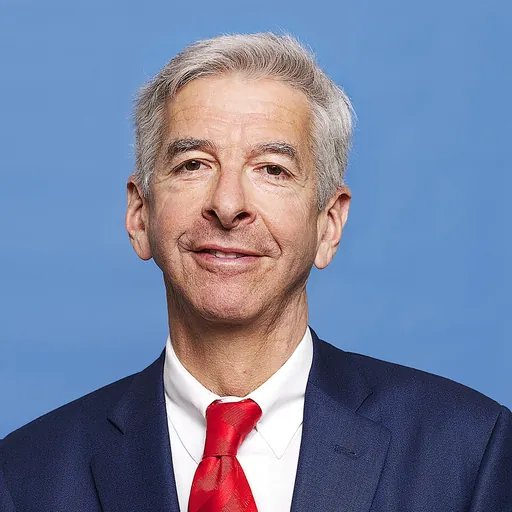
Ronald Plasterk
Dutch politician and scientist (born 1957)
About Ronald Plasterk
Born 1957. Ronald Plasterk is a Dutch politician, columnist, microbiologist, university teacher, geneticist and writer.
Ronald Hans Anton Plasterk (; born 12 April 1957) is a Dutch retired politician of the Labour Party (PvdA). He has a PhD degree in biology, specialising in molecular genetics. He is founder and CEO of Frame Cancer Therapeutics. He was appointed professor at the University of Amsterdam in September 2018.
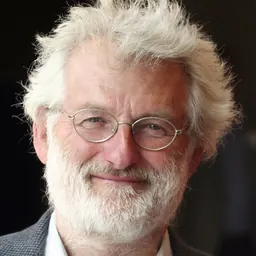
Education and scientific career Plasterk was born in The Hague, and he attended the Sint Janscollege secondary school at level between 1969 and 1975. In 1981, he obtained an MSc degree Cum Laude in biology. He obtained his propaedeutic diploma in economics in the same year. From 1981 to 1984 he worked as a researcher at the biomedical institute of Leiden University before earning his PhD degree in mathematics and natural science in 1984. He did genetic research into flatworms for his thesis entitled "Inversion of the G segment of bacteriophage Mu: analysis of a genetic switch". where he worked with John Sulston. He studied Caenorhabditis elegans, a nematode that is used as a model organism.
In 1987 he returned to the Netherlands where he became group leader and member of the board of the Netherlands Cancer Institute in Amsterdam. In July 1989, he became director of the research school of oncology at the institute, where he remained until February 2000. Between January 1993 and February 1997, he occupied the endowed chair in molecular microbiology at the Vrije Universiteit Amsterdam. Before entering politics he also was a member of the Health Council, which advises the Minister of Health, Welfare and Sport, a member of the board of the Wellcome Trust, member of the Committee on Biotechnology and Animals and of the European Molecular Biology Organization.
Politics
An admirer of Prime Minister Joop den Uyl, Plasterk joined the Labour Party in 1977 as a student. He served on the Municipal Council of Leiden from 11 October 1982 until 1 September 1984 while a doctoral researcher. Wouter Bos, leader of the Labour Party, sees Plasterk as a social and cultural libertarian, who balances out the social and cultural conservativism of the Labour Party's coalition partners Christian Democratic Appeal and the Christian Union. As such he is vice chair of the national Innovation Platform and member of the task force Women on Top.
A key issue during Plasterk's period as minister was the salary of teachers. When there was no room in the national budget to increase the salaries of teachers as advised by a committee led by Alexander Rinnooy Kan, Plasterk was forced to find money from within the budget of his own ministry. Kan made his advice public just days after the Miljoenennota (the national budget) was published. One of the solutions Plasterk considered was cutting the allowance for students and raising the fees for universities. Plasterk was strongly criticized by the students unions for his proposals and by his coalition partners CDA and CU and the leftwing opposition parties SP and GroenLinks. In the end he and Wouter Bos, the minister of Finance, were able to find sufficient money for a marked increase in the salaries of teachers. Under the pressure of strikes by teachers, Plasterk came to a deal with the teachers´ union in April 2008.
The Cabinet Balkenende IV fell on 20 February 2010 after tensions in the coalition over the extension of the Dutch involvement in the Task Force Urozgan of the International Security Assistance Force (ISAF) in Afghanistan and continued to serve in a demissionary capacity until the Labour Party cabinets members resigned on 23 February 2010.
Continued political career Plasterk successfully ran for the Member of the House of Representatives in the June 2010 general election as the Labour's Party third candidate, taking office on 17 June 2010. He served as the party's spokesperson for finances.
Following the election of 2012 Plasterk was appointed as Minister of the Interior and Kingdom Relations in the Cabinet Rutte II, taking office on 5 November 2012. He did not succeed to merge the provinces of North Holland, Flevoland, and Utrecht and to reduce the memberships of provincial councils and executives.
Columnist Plasterk started as a columnist in the Intermediair, a weekly magazine oriented at young professionals and academics, in 1995. Furthermore, in the referendum on the European constitution, he positioned himself as an outspoken critic of the Treaty establishing a Constitution for Europe. He opposed the constitution because he considered that it did not clearly codify the responsibilities of the European Union. He also felt that it laid too much emphasis on the free market. In 2000, several of his columns were bundled in the book Leven uit het Lab ("Life from the Lab").
Plasterk's convictions moved to the political right in columns for De Telegraaf after his retirement from politics. He wrote that the Labour Party had lost touch with regular citizens, and he opined that the state of Dutch nature was not deteriorating during the nitrogen crisis in the Netherlands. In 1997 he coined the term ietsisme ("somethingism") to refer to the religious belief that the Christian God does not exist, but that there is some greater force that created the universe and governs it. This position is roughly equivalent to 18th century Deism. He first strongly criticized the belief on intellectual grounds, calling it a "poor and irritating phenomenon", but later claimed that it was a mix of atheism and nostalgia, and much more sympathetic "than the idea of a cruel God that wants this misery".
Return to microbiology Following his retirement from national politics in October 2017, Plasterk continued his scientific work in the private sector. He became chief scientific officer of myTomorrows, a company that connects patients with experimental treatments.
He started working with microbiologist Jan Koster of the Academic Medical Center (soon to become Amsterdam UMC through a merger) on developing methods for cancer immunotherapy through vaccines using biological data collected by Koster. In the data, they found similar frameshift mutations of tumors in different patients, leading to a list of potential vaccines. While they were working on a scientific paper, Plasterk filed a patent for a method to develop personalized cancer treatments in July 2018, and he established a company called Frame Pharmaceuticals in December 2018. His investors and shareholders were Dinko Valerio, Bob Löwenberg, and René Beukema, who had all earned their wealth through the sale of biotechnology company Crucell. Valerio had worked with Plasterk in the 1990s, and Löwenberg had introduced him to Koster. In the meantime, Plasterk had rejoined the University of Amsterdam, to which Amsterdam UMC is affiliated, as a professor with a zero-hour contract in September 2018. He acknowledged that he mostly kept doing research for his own company with the exception of sporadic lectures and supervising some internships. The week before Plasterk would release his report – in February 2024 – NSC pulled out of the talks, citing financial setbacks and Plasterk's delayed information about them. Plasterk called the statement "muddled" and denied having withheld details. In his final report, he advised the four parties to continue talking, and Kim Putters was selected as the new informateur. When the four parties reached a coalition agreement on 16 May 2024, national media outlets reported that Wilders had proposed Plasterk for the position of Prime Minister of the Netherlands. Pieter Omtzigt, leader of the NSC, reportedly opposed Plasterk's nomination for prime minister.
Two months earlier, newspaper NRC had chronicled Plasterk's scientific career in the private sector in the preceding years. They noted the absence of Koster's name in the patent application for their cancer treatment method, and the fact that Amsterdam UMC (Koster's employer) had not shared in the profit's resulting from their joint research. The NRC article noted that as Minister of Education, Culture and Science, Plasterk had successfully worked on a system to have researchers and universities share in profits resulting from their findings. Koster admitted he had not shared interest in commercial applications. The university medical center had found out about the patent when the scientific paper of Plasterk and Koster was published in April 2019. In response to the article, Plasterk denied that Koster had been involved in the inventive step for the cancer treatment method despite their scientific paper crediting Koster with developing the method and performing the bioinformatics analysis. Additionally, a criminal complaint for economic offenses and falsification of documents was filed by an attorney, who argued Plasterk had wrongfully referred to his company as a microbusiness in 2022.
Plasterk withdrew himself as a candidate for prime minister on 20 May 2024, stating that the public perception of the accusations would hinder his ability to function effectively in the role. The Public Prosecution Service later decided not to bring any charges related to the criminal complaint. Amsterdam UMC concluded that Koster should have been recognized as co-inventor, and it filed a civil case against Plasterk and CureVac to be recognized as co-inventor and co-owner of the patents and to receive damages.
Personal life Plasterk is married and has two children. He lives in Amsterdam. Plasterk is a member of the Royal Christian Oratory Association "Excelsior" in Amsterdam, an evangelical choir in which he sings as a tenor. He participates in the yearly recital of the Mattheus Passion of Johann Sebastian Bach of Excelsior. His other hobbies include literature, painting and photography.
In the summer of 2008 he appeared in Zomergasten, an evening long in-depth television interview of the VPRO.
Awards and decorations 1999: Spinoza Prize of the Netherlands Organisation for Scientific Research 2002: Award for Communication in the Life Sciences of European Molecular Biology Organization 2005: Grand Prix scientifique de la Fondation Louis D. of the Institut de France (shared with American molecular biologist David P. Bartel) 2010: Officer of the Order of Orange-Nassau
Don’t just read it —
keep it.
Full-length biographies made to live with: read them, listen on the way to work, watch them tonight.
- E-book
- Audio
- Video
Instant download · yours to keep · every purchase keeps this site free
Important facts
People in Ronald Plasterk's life
Named in this biography and alive at the same time






Related people
Same field, nearest in time



Contemporaries
People whose lives overlapped Ronald Plasterk's

Frequently asked questions
Who is Ronald Plasterk?
Dutch politician and scientist (born 1957)
When was Ronald Plasterk born?
Ronald Plasterk was born on 12 April 1957 in The Hague.
What is Ronald Plasterk's occupation?
Ronald Plasterk is a politician, columnist, microbiologist, university teacher, geneticist and writer.
What nationality is Ronald Plasterk?
Ronald Plasterk is Dutch.
Sources & further reading
Cite this page
APA: Biography.guide. (2026). Ronald Plasterk. https://biography.guide/ronald-plasterk/
MLA: "Ronald Plasterk." Biography.guide, https://biography.guide/ronald-plasterk/.
Chicago: "Ronald Plasterk." Biography.guide. https://biography.guide/ronald-plasterk/.
Data last updated: 2026-09-23 · Spot an error? Report a correction.
Portrait: Wikimedia Commons · author & licence
Page generated 2026-09-27 05:07 UTC