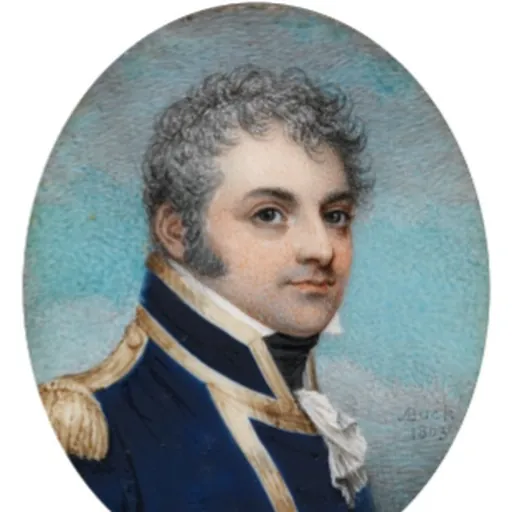
About Robert Plampin
Lived 1762 – 1834 (aged 71–72). Robert Plampin was a British naval officer.
Vice-Admiral Robert Plampin (1762 – 14 February 1834) was a British Royal Navy officer during the late 18th and early 19th centuries, serving in the American Revolutionary War, the French Revolutionary Wars and the Napoleonic Wars, but best known for his time as commander of the British colony of Saint Helena in the South Atlantic during the period when former Emperor Napoleon Bonaparte was imprisoned there. Born into a Navy family, Plampin went to sea at age 13 and fought throughout the American Revolutionary War, based principally in the Caribbean Sea. During the French Revolutionary Wars, Plampin served in a number of ships with mixed success, once being involved in a shipwreck and twice serving ashore during sieges. After the Peace of Amiens, Plampin took command of the ship of the line and operated successfully in the Atlantic and the Indian Ocean. In 1816, following the defeat and capture of the French Emperor, Plampin was placed in command of the squadron at the Cape of Good Hope, which also had responsibility for Saint Helena, which Plampin regularly visited and had numerous conversations with Napoleon.
Life Plampin was born in 1762, the son of naval officer John Plampin of Chadacre Hall, in Suffolk. Intended for a career at sea, Plampin joined the Navy in 1775, aged 13, and served aboard under Captain Francis Banks off the coast of North America during the American Revolutionary War. In 1778, Plampin moved to at Gibraltar and subsequently moved in 1780 to , the flagship of Admiral Sir George Rodney. In Sandwich Plampin participated in the Battle of Martinique in April 1780, and subsequent operations, earning a promotion to lieutenant aboard and returning to Britain. In 1781, he operated in off Newfoundland, remaining on the station for the remainder of the war.
Placed in reserve following the end of the war in 1783, Plampin traveled widely in Europe, making specific studies of the French language in 1786 and the Dutch language in 1787. At the Spanish Armament in 1790, Plampin became a lieutenant on the new ship of the line under Sir Hyde Parker. Parker was impressed by his subordinate's language skills and intelligence and, in 1793, suggested Plampin for a mission to the Netherlands, at that time allied to Britain in the French Revolutionary Wars.
Arriving in the Indian Ocean, Plampin found no sign of Willaumez (who had remained in the Atlantic), but did discover that British trade was under constant attack from French frigates and privateers based on Île de France, which particularly targeted the large East Indiamen. On 13 June 1806, Plampin captured the small privateer Henrietta off Trincomalee, but was especially concerned by the depredations of the large privateer frigate Bellone, which carried 34 guns. Disguising Powerful as an East Indiaman, Plampin cruised off Ceylon in search of the enemy and on 9 July discovered Bellone under pursuit by the Royal Navy sloop . Moving to cut Bellone off, Powerful was hampered by light winds and Bellone almost slipped between Plampin's ship and shore. However, the breeze gradually increased and Plampin was able to close with the privateer. The French ship defended itself and a running fight began that lasted for 105 minutes before Bellone surrendered, having caused greater casualties on Powerful than had been suffered herself.
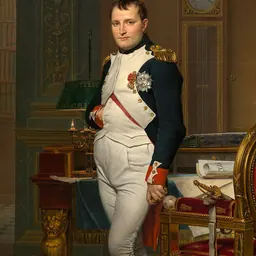
Napoleon's gaoler After a brief voyage to Java, disease spread aboard Powerful and Plampin himself was taken ill, returning to Britain to recuperate. Rejoining the service in 1809, Plampin commanded at the disastrous Walcheren Expedition and in 1810 commanded the squadron at Basque Roads near Brest in . In 1812, he commanded the 98-gun off Toulon and in 1814 was promoted to rear-admiral. In 1816, following the end of the wars, Plampin was appointed commander at the Cape of Good Hope Station. Part of Plampin's duties was to observe the former French Emperor Napoleon Bonaparte, who was kept prisoner in a house on the island of Saint Helena, deep in the Atlantic Ocean. Plampin regularly visited his prisoner and the two had a number of conversations that were recorded by the naval historian James Ralfe. He was survived by his wife Fanny, who died in 1864, but the couple had no children.
Don’t just read it —
keep it.
Full-length biographies made to live with: read them, listen on the way to work, watch them tonight.
- E-book
- Audio
- Video
Instant download · yours to keep · every purchase keeps this site free
Important facts
People in Robert Plampin's life
Named in this biography and alive at the same time

Related people
Same field, nearest in time





Contemporaries
People whose lives overlapped Robert Plampin's




Frequently asked questions
Who was Robert Plampin?
British Royal Navy officer
When was Robert Plampin born?
Robert Plampin was born in 1762 in Suffolk.
When did Robert Plampin die?
Robert Plampin died on 14 February 1834 in Florence.
What was Robert Plampin's occupation?
Robert Plampin was a naval officer.
What nationality was Robert Plampin?
Robert Plampin was British.
Sources & further reading
Cite this page
APA: Biography.guide. (2026). Robert Plampin. https://biography.guide/robert-plampin/
MLA: "Robert Plampin." Biography.guide, https://biography.guide/robert-plampin/.
Chicago: "Robert Plampin." Biography.guide. https://biography.guide/robert-plampin/.
Data last updated: 2026-09-24 · Spot an error? Report a correction.
Portrait: Wikimedia Commons · author & licence
Page generated 2026-09-27 05:08 UTC