
About Robert Murray
Lived 1763 – 1834 (aged 70–71). Robert Murray was a naval officer.
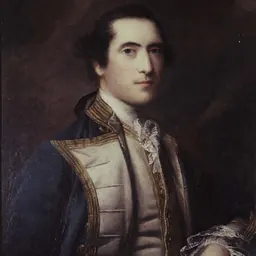
Robert Murray (c.1763 – 30 June 1834) was an officer in the Royal Navy who served during the American War of Independence and the French Revolutionary and Napoleonic Wars.
Murray entered the navy at a young age, probably using the patronage of a relation, Captain the Hon. Robert Digby. After service at sea, Murray was serving as a lieutenant during the American War of Independence and saw action at the Battle of Ushant in 1778. He followed Digby to other ships after Digby was promoted to flag rank, and was then given his own commands on the North American Station shortly before the end of the war. He saw some service during the years of peace, commanding a frigate in the Caribbean for a time, before the outbreak of the French Revolutionary Wars brought further opportunities. Murray commanded the frigate HMS Oiseau on the North American station for a time, operating with success against French warships and privateers. Serving under Murray during this time was Yuri Lisyansky, who became an important explorer in the Imperial Russian Navy, and, albeit in name only, Provo Wallis, whom Murray had been persuaded to enter onto his books despite Wallis only being four years old.
Murray moved to command a ship of the line, still at Halifax, after his time in Oiseau, and spent some years as the flag captain of the station commander. Returning to Britain, he was promoted to flag rank himself, but saw little active service. He was appointed as Commander in chief at North Yarmouth in 1811, serving as such until the end of the wars with France. He was promoted to the rank of admiral and busied himself with sailor's welfare, helping to secure the establishment of a floating chapel at Liverpool before his death in 1834.
Family and early life An 1848 depiction of the Battle of Ushant by Jean Antoine Théodore de Gudin. Murray was present during the fighting as a lieutenant aboard . Little is recorded of Murray's early life and service, but he was born circa 1763 and entered the navy at a young age, The Annual Biography and Obituary noting that he "may almost be said to have been cradled on the wave." He left her on his promotion to post-captain on 15 December 1782, towards the end of the American War of Independence. He briefly commanded the newly purchased 16-gun sloop at New York City in January 1783, but she was broken up at the end of the month.
The naval draw-down after the war meant there was little opportunity for employment. Murray finally received a ship in January 1789, when he was appointed to command the 32-gun prior to and during the Spanish Armament. He took her out to the Leeward Islands with a squadron under Rear-Admiral George Murray, departing Plymouth on 18 May 1794. Murray's decision meant that when Wallis actually came to join a ship, the 32-gun in 1804 at the age of thirteen, he already had nearly ten years of service logged, allowing him to amass 96 years of service in the Royal Navy before his death at the age of 100.
Flag rank and later life Murray was promoted to rear-admiral on 23 April 1804, and thereafter rose through the ranks, reaching vice-admiral on 25 October 1809. He was appointed to be Commander in Chief, North Yarmouth in summer 1811, and hoisted his flag aboard HMS Solebay. There are only thirty days in the month of June, so The Gentleman's Magazine may be in error.
b. Sources say that Murray was appointed to a 32-gun frigate named HMS Blonde in this period, which they suggest was a captured French ship. However the 32-gun captured in 1760 had been wrecked in 1782. A later British-built entered service in 1789, but Winfield's British Warships in the Age of Sail records she was commanded by Captain William Affleck in this period. A captured former French frigate, the 32-gun was also in the Royal Navy at this time, though she was only renamed Blonde in 1805, and was not in commission in 1789. Winfield instead records Murry as being appointed to the 32-gun Blanche in 1789, and serving in command until 1792.
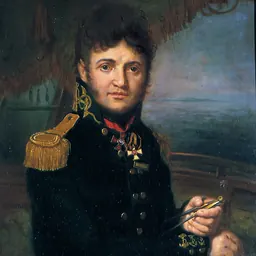
c. Lisyansky became a prominent officer and explorer after his return to the Imperial Russian Navy, serving on the first Russian circumnavigation of the globe under Adam Johann von Krusenstern. While in the West Indies he was struck by yellow fever, and later recalled how Murray had helped his recovery, even giving up part of his own accommodation for the sick Lisyansky.
d. In his long career Wallis served during the War of 1812 and as second lieutenant of , was present at the capture of USS Chesapeake, and commanded the prize crew that took her to Halifax. His time in command qualified him for further promotions before the end of the Napoleonic Wars, and he rose to the rank of admiral in 1863, and admiral of the fleet in 1877. The Admiralty suggested he retire when he reached his nineties, as being on the active list meant he was liable for calling up for a seagoing command. Wallis instead replied he was ready to accept one, and remained on the active list until his death in 1892.
Don’t just read it —
keep it.
Full-length biographies made to live with: read them, listen on the way to work, watch them tonight.
- E-book
- Audio
- Video
Instant download · yours to keep · every purchase keeps this site free
Important facts
People in Robert Murray's life
Named in this biography and alive at the same time
Related people
Same field, nearest in time




Contemporaries
People whose lives overlapped Robert Murray's





Frequently asked questions
Who was Robert Murray?
Royal Navy officer (1763-1834)
When was Robert Murray born?
Robert Murray was born in 1763.
When did Robert Murray die?
Robert Murray died on 30 June 1834 in Liverpool.
What was Robert Murray's occupation?
Robert Murray was a naval officer.
Sources & further reading
· DBpedia: Robert Murray (Royal Navy officer)
Cite this page
APA: Biography.guide. (2026). Robert Murray. https://biography.guide/robert-murray-naval-officer/
MLA: "Robert Murray." Biography.guide, https://biography.guide/robert-murray-naval-officer/.
Chicago: "Robert Murray." Biography.guide. https://biography.guide/robert-murray-naval-officer/.
Data last updated: 2026-09-20 · Spot an error? Report a correction.
Page generated 2026-09-27 05:04 UTC