
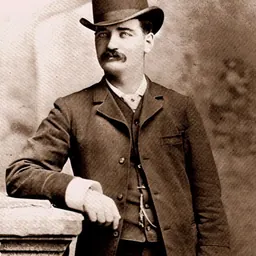
Robert H. Paul
American sheriff
About Robert H. Paul
Lived 1831 – 1901 (aged 69). Robert H. Paul was an American constables in the United States, known for Pima County, Arizona.
Robert Havlin Paul (June 12, 1830 – March 26, 1901) was a law enforcement officer in the American Southwest for more than 30 years. He was sheriff of Pima County, Arizona Territory, from April 1881 to 1886. He was also a friend of Deputy U.S. Marshall Virgil Earp and his brother Wyatt Earp. At and , he was described as "larger than life". and at age 12 (some reports say age 14)
Mining in California Paul worked a placer mine in Hangtown for several months without success. He followed others to fresh discoveries of gold on the Yuba River and then to the Mokelumne River, where he found and worked a successful mining claim. and a month later was appointed Calaveras County Deputy Sheriff for the next three years. In 1857 he was appointed undersheriff. He was responsible for breaking up the Tom Bell gang that was operating in Calaveras and Placer County.
Immediately, Crane fired at the guard's seat, killing the popular and well-known driver Eli 'Budd' Philpot. This would lead to theories of an assassination attempt. Paul fired his shotgun and emptied his revolver at the robbers, wounding a Cowboy later identified as Bill Leonard in the groin. In the exchange, a miner named Peter Roerig, riding in the rear dickey seat, was also killed. Wyatt, believing that Virgil was dying, telegraphed U.S. Marshal Crawley Dake and asked to be named as Virgil's replacement as Deputy U.S. Marshal. Dake agreed. On February 2, the Clantons were put on trial before Judge Stilwell. Ike's hat had been found at the scene and McMaster testified that he had been in Charleston the evening of the shooting. He said that when Ike learned that Virgil had survived the shooting, Ike said he "would have to go back and do the job over."
On Saturday evening, March 18, 1882, Morgan Earp was waiting for saloon owner Bob Hatch to line up a billiards shot when two bullets were fired through the window of the back door of the saloon. Morgan was shot through the spine and died within the hour. While escorting the maimed Virgil and Morgan's remains to the train in Tucson, Deputy U.S. Marshal Wyatt Earp, Warren Earp and other deputies found Frank Stilwell lying in wait in the railyard and killed him. Tucson Justice of the Peace Charles Meyer issued arrest warrants for five of the Earps' party. The federal posse returned to Tombstone.
Meyer sent a telegram to Cochise County Sheriff Johnny Behan instructing him to arrest them. The telegraph office manager, a friend of the Earps, delayed its delivery long enough to allow the Earps and their associates to make ready to leave town Tuesday evening. Ignoring Behan, the well-armed Earp posse rode out of town the same evening of Tuesday, March 21. They headed for the woodcutting camp of Pete Spence in the South Pass in the Dragoon Mountains. Tucson, where the Earps had killed Stilwell, was in Paul's jurisdiction, but Paul was a friend of the Earps and failed to execute the warrant.
On May 16, 1882, the sheriff of Arapahoe County, Colorado, notified Cochise County Sheriff Johnny Behan that he had Wyatt and Warren Earp in his custody, along with Doc Holliday. Behan applied to the governor for money to go to Colorado to bring the Earps back, but Governor Fremont instead gave the funds to Paul as Pima County Sheriff. Paul had received word on the same day from Denver that the sheriff there had five of the Earp party in custody. When Paul arrived in Denver, he served a warrant for Doc Holiday's arrest on charges that he killed Frank Stilwell in Tucson. Wyatt Earp, also in Denver, feared for Holiday's life if he was returned to Tombstone. He asked his friend and Trinidad, Colorado Sheriff Bat Masterson to help get Holiday released. Sheriff Masterson appealed to Governor Frederick W. Pitkin and succeeded in getting Holiday released from jail. Paul also knew of warrants for the Earp's arrest, but he was a friend of the men and never served the warrants. Paul cleared the courthouse and almost single-handedly saved Casey's life. in what his obituary called both "his first and last sickness". He was buried in Tucson's Court Street Cemetery.
Don’t just read it —
keep it.
Full-length biographies made to live with: read them, listen on the way to work, watch them tonight.
- E-book
- Audio
- Video
Instant download · yours to keep · every purchase keeps this site free
Important facts
People in Robert H. Paul's life
Named in this biography and alive at the same time



Contemporaries
People whose lives overlapped Robert H. Paul's




Frequently asked questions
Who was Robert H. Paul?
American sheriff (1831-1901)
When was Robert H. Paul born?
Robert H. Paul was born on 12 June 1831 in Lowell.
When did Robert H. Paul die?
Robert H. Paul died on 26 March 1901 in Tucson.
What was Robert H. Paul's occupation?
Robert H. Paul was a constables in the United States.
What was Robert H. Paul known for?
Robert H. Paul was known for Pima County, Arizona.
What nationality was Robert H. Paul?
Robert H. Paul was American.
Sources & further reading
Cite this page
APA: Biography.guide. (2026). Robert H. Paul. https://biography.guide/robert-h-paul/
MLA: "Robert H. Paul." Biography.guide, https://biography.guide/robert-h-paul/.
Chicago: "Robert H. Paul." Biography.guide. https://biography.guide/robert-h-paul/.
Data last updated: 2026-09-22 · Spot an error? Report a correction.
Page generated 2026-09-27 05:18 UTC