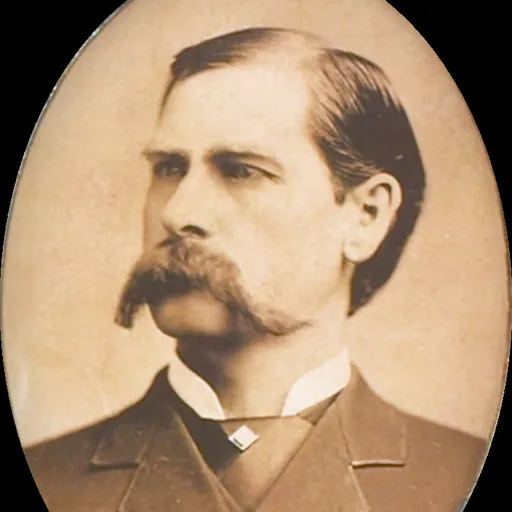
About Wyatt Earp
Lived 1848 – 1929 (aged 80). Wyatt Earp was an American politician and hunter, known for Fitzsimmons vs. Sharkey and Gunfight at the O.K. Corral.
Early life
Wyatt Berry Stapp Earp was born on March 19, 1848, in Monmouth, Illinois, the fourth child of Nicholas Porter Earp and his second wife, Virginia Ann Cooksey. He was named after his father's commanding officer in the Mexican–American War, Captain Wyatt Berry Stapp, of the 2nd Company, Illinois Mounted Volunteers. Some evidence supports Earp's birthplace as 406 S. 3rd St. in Monmouth, Illinois, though the street address is disputed. thumb
In March 1849, where Martha died on May 26, 1856.
Nicholas and Virginia Earp's last child, Adelia, was born in June 1861 in Pella.
Adult life California Looking east from D St. toward 3rd St. in downtown San Bernardino in 1864
On May 12, 1864, Nicholas Earp organized a wagon train and headed to San Bernardino, California, arriving on December 17. By late summer 1865, Virgil found work as a driver for Phineas Banning's stagecoach line in California's Imperial Valley, and 16-year-old Earp assisted. In spring 1866, Earp became a teamster transporting cargo for Chris Taylor from 1866 to 1868. He drove cargo over on the wagon road from Wilmington through San Bernardino, then Las Vegas, Nevada, to Salt Lake City, Utah Territory.
In spring 1868, Earp was hired to transport supplies for the Union Pacific Railroad. He learned gambling and boxing while working on the railhead in the Wyoming Territory
Lawman and marriage
During that summer in Beardstown, a railroad brakeman named Tom Pinard mocked Wyatt, calling him "the California boy", a euphemism for coward, implying that Wyatt had gone to California to avoid serving in the Civil War. Although Wyatt had attempted to join the army at 13 and had been stopped by his father, he took offense at Piner's remarks. They were married by Wyatt's father on January 10, 1870. The court seized Cromwell's mowing machine and sold it for $38 to make up the difference between what Wyatt turned in and what Cromwell owed. Cromwell's suit claimed that Earp owed him the estimated machine value of $75.
On April 6, Deputy U.S. Marshal J. G. Owens arrested Earp for the horse theft. Commissioner James Churchill arraigned him on April 14 and set bail at $500. Wyatt was summoned to appear at a hearing, and before he could appear, Wyatt sold his property, escaped through the roof of the jail, and headed for Peoria, Illinois. But Peoria police raided a brothel on February 24, 1872, and arrested Wyatt and Morgan Earp, George Randall, and four women including Jane Haspel. The men were charged with "keeping and being found in a house of ill-fame," A prostitute named Sally Heckell was arrested with him, and she called herself his wife; she was likely the 16-year-old daughter of Jane Haspel. a "beggar" Wyatt followed his brother James and his wife in 1876 as they moved west to Dodge City after it became the “queen of the cow towns.”
Dodge City and Deadwood Wyatt dealt faro at the Long Branch Saloon in Dodge City, Kansas.
After 1875 Dodge City, Kansas, became a major terminal for cattle drives from Texas, Wyatt Earp was appointed assistant marshal in Dodge City under Marshal Lawrence Deger around May 1876. At some point he met prostitute Mattie Blaylock, who became his common-law wife until 1881. Wyatt and Morgan left Dodge for Deadwood in the Dakota Territory on September 9, 1876, with a team of horses only to find that all the land was already tied up in mining claims. While Morgan returned to Dodge City, Wyatt remained and made a deal to buy all the wood that a local individual had cut and put his horses to work during the winter of 1876–1877, hauling firewood into camp.
On Sunday, January 9, 1876, while sitting in the back room of the Custom House saloon, Wyatt Earp's revolver slipped from its holster and hit his chair. A .45 caliber round discharged because he left the hammer on a loaded chamber and punched a hole in his coat. The shot "got up a lively stampede from the room." Wyatt rejoined the Dodge City police in spring 1877 at the request of Mayor James H. Kelley. The Dodge City newspaper reported in July 1878 that he had been fined one dollar for slapping a muscular prostitute named Frankie Bell, who "heaped epithets upon the unoffending head of Mr. Earp to such an extent as to provide a slap from the ex-officer," according to the account. Bell spent the night in jail and was fined $20, while Wyatt's fine was the legal minimum. he went to the Bee Hive Saloon. It was the largest in town and owned by John Shanssey, whom Wyatt had known since he was 21. Shanssey told Wyatt that Rudabaugh had passed through town earlier in the week, but did not know where he was headed. Shanssey suggested that Wyatt ask gambler Doc Holliday, who played cards with Rudabaugh.
By May 11, 1878, the Dodge newspapers reported that Wyatt Earp had returned. The Dodge City Times noted on May 14 that he'd been appointed Assistant Marshal for $75 per month, Wyatt credited Doc with saving his life that day, and the two became lifelong friends. The Earps arrived with their wives on December 1, 1879, while Doc Holliday remained in Prescott where the gambling afforded better opportunities. The three Earps and Robert J. Winders filed a location notice on December 6, 1879, for the First North Extension of the Mountain Maid Mine. They also bought an interest in the Vizina mine and some water rights.
Jim worked as a barkeep, but none of their other business interests proved fruitful. Wyatt was hired in April or May 1880 by Wells Fargo agent Fred J. Dodge as a shotgun messenger on stagecoaches when they transported Wells Fargo strongboxes. In late July 1880, his younger brother Morgan arrived, leaving his wife Lou in Temescal, California (near San Bernardino). Warren Earp moved to Tombstone, and Doc Holliday arrived from Prescott in September with in gambling winnings in his pocket.
First confrontation with the outlaw Cowboys On July 25, 1880, Army Captain Joseph H. Hurst asked Deputy U.S. Marshal Virgil Earp to assist him in tracking outlaw Cowboys who had stolen six Army mules from Fort Rucker, Arizona. Virgil requested the assistance of his brothers Wyatt and Morgan, along with Wells Fargo agent Marshall Williams, and they found the mules at the McLaurys' ranch. McLaury was a 'Cowboy,' a term in that region that generally referred to a loose association of outlaws, some of whom were landowners and ranchers. Legitimate cowmen were referred to as cattle herders or ranchers. They found a branding iron that the Cowboys had used to change the "U.S." brand into "D.8."
Town marshal shot On October 28, 1880, Tombstone town marshal Fred White attempted to break up a group of five late-night drunken revelers shooting at the moon on Allen Street. The pistol contained one expended cartridge and five live rounds.
Shibell election On November 2, 1880, the Democratic incumbent Charles Shibell ran for re-election as county sheriff against Republican challenger Robert H. Paul. Initially, Shibell was declared the winner by a margin of 58 votes
Curly Bill had been arrested and jailed in Tucson on October 28 for shooting Marshal White, and he was still there on election day.
Earp loses reappointment
Earp served as deputy sheriff for eastern Pima County for only three months. The region was strongly Republican
Earp resigned from the sheriff's office on November 9, 1880, and Shibell immediately appointed Johnny Behan as the new deputy sheriff for eastern Pima County.
Behan wins election Earp and Behan applied for the new position of Cochise County sheriff, which paid the office holder 10% of the fees and taxes collected, as did the Pima County sheriff's job. but modern researchers have not found any record that she was ever part of the theater company. The only difference noted in the 1880 census is in their occupations: the Sadie who lived in San Francisco is listed as "At home", while the Sadie in Tip Top is recorded as a "Courtesan". Modern researchers have found Blaylock listed as Earp's wife in the June 1880 census. She suffered from severe headaches and became addicted to laudanum, a commonly used opiate and painkiller, and later committed suicide. When Marcus learned that Stuart Lake had discovered the existence of Blaylock, she successfully demanded that he omit her from his book I Married Wyatt Earp.
In April 1882, shortly after he left Tombstone, there is evidence that Earp had developed feelings for Marcus. The Earp posse, by that time on their vendetta ride, arrived in Albuquerque, New Mexico, intending to stay for two weeks. Like Marcus, Jaffa was Jewish.
Earp's anger at Holliday's ethnic slur may indicate that his feelings for Marcus were more serious at the time than is commonly known. The information in the letter is compelling because, at that time in the 1940s, the possibility of a prior relationship between Wyatt Earp and Josephine Marcus while in Tombstone was unknown. Otero could know these things only if he had a relationship with someone who had personal knowledge of the people involved.
Marcus went to great lengths to sanitize her own and Wyatt's history. For example, as mentioned, she worked hard to keep her name and the name of Wyatt's second wife, Mattie, out of Stuart Lake's 1931 book, Wyatt Earp: Frontier Marshal, and Marcus threatened litigation to keep it that way. Marcus also told Earp's biographers and others that Earp never drank, Earp invited his friend Bat Masterson to Tombstone to help him run the faro tables in the saloon, and he telegraphed Luke Short in June 1881 to offer him a job as a faro dealer. Masterson remained until April 1881, when he returned to Dodge City to assist his brother Jim.
On October 8, 1881, Doc Holliday got into a dispute with Cowboy and outlaw John Tyler in the Oriental Saloon. A rival gambling concession operator hired someone to disrupt Wyatt's business. When Tyler started a fight after losing a bet, Wyatt threw him out of the saloon. Holliday later wounded Oriental owners Milt Joyce and his partner, William Parker, and was convicted of assault.
Facing down a lynch mob Michael O'Rourke killed Henry Schneider, chief engineer of the Tombstone Mining and Milling Company, and said that it was in self-defense. Schneider was well-liked, and a mob of miners quickly gathered and threatened to lynch O'Rourke on the spot.
The holdup took place near Benson, during which the robbers killed driver Eli "Budd" Philpot and passenger Peter Roerig. The Earps and a posse tracked the men down and arrested Luther King, who confessed that he had been holding the reins while Bill Leonard, Harry "The Kid" Head, and Jim Crain robbed the stage. They arrested King, and Sheriff Johnny Behan escorted him to jail, but somehow King walked in through the front door and out the back.
In his testimony at the court hearing, Clanton said that Earp did not want to capture the men but to kill them. He told the court that Earp wanted to conceal his family's involvement in the Benson stage robbery and had sworn him to secrecy, and that Morgan Earp had confided in him that he and Wyatt had "piped off $1,400 to Doc Holliday and Bill Leonard", who were supposed to be on the stage the night when Bud Philpot was killed. Clanton told the court, "I was not going to have anything to do with helping to capture..." and then he corrected himself "...kill Bill Leonard, Crane, and Harry Head." Clanton denied having any knowledge of the Wells Fargo telegram confirming the reward money.
September stagecoach robbery Meanwhile, tensions increased between the Earps and the McLaurys when Cowboys robbed the passenger stage on the Sandy Bob Line in the Tombstone area on September 8, bound for nearby Bisbee, Arizona. The masked robbers robbed the passengers and the strongbox, but they were recognized by their voices and language. They were identified as Deputy Sheriff Pete Spence (an alias for Elliot Larkin Ferguson) and Deputy Sheriff Frank Stilwell,
Wyatt and Virgil Earp rode with the sheriff's posse to track the stage robbers, and Wyatt discovered an unusual boot heel print in the mud. The posse checked with a shoemaker in Bisbee and found a matching heel that he had just removed from Stilwell's boot. A further check of a Bisbee corral turned up both Spence and Stilwell, who were arrested by sheriff's deputies Billy Breakenridge and Nagel. Sheriff Behan testified that the Cowboys had not resisted but had thrown up their hands and turned out their coats to show that they were not armed. He said that Tom McLaury threw open his coat to show that he was not armed and that the first two shots were fired by the Earp party.
The Earps hired experienced trial lawyer Thomas Fitch as defense counsel. Since Virgil was confined to bed due to his wounds, Wyatt testified in a written statement that he drew his gun only after Clanton and McLaury went for their pistols. He detailed the Earps' previous troubles with the Clantons and McLaurys and explained that they had intended to disarm the Cowboys and that his party had fired in self-defense. The Earps and Holliday were free, but their reputations had been tarnished. The Cowboys in Tombstone looked upon the Earps as robbers and murderers and plotted revenge.
Cowboys' revenge
Virgil was ambushed on December 28 while walking between saloons on Allen Street in Tombstone, and he was maimed by a shotgun blast that struck his left arm and shoulder. Ike Clanton's hat was found in the back of the building across Allen Street from where the shots were fired. Wyatt wired U.S. Marshal Crawley P. Dake, asking to be appointed as a deputy U.S. marshal with authority to select his own deputies.
Morgan Earp was murdered on March 18 while playing billiards, shot by gunmen firing from a dark alley through a door window into the billiard room. He was struck in the right side; the bullet shattered his spine, passed through his left side, and lodged in the thigh of George A. B. Berry, while another round narrowly missed him. A doctor was summoned, and Morgan was moved from the floor to a nearby couch, while the murderers escaped in the dark. He died 40 minutes later. They took Morgan's body to the railhead in Benson, and James accompanied it to the family home in Colton, California, where Morgan's wife and parents waited to bury him. The posse guarded Virgil and Allie to Tucson, where they had heard that Frank Stilwell and other Cowboys were waiting to kill Virgil. The next morning, Frank Stilwell's body was found alongside the tracks, with a shotgun bullet in his chest. Even the Tombstone Nugget, generally sympathetic to the Cowboys, condemned both killings in equal terms, calling Morgan's murder and Stilwell's assassination "two of the foulest, ghoul-like assassinations that ever disgraced any community" and placing Stilwell's killers "in the same category as the skulking murderers of Earp." Wyatt and 5 other federal lawmen were indicted for murdering him, and Tucson Justice of the Peace Charles Meyer issued warrants for their arrest.
The Earp posse briefly returned to Tombstone, where Sheriff Behan tried to stop them, but was brushed aside. The case of the Territory against D.G. Tipton and O.C. Smith, friends of the Earp brothers arrested for resisting officers and conspiracy after departing Tombstone with the posse, was dismissed by Justice Felter, who ruled that Behan had no legal process at the time of his attempt to arrest the Earp party. Hairlip Charlie and Warren remained in Tombstone, and the rest set out for Pete Spence's wood camp in the Dragoon Mountains. Spence was absent, but they found and killed Florentino "Indian Charlie" Cruz. Two days later, they stumbled onto the wood camp of William Brocius, Pony Diehl, and other outlaw Cowboys near Iron Springs in the Whetstone Mountains. He provided Wyatt and his posse with new mounts but refused to take their money. Behan's posse was then observed in the distance, and Hooker suggested that Earp make his stand there, but Earp moved into the hills about three miles (5km) distant near Reilly Hill. In the middle of April 1882, the Earp posse left the Arizona Territory and headed east into the New Mexico Territory, then into Colorado. They stopped in Albuquerque, New Mexico where they met up with Earp's friend Deputy U.S. Marshal Bat Masterson. Masterson went with them to Trinidad, Colorado, where he opened a faro game in a saloon and later became marshal.
Earp dealt faro at Masterson's saloon for several weeks, then left for Gunnison, Colorado in May 1882 with McMaster, Vermillion, and Warren Earp. The Earps and Texas Jack set up camp on the outskirts of Gunnison, where they remained quietly at first, rarely going into town for supplies. They reportedly pulled a "gold brick scam" in Gunnison on a German visitor named Ritchie by trying to sell him gold-painted rocks for $2,000.
Holliday and Earp met again in June 1882 in Gunnison after Earp intervened to keep his friend from being arrested on murder charges which they all had pending against them for killing Frank Stillwell in Tucson. Earp saw Holliday for a final time in the late winter of 1886, where they met in the lobby of the Windsor Hotel. Josephine Marcus described the skeletal Holliday as having a continuous cough and standing on "unsteady legs".
The San Diego Union printed a report from the San Francisco Call on July 9, 1882, that Virgil Earp was in San Francisco receiving treatment for his shattered arm, and that Wyatt was expected to arrive from Colorado that day.
Following Wyatt's return to San Francisco, Josephine began using the name "Josephine Earp". It was the first of many mining camps and boomtowns in which they lived. He still owned a house in Tombstone with his former common-law wife, Mattie, who had waited for him in Colton, where his parents and Virgil were living. The "Dodge City Peace Commission", June 10, 1883. Standing: William H. Harris, Luke Short, Bat Masterson, William F. Petillon. Seated: Charlie Bassett, Wyatt Earp, Michael Francis "Frank" McLean, and Cornelius "Neil" Brown
Earp's friend Luke Short was part-owner of the Long Branch saloon in Dodge City, but the mayor tried to run him out of business and out of town during the Dodge City War. Short appealed to Masterson, and Masterson contacted Earp on May 31, 1883. Earp and Josephine went with Masterson, Johnny Millsap, Shotgun John Collins, Texas Jack Vermillion, and Johnny Green to Dodge City to help Short, Earp joined the crowd looking for gold in the Murray-Eagle mining district, and they paid $2,250 for a diameter white circus in which they opened a dance hall and saloon called The White Elephant. Earp speculated in San Diego's booming real estate market, They offered 21 games, including faro, blackjack, poker, keno, pedro, and monte. He also owned the Oyster Bar located in the first granite-faced building in San Diego, the four-story Louis Bank Building at 835 5th Avenue, one of the more popular saloons in the Stingaree district. and each prostitute was required to dress in matching garments.
Earp had a long-standing interest in boxing and horse racing, and he refereed boxing matches in San Diego, Tijuana, and San Bernardino. The boom came to an end as rapidly as it had started, and the population of San Diego fell from a high of 40,000 in 1885 when Earp arrived to only 16,000 in 1890.
In the 1920s, Earp gave Josephine signed legal papers and filing fees for a claim for an oil lease in Kern County, California. She gambled away the filing fees and lied to him about what happened to the lease, which later proved valuable. He distrusted her ability to manage her finances and made an arrangement with her sister Henrietta Lenhardt. He put oil leases in Henrietta's name with the agreement that the proceeds would benefit Josephine after his death. In February 1926, the oil well was completed and was producing 150 barrels a day, but Henrietta's three children refused to keep the agreement after their mother's death and kept the royalties to themselves. Josephine sued her sister's estate in an attempt to collect the royalties.
Josephine later developed a reputation as a shrew who made life difficult for Earp. She frequently griped about his lack of work and financial success and even his character and personality, and he often went on long walks to get away from her. He was furious about her gambling habit, during which she lost considerable sums of money; each may have engaged in extramarital affairs. Josephine could also be controlling,
Fitzsimmons dominated Sharkey throughout the fight, and he hit Sharkey with his famed "solar plexus punch" in the eighth round, an uppercut under the heart that could render a man temporarily helpless. Then, at Fitzsimmons' next punch, Sharkey dropped, clutched his groin, and rolled on the canvas screaming foul. It was widely believed that no foul had occurred and that Earp had bet on Sharkey. Newspapers across the United States republished the stories from the San Francisco papers and looked for local angles. On December 14, 1896, the San Francisco Call quoted a story from the New York Journal by Alfred H. Lewis, who accused the Earp brothers of being "stage robbers", Stories about the fight and Earp's contested decision were distributed nationwide to a public that knew little of Wyatt Earp prior to that time.
Klondike Gold Rush
Nome, Alaska, in 1900: The Dexter Saloon at left was owned by Wyatt Earp and his partner Charles E. Hoxie. It was the city's first two-story wooden building and its largest and most luxurious saloon
While in Yuma, Wyatt heard of the gold rush in the Alaska Yukon. On August 5, 1897, Wyatt and Sadie left for San Francisco. Earp was reported to have secured the backing of a syndicate of sporting men to open a gambling house there. They arrived in Dawson in the Yukon on late September, where Wyatt planned to open a faro game. Wyatt and Josephine spent only a month in Dawson.
When they returned north, Wyatt was offered a job as the marshal in Wrangell, Alaska, but he served for only ten days. Sadie learned she was pregnant again, and they returned to San Francisco on October 11 aboard the steamship City of Seattle. But Sadie miscarried again.
The Earps spent the winter in Wrangell before setting out in the spring for Dawson on board the Governor Pingree via the Yukon River. By the time they reached Rampart on the Yukon River, freeze-up had set in. The Earps rented a cabin from Rex Beach for $100 a month and spent the winter of 1898–1899 there.
In 1898, they reached Rampart before the Yukon River froze over for the winter. Rampart was a friendly place, but far from the real action. They left with the spring thaw and headed for St. Michael, on the Norton Sound, a major gateway to the Alaskan interior via the Yukon River. Wyatt managed a small store during the spring of 1899, selling beer and cigars for the Alaska Commercial Company. But Wyatt's friend Tex Rickard sent him a number of letters belittling Wyatt's steady but small income in St. Michael as "chickenfeed" and persuaded him to relocate to Nome. The second floor had 12 "clubrooms" decorated with fine mirrors, thick carpets, draperies, and sideboards. Trading on Earp's name, the Dexter was a success. It was used for a variety of purposes because it was so large: with ceilings. Most members of law enforcement were corrupt or paid no-shows.
On July 6, 1900, Wyatt's brother Warren was shot and killed in a saloon in Willcox, Arizona. Wyatt learned about his death soon after, and although some modern researchers believe he went to Arizona to avenge his brother's death, the distance and time required to make the trip made it unlikely, and no contemporary evidence has been found to support that theory.
Saloon ownership and gambling Earp arrived in Seattle with a plan to open a saloon and gambling room. On November 25, 1899, the Seattle Star described him as "a man of great reputation among the toughs and criminals, inasmuch as he formerly walked the streets of a rough frontier mining town with big pistols stuck in his belt, spurs on his boots, and a devil-may-care expression upon his official face". The Seattle Daily Times was less full of praise, announcing in a very small article that he had a reputation in Arizona as a "bad man", which in that era was synonymous with "villain" and "desperado".
He faced considerable opposition to his plan from John Considine, who controlled all three gaming operations in town. Although gambling was illegal, Considine had worked out an agreement with Police Chief C. S. Reed. Earp partnered with an established local gambler named Thomas Urguhart, and they opened the Union Club saloon and gambling operation in Seattle's Pioneer Square. The Seattle Star noted two weeks later that Earp's saloon was developing a large following. Considine unsuccessfully tried to intimidate Earp, but his saloon continued to prosper. After the city failed to act, on March 23, 1900, the Washington state attorney general filed charges against several gamblers, including Earp and his partner. The club's furnishings were confiscated and burned.
Newspapers in Seattle and San Francisco falsely reported on Wyatt's wealth, which prompted a stampede to Nome to seek similar riches. Passenger steamship Alliance approaching the dock in Marshfield, Oregon. She carried passengers and freight along the west coast of North America to Alaska and back until about 1910. On June 14, 1900, Wyatt and Sadie boarded the steamer SS Alliance in Seattle, bound for Nome.
Wyatt Earp's Northern Saloon, Tonopah, Nevada. The man in the center is believed to be Wyatt Earp, and the woman on the left is often identified as Josephine Earp
In November 1901, at age 40, Sadie got pregnant again, and she and Wyatt decided to leave Alaska. They sold their interest in the Dexter to their partner, Charlie Hoxie. They had an estimated , a relative fortune.
Three months later, in February 1902, they arrived in Tonopah, Nevada, known as the "Queen of the Silver Camps", where silver and gold had been discovered in 1900. When they arrived, they had to endure a two-week blizzard. They soon learned unemployment was high, and many residents had already moved on.
Wyatt and Josie persevered, and within a few months, he and Al Martin opened the Northern Saloon. Earp hauled ore and supplies for the Tonopah Mining Company to the Carson and Colorado Railroad depots at Sodaville and Candelaria. He was briefly appointed Deputy U.S. Marshal in Tonopah under Marshal J.F. Emmitt, but his duties were limited to serving papers to defendants in federal court cases.
Disappointed with future prospects in Tonopah, they sold their interests in the summer of 1903. They prospected in the desert around Silver Peak, Esmeralda County, and wintered in Los Angeles. They staked three claims in the Palmetto Mountains but never found anything of value. They visited his brother Virgil and his wife in 1905 in Goldfield, Nevada, where Virgil had become an Esmeralda County deputy sheriff. He briefly hired Wyatt as a pit boss.
Wyatt also staked mining claims just outside Death Valley and elsewhere in the Mojave Desert. In 1906 he discovered several deposits of gold and copper in the Whipple Mountains near the Sonoran Desert town of Vidal, California, on the Colorado River and filed more than 100 mining claims His saloon, oil, and copper mining interests produced some income for a period. While in Los Angeles, they lived in at least nine small Los Angeles rentals as early as 1885 and as late as 1929, mainly during the summer.
On July 23, 1911, Earp was arrested in Los Angeles and charged with attempting to fleece J. Y. Peterson, a realty broker, in a fake faro game. Since money had not changed hands, the charge against Earp was reduced to vagrancy, and he was released on $500 bail.
Around 1923, Charles Welsh, a retired railroad engineer and friend that Earp had known since Dodge City, frequently invited the Earps to visit his family in San Bernardino. In 1915, Earp visited the set of director Allan Dwan's movie, The Half-Breed, starring Douglas Fairbanks. In his autobiography, Dwan recalled, "As was the custom in those days, he [Earp] was invited to join the party and mingle with our background action."
In 1916, Earp went with his friend Jack London, whom he knew from Nome, to visit the set of former cowboy, sailor, and movie actor-turned-film director Raoul Walsh, who was shooting at the studio of Mutual Film conglomerate in Edendale, California. Walsh took the two men to dinner at Al Levy's Cafe on Main and Third Street. During the meal, the highest paid entertainer in the world, Charlie Chaplin, dropped by to greet Wyatt Earp. Chaplin was impressed by both men, but particularly the former Tombstone marshal.
Death Wyatt Earp was the last surviving Earp brother and the last surviving participant of the gunfight at the O.K. Corral when he died at home in the Earps' small rented bungalow at 4004 W 17th Street, Charlie Welsh's daughter Grace Spolidora and his daughter-in-law Alma were the only witnesses to Wyatt's cremation. Josephine was apparently too grief-stricken to assist. The newspapers reported that Tom Mix cried during his friend's service. When Josephine did not attend Wyatt's funeral, Grace Spolidora was furious. "She didn't go to his funeral, even. She wasn't that upset. She was peculiar. I don't think she was that devastated when he died." had Earp's body cremated and secretly buried his remains in the Marcus family plot at the Hills of Eternity Memorial Park, a Jewish cemetery in Colma, California. When she died in 1944, her body was buried alongside his ashes. She had purchased a small white marble headstone, which was stolen shortly after her death in 1944. It was discovered in a backyard in Fresno, California. A second flat granite headstone was also stolen.
In 1957, the Tombstone Restoration Commission sought Wyatt's ashes with the intention of relocating them to Tombstone. They contacted family members seeking permission and the location of his ashes, but no one could or would tell them where they were buried, not even his closest living relative, George Earp. Arthur King, a deputy to Earp from 1910 to 1912, finally revealed that Josephine had buried Wyatt's ashes in Colma, California. The Marcus family kept the location secret to avoid hordes of visitors from trampling the site. The Tombstone Commission decided not to seek to relocate Earp's remains. His and Josie's gravesite is the most-visited resting place in the Jewish cemetery. Actor Hugh O'Brian, who was playing Earp in the 1955–1961 television series, The Life and Legend of Wyatt Earp, offered a reward for the stone's return. It was located for sale at a flea market.
Don’t just read it —
keep it.
Full-length biographies made to live with: read them, listen on the way to work, watch them tonight.
- E-book
- Audio
- Video
Instant download · yours to keep · every purchase keeps this site free
Important facts
Family & relationships
People in Wyatt Earp's life
Named in this biography and alive at the same time




Related people
Same field, nearest in time






Contemporaries
People whose lives overlapped Wyatt Earp's




Frequently asked questions
Who was Wyatt Earp?
American lawman (1848–1929)
When was Wyatt Earp born?
Wyatt Earp was born on 19 March 1848 in Monmouth.
When did Wyatt Earp die?
Wyatt Earp died on 13 January 1929 in Los Angeles.
What was Wyatt Earp's occupation?
Wyatt Earp was a politician and hunter.
What was Wyatt Earp known for?
Wyatt Earp was known for Fitzsimmons vs. Sharkey and Gunfight at the O.K. Corral.
What nationality was Wyatt Earp?
Wyatt Earp was American.
Sources & further reading
Cite this page
APA: Biography.guide. (2026). Wyatt Earp. https://biography.guide/wyatt-earp/
MLA: "Wyatt Earp." Biography.guide, https://biography.guide/wyatt-earp/.
Chicago: "Wyatt Earp." Biography.guide. https://biography.guide/wyatt-earp/.
Data last updated: 2026-09-22 · Spot an error? Report a correction.
Portrait: Wikimedia Commons · author & licence
Page generated 2026-09-27 05:21 UTC