
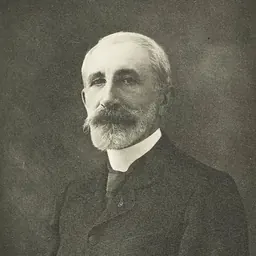
Robert Gregg Bury
Irish clergyman and classical philologist
About Robert Gregg Bury
Lived 1869 – 1951 (aged 81). Robert Gregg Bury was a British and Irish classical philologist, anglican priest, hellenist, university teacher, translator and christian minister.
Robert Gregg Bury (; 22 March 1869 – 11 February 1951) was an Irish Anglican clergyman, classicist, philologist, and a translator of the works of Plato and Sextus Empiricus into English.
Early life and education Born in Clontibret, County Monaghan, Ireland, Bury was the son of Edward John Bury, the canon of Clogher, and the brother of John Bagnell Bury, an Irish historian, classical scholar, Medieval Roman historian and philologist. It was pleasantly claimed by neighbors that the only language spoken in the Clontibret presbytery was Greek.
He studied classics under Professor Henry Jackson at Trinity College, Cambridge, winning the Browne Medal Scholar in 1889 and graduating with first-class honours in classics in 1890. He graduated as M.A. in 1893 and received a Litt.D. in 1910.
Academic career
In 1893–94 he was Bishop Berkeley Fellow in Ancient Philosophy at Owens College in Manchester and in 1895 he was appointed lecturer in Greek and Latin Literature at Bryn Mawr College, Pennsylvania, United States. He worked as Examiner in Classical Tripos at Cambridge University in the years 1899–1900 and 1905-6. For several decades he was a curate successively at Staplehurst, Kent (1895–98), in the parish of St Andrew Holborn (1897–99), at Clontibret, County Monaghan (1899–1900), and at Templecarn, County Donegal (1900–01); then a vicar at Trumpington, Cambridgeshire (1903–18); and finally a rector at East Gilling, Yorkshire (1918–24), and at Dickleburgh and Langmere, Norfolk (1924–28). new editions (with introductions, critical commentaries and notes) for the Cambridge University Press of Plato's Socratic dialogues Philebus and Symposium. Then he composed English translations (again accompanied by commentaries and notes) of Plato's Timaeus, Critias, Cleitophon, Menexenus, Epistles and Laws and of the works of Sextus Empiricus for the bilingual Loeb Classical Library. In late life he turned his mind to other areas of religion and philosophy, penning a study of the logos doctrine in the Gospel of John and study in the history of philosophy with the title of The Devil's Puzzle. A Survey of Men's Notions of Man.
Critics have remarked on the extensive nature of the introductions, commentaries, notes and appendices to be found in Bury's books (for example, the introduction of 75 pages in his Philebus and the 53 pages of notes out of a total of 80 pages in his The Fourth Gospel and the Logos-Doctrine).
Professor Robert B. Todd remarked that "ew British scholars have served Greek philosophical studies as well without holding a formal academic position".
Personal life In 1894 Bury married Eloise Ives Lanyon (1863–1934). They had one son, John Patrick Tuer Bury (1908–87), who became a fellow and university lecturer in modern history at Corpus Christi College, Cambridge University.
Gregg Bury Prize The Gregg Bury Prize has been established at the University of Cambridge and is "awarded for a distinguished dissertation on the subject of the Philosophy of Religion". Past recipients have included Malcolm Jeeves, Ian Hacking, Neema Sofaer and K. M. A. (Karim) Esmail.
Select bibliography Books: As editor and commentator The Philebus of Plato. Edited with Introduction, Notes and Appendices. Cambridge University Press, 1897, online. The Symposium of Plato. Edited with Introduction, Critical Notes and Commentary. Cambridge, W. Heffer and Sons, 1909, online.
Books: As translator, editor and commentator Plato in Twelve Volumes: IX. Timaeus. Critias. Cleitophon. Menexenus. Epistles. With an English Translation. Cambridge, Massachusetts, Harvard University Press, 1929 (Loeb Classical Library, 234), online Plato, with an English Translation: Volume IX: Laws. In Two Volumes. I. Cambridge, Massachusetts, Harvard University Press, London, William Heinemann, 1926 (Loeb Classical Library, 187), online. Plato, with an English Translation: Volume IX: Laws. In Two Volumes. II. London, William Heinemann, New York, G. P. Putnam’s Sons, 1926 (Loeb Classical Library, 192), online. Sextus Empiricus. With an English Translation by the Rev. R. G. Bury, Litt.D. In Four Volumes. Vol. I: Outlines of Pyrrhonism. Cambridge, Massachusetts, Harvard University Press, London, William Heinemann, 1933 (Loeb Classical Library, 273), online Vol. II: Against the Logicians. Cambridge, Massachusetts, Harvard University Press, London, William Heinemann, 1935 (Loeb Classical Library, 291), online Vol. III: Against the Physicists. Against the ethicists. Cambridge, Massachusetts, Harvard University Press, London, William Heinemann, 1936 (Loeb Classical Library, 311) Vol. IV: Against the Professors. Cambridge, Massachusetts, Harvard University Press, London, William Heinemann, 1949 (Loeb Classical Library, 382)
Books: As critic The Fourth Gospel and the Logos-Doctrine. Cambridge, W. Heffer & Sons, 1940. The Devil's Puzzle: A Survey of Men's Notions of Man. Dublin, At the Sign of the Three Candles Press, 1949. Introduction by Shane Leslie.
Articles "The Later Platonism", in: Journal of Philology, vol. 23 (1895), pp. 161–201. Review of R. K. Gaye, The Platonic Conception of Immortality, in: The Classical Review, vol. 19 (1905), pp. 160–62. "Theory of education in Plato's « Laws »", in: Revue des Études greques, Volume 50 (1937), Numéro 236, pp. 304–320.
Don’t just read it —
keep it.
Full-length biographies made to live with: read them, listen on the way to work, watch them tonight.
- E-book
- Audio
- Video
Instant download · yours to keep · every purchase keeps this site free
Important facts
People in Robert Gregg Bury's life
Named in this biography and alive at the same time





Related people
Same field, nearest in time


Contemporaries
People whose lives overlapped Robert Gregg Bury's





Frequently asked questions
Who was Robert Gregg Bury?
Irish clergyman and classical philologist (1869–1951)
When was Robert Gregg Bury born?
Robert Gregg Bury was born on 22 March 1869 in Clontibret.
When did Robert Gregg Bury die?
Robert Gregg Bury died on 11 February 1951 in Cambridge.
What was Robert Gregg Bury's occupation?
Robert Gregg Bury was a classical philologist, anglican priest, hellenist, university teacher, translator and christian minister.
What nationality was Robert Gregg Bury?
Robert Gregg Bury was British and Irish.
Sources & further reading
· Wikipedia: Robert Gregg Bury
Cite this page
APA: Biography.guide. (2026). Robert Gregg Bury. https://biography.guide/robert-gregg-bury/
MLA: "Robert Gregg Bury." Biography.guide, https://biography.guide/robert-gregg-bury/.
Chicago: "Robert Gregg Bury." Biography.guide. https://biography.guide/robert-gregg-bury/.
Data last updated: 2026-09-20 · Spot an error? Report a correction.
Page generated 2026-09-27 04:57 UTC