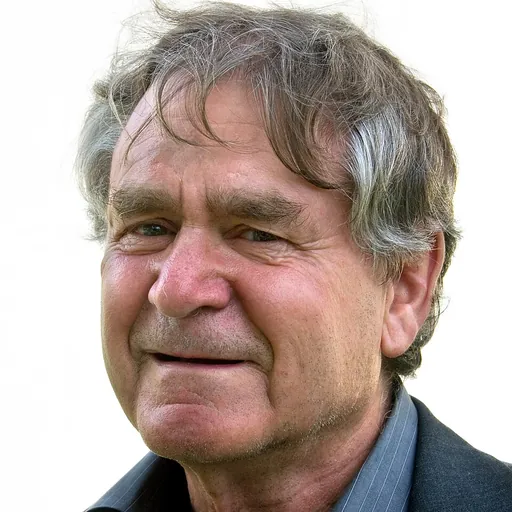
About Ian Hacking
Lived 1936 – 2023 (aged 87). Ian Hacking was a Canadian philosopher, professor and historian.
Ian MacDougall Hacking (February 18, 1936 – May 10, 2023) was a Canadian philosopher specializing in the philosophy of science. Throughout his career, he won numerous awards, such as the Killam Prize for the Humanities and the Balzan Prize, and was a member of many prestigious groups, including the Order of Canada, the Royal Society of Canada and the British Academy.
Life and career Born in Vancouver, British Columbia, he earned undergraduate degrees from the University of British Columbia (1956) and the University of Cambridge (1958), where he was a student at Trinity College. Hacking also earned his PhD at Cambridge (1962) under the direction of Casimir Lewy, a former student of G. E. Moore.
Hacking started his teaching career as an instructor at Princeton University in 1960 but, after just one year, moved to the University of Virginia as an assistant professor. After working as a research fellow at Peterhouse, Cambridge, from 1962 to 1964, he taught at his alma mater, UBC, first as an assistant professor and later as an associate professor from 1964 to 1969. He became a lecturer at Cambridge, again a member of Peterhouse, in 1969 before moving to Stanford University in 1974. After teaching for several years at Stanford, he spent a year at the Center for Interdisciplinary Research in Bielefeld, Germany, from 1982 to 1983. Hacking was promoted to Professor of Philosophy at the University of Toronto in 1983 and University Professor, the highest honour the University of Toronto bestows on faculty, in 1991. After retiring from the Collège de France, Hacking was a professor of philosophy at UC Santa Cruz, from 2008 to 2010. He concluded his teaching career in 2011 as a visiting professor at the University of Cape Town.
Hacking was married three times: his first two marriages, to Laura Anne Leach and fellow philosopher Nancy Cartwright, ended in divorce. His third marriage, to Judith Baker, also a philosopher, lasted until her death in 2014. He had two daughters and a son, as well as one stepson.
Philosophical work Influenced by debates involving Thomas Kuhn, Imre Lakatos, Paul Feyerabend and others, Hacking is known for bringing a historical approach to the philosophy of science. The fourth edition (2010) of Feyerabend's 1975 book Against Method, and the 50th anniversary edition (2012) of Kuhn's The Structure of Scientific Revolutions include an Introduction by Hacking. He is sometimes described as a member of the "Stanford School" in philosophy of science, a group that also includes John Dupré, Nancy Cartwright and Peter Galison. Hacking himself identified as a Cambridge analytic philosopher. Hacking was a main proponent of a realism about science called "entity realism." This form of realism encourages a realistic stance towards answers to the scientific unknowns hypothesized by mature sciences (of the future), but skepticism towards current scientific theories. Hacking has also been influential in directing attention to the experimental and even engineering practices of science, and their relative autonomy from theory. Because of this, Hacking moved philosophical thinking a step further than the initial historical, but heavily theory-focused, turn of Kuhn and others.
After 1990, Hacking shifted his focus somewhat from the natural sciences to the human sciences, partly under the influence of the work of Michel Foucault. Foucault was an influence as early as 1975 when Hacking wrote Why Does Language Matter to Philosophy? and The Emergence of Probability. In the latter book, Hacking proposed that the modern schism between subjective or personalistic probability, and the long-run frequency interpretation, emerged in the early modern era as an epistemological "break" involving two incompatible models of uncertainty and chance. As history, the idea of a sharp break has been criticized, but competing 'frequentist' and 'subjective' interpretations of probability still remain today. Foucault's approach to knowledge systems and power is also reflected in Hacking's work on the historical mutability of psychiatric disorders and institutional roles for statistical reasoning in the 19th century, his focus in The Taming of Chance (1990) and other writings. He labels his approach to the human sciences transcendental nominalism (also dynamic nominalism or dialectical realism ),
In Mad Travelers (1998) Hacking provided a historical account of the effects of a medical condition known as fugue in the late 1890s. Fugue, also known as "mad travel," is a diagnosable type of insanity in which European men would walk in a trance for hundreds of miles without knowledge of their identities.
Hacking used the work of historian of science A. C. Crombie to develop his own "style" project. In 2012 he wrote "I have been thinking about 'styles of scientific thinking in the European tradition' off and on, ever since I encountered A. C. Crombie at a conference in Pisa in 1978." Parts of this project appeared in his book Historical Ontology (2002).
Awards and lectures In 2002, Hacking was awarded the first Killam Prize for the Humanities, Canada's most distinguished award for outstanding career achievements. He was made a Companion of the Order of Canada (CC) in 2004. Hacking was appointed visiting professor at University of California, Santa Cruz for the Winters of 2008 and 2009. On August 25, 2009, Hacking was named winner of the Holberg International Memorial Prize, a Norwegian award for scholarly work in the arts and humanities, social sciences, law and theology.
In 2003, he gave the Sigmund H. Danziger Jr. Memorial Lecture in the Humanities, and in 2010 he gave the René Descartes Lectures at the Tilburg Center for Logic and Philosophy of Science (TiLPS). Hacking also gave the Howison lectures at the University of California, Berkeley, on the topic of mathematics and its sources in human behavior ('Proof, Truth, Hands and Mind') in 2010. In 2012, Hacking was awarded the Austrian Decoration for Science and Art, and in 2014 he was awarded the Balzan Prize.
Selected works Books Hacking's works have been translated into several languages. His works include: Logic of Statistical Inference (1965) A Concise Introduction to Logic (1972) The Emergence of Probability (1975) Why Does Language Matter to Philosophy? (1975) Scientific Revolutions (1981) Representing and Intervening, Introductory Topics in the Philosophy of Natural Science, Cambridge University Press, Cambridge, UK, 1983. The Taming of Chance (1990) Rewriting the Soul: Multiple Personality and the Sciences of Memory (1995) Mad Travelers: Reflections on the Reality of Transient Mental Illnesses (1998) The Social Construction of What? (1999) An Introduction to Probability and Inductive Logic (2001) Historical Ontology (2002) Why Is There Philosophy of Mathematics at All? (2014)
Chapters in books
Articles
1979: "What is Logic?", Journal of Philosophy 76(6), reprinted in A Philosophical Companion to First Order Logic (1993), edited by R.I.G. Hughes
2007: "Root and Branch: A Canadian philosopher surveys some of the livelier flashpoints in America's battle over evolution". , The Nation
Don’t just read it —
keep it.
Full-length biographies made to live with: read them, listen on the way to work, watch them tonight.
- E-book
- Audio
- Video
Instant download · yours to keep · every purchase keeps this site free
Important facts
People in Ian Hacking's life
Named in this biography and alive at the same time





Related people
Same field, nearest in time



Contemporaries
People whose lives overlapped Ian Hacking's





Frequently asked questions
Who was Ian Hacking?
Canadian philosopher (1936–2023)
When was Ian Hacking born?
Ian Hacking was born on 18 February 1936 in Vancouver.
When did Ian Hacking die?
Ian Hacking died on 10 May 2023 in Toronto.
What was Ian Hacking's occupation?
Ian Hacking was a philosopher, professor and historian.
What nationality was Ian Hacking?
Ian Hacking was Canadian.
Sources & further reading
Cite this page
APA: Biography.guide. (2026). Ian Hacking. https://biography.guide/ian-hacking/
MLA: "Ian Hacking." Biography.guide, https://biography.guide/ian-hacking/.
Chicago: "Ian Hacking." Biography.guide. https://biography.guide/ian-hacking/.
Data last updated: 2026-09-22 · Spot an error? Report a correction.
Portrait: Wikimedia Commons · author & licence
Page generated 2026-09-27 05:04 UTC