
About Robert Bloomfield
Lived 1766 – 1823 (aged 56). Robert Bloomfield was a British poet and writer.
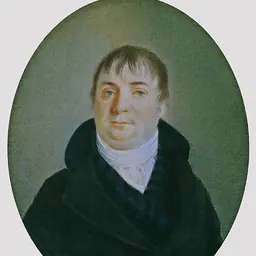
Robert Bloomfield (3 December 1766 – 19 August 1823) was an English labouring-class poet, whose work is appreciated in the context of other self-educated writers, such as Stephen Duck, Mary Collier and John Clare.
Life Robert Bloomfield was born into a poor family in the village of Honington, Suffolk. His father was a tailor, who died of smallpox when his son was a year old. He had his first poem, "The Village Girl", published in 1786. The poem was particularly admired by the Suffolk-born painter John Constable, who used couplets from it as tags for two of his paintings: "A Ploughing Scene" (shown at the Royal Academy in 1814) and "A Harvest Field, Reapers, Gleaners" (shown at the British Institution in 1817), which he marked as derived from "Bloomfield's poem". It was also admired by Robert Southey, a Romantic poet and future poet laureate. Other publications by Bloomfield included Good Tidings (in praise of inoculation at the instigation of Edward Jenner, 1804); Wild Flowers or Pastoral and Local Poetry (1806); and The Banks of the Wye (a poetic journal of a walking tour taken in the footsteps of Wordsworth, 1811).
Unfortunately Vernor and Hood, his publishers, failed, and in 1812 Bloomfield had to move from London into a cottage rented to him by a friend in the Bedfordshire village of Shefford. There one of his daughters died in 1814 and his wife became insane. To support himself, he tried to carry on a business as a bookseller but it failed, and in his later years he was reduced to making Aeolian harps, which he sold among his friends. With failing eyesight and his own reason threatened by depression, he died in great poverty on 19 August 1823. Both wrote much in couplets of iambic pentameters, and both provide descriptions of rural life at its hardest and least inviting. Bloomfield, however, is more cheerful in tone and his verse is denser and more vigorous. Here, for instance, is the episode in "The Farmer's Boy" where Giles chops up turnips to feed to the livestock in winter: On GILES, and such as Giles, the labour falls, To strew the frequent load where hunger calls. On driving gales sharp hail indignant flies, And sleet, more irksome still, assails his eyes; Snow clogs his feet; or if no snow is seen, The field with all its juicy store to screen, Deep goes the frost, till every root is found A rolling mass of ice upon the ground. No tender ewe can break her nightly fast, Nor heifer strong begin the cold repast, Till Giles with pond'rous beetle foremost go, And scatt'ring splinters fly at every blow; When pressing round him, eager for the prize, From their mixt breath warm exhalations rise.
However, such verse varies little from the work of many of Bloomfield's contemporaries, such as James Montgomery and Ebenezer Elliot, whose names, like his, were well known in their time but are scarcely remembered now. Besides such formal productions, he told many light-hearted stories in octosyllabics, some of which are incidentally interesting for their employment of Suffolk dialect words, particularly in "The Horkey". His work served as an inspiration to John Clare, who began publishing his own rural poetry in 1820 and praised Bloomfield's highly.
Robert's brother, Nathaniel, also published a collection of poetry in 1803, An Essay on War, in Blank Verse, and Other Poems. Byron commented on the brothers in English Bards and Scotch Reviewers (lines 775–786), linking Robert's name favourably with other poets of humble beginnings such as Burns and Gifford, but dismissing Nathaniel's writing as routine and uninspired. Byron returned to the charge in Hints from Horace with the apostrophe: Hark to those lines, narcotically soft, The cobbler-laureats sing to Capel Lofft! (lines 733–734) Although a note makes it clear that Nathaniel is his principal target, he also seems to include his "brother Bobby" in the accusation that Lofft "has spoiled some excellent shoemakers and been accessory to the poetic undoing of many of the industrious poor."
Later reputation The Robert Bloomfield Masonic lodge No 8328 was founded in 1971 at Biggleswade Masonic Centre, where it continues to meet. Shefford's secondary school, later a middle school (for pupils aged 9–13), was named after the poet. In 2000 the Robert Bloomfield Society was founded to promote awareness of his life and work and has encouraged scholarly publications relating to him. A revised and enlarged selection of his poems was published by Trent Editions in 2007. Recent studies see his poetry in its social as well as its literary context.
Don’t just read it —
keep it.
Full-length biographies made to live with: read them, listen on the way to work, watch them tonight.
- E-book
- Audio
- Video
Instant download · yours to keep · every purchase keeps this site free
Important facts
People in Robert Bloomfield's life
Named in this biography and alive at the same time

Related people
Same field, nearest in time


Contemporaries
People whose lives overlapped Robert Bloomfield's




Frequently asked questions
Who was Robert Bloomfield?
Shoemaker, poet and maker of aeolian harps
When was Robert Bloomfield born?
Robert Bloomfield was born on 3 December 1766 in Honington.
When did Robert Bloomfield die?
Robert Bloomfield died on 19 August 1823 in Shefford.
What was Robert Bloomfield's occupation?
Robert Bloomfield was a poet and writer.
What nationality was Robert Bloomfield?
Robert Bloomfield was British.
Sources & further reading
· Wikipedia: Robert Bloomfield
Cite this page
APA: Biography.guide. (2026). Robert Bloomfield. https://biography.guide/robert-bloomfield/
MLA: "Robert Bloomfield." Biography.guide, https://biography.guide/robert-bloomfield/.
Chicago: "Robert Bloomfield." Biography.guide. https://biography.guide/robert-bloomfield/.
Data last updated: 2026-09-26 · Spot an error? Report a correction.
Page generated 2026-09-27 05:14 UTC