
About Robert B. Anderson
Lived 1910 – 1989 (aged 79). Robert B. Anderson was an American politician, lawyer, businessperson, jurist and finance minister.
Early life Anderson was born in Burleson, Texas on June 4, 1910, to Robert Lee Anderson and his wife Elizabeth Haskew "Lizzy" Anderson. He was a high school teacher prior to entering the University of Texas Law School, from which he graduated in 1932. He thereafter engaged in political, governmental, law and business activities in the state of Texas.
State government service
Upon leaving the University of Texas School of Law in 1932, Anderson soon became an Assistant Attorney General for the State of Texas where he worked in 1933–1934. By 1934, he moved onward to become a State of Texas Tax Commissioner.
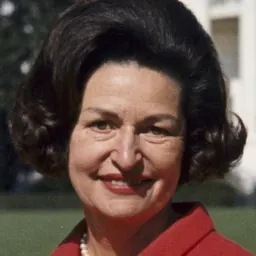
By 1939–1940, Anderson pursued opportunities within the private sector; he and two other partners purchased the City of Austin-based KTBC radio station from the Texas Broadcasting Company. In 1943, not able to increase KTBC's broadcasting power from the Federal Communications Commission (FCC), the three partners sold KTBC to Lady Bird Johnson, wife of then-Representative and future President Lyndon B. Johnson.
Marriage and children Anderson married Ollie Mae Rawlins on April 10, 1935. The couple had two sons, Gerald Lee and James Richard. The Anderson family later moved to Cleburne, Texas. Ollie Anderson died in Greenwich, Connecticut of Alzheimer's disease on May 31, 1987.
Federal government service According to the Seagraves, Anderson was with Douglas MacArthur and Edward Lansdale inspecting the Philippine caves containing Yamashita's gold immediately after World War II ended.
During his time as Navy Secretary, he ended the last formal vestiges of racial segregation in the Navy and advocated the force levels and technological advances necessary to maintain a flexible defense strategy. In May 1954, Anderson left his Navy post to become Deputy Secretary of Defense. He received the Medal of Freedom in 1955. From 1957 to 1961, he served as Eisenhower's Secretary of the Treasury.
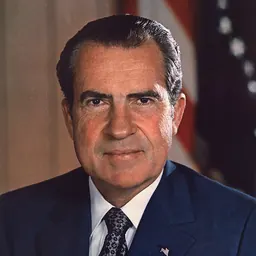
Eisenhower was particularly impressed by Anderson's abilities, believing him to be more than capable of being president himself, and named him as one of his leading choices to be his running mate in 1956 if Vice-President Richard Nixon had accepted Eisenhower's recommendation to leave the vice-presidency to serve as Secretary of Defense. However, Nixon opted to remain on the ticket with Ike. As 1960 approached, although Eisenhower acknowledged that Nixon certainly had the Republican presidential nomination sewn up, Eisenhower privately pressed Anderson to enter the primaries and to challenge Nixon, but Anderson declined. Once Nixon was nominated, Eisenhower suggested that he select Anderson as his running mate, but Nixon chose Henry Cabot Lodge Jr. instead. Eisenhower said Anderson "is just about the ablest man that I know, He would make a splendid President."
In 1959, as Secretary of the Treasury, Anderson supported the creation of the International Development Association, after pressure from then-Senator Mike Monroney (D-Oklahoma). Anderson was close to Sid Richardson and Clint Murchison who was very close to FBI Director J. Edgar Hoover. Many Texas oilmen including Murchison, formerly a close associate of Lyndon B. Johnson, ended their relationships with Johnson when Johnson became vice president on John F. Kennedy's 1960 presidential ticket because Kennedy advocated tax reform on oil companies and their investments.
In 1963, President Kennedy appointed Anderson to a special committee to study the United States foreign aid program.
Private business and death After leaving office in 1961, Anderson moved to New York City and was active in business, investment, banking affairs, oil, and real estate.
He was unsuccessful in establishing a free port in Malta.
He was a lobbyist for the Rev. Sun Myung Moon's Unification Church during the 1980s.
Anderson's career ended in personal suffering. He was hospitalized several times for alcoholism. From 1983 to 1985, he and his partner David B. Gould illegally operated the Commercial Exchange Bank and Trust of Anguilla, British West Indies, which had an unlicensed New York branch office. The bank lost $4.4 million and several investors lost their life savings in the mid-1980s, including record producer Ethel Gabriel. The bank also laundered large amounts of cash for drug traffickers. In 1987, Anderson, who was charged by Rudolph Giuliani as the United States Attorney for the Southern District of New York, pleaded guilty to criminal violations of the banking laws and to tax evasion, and was sentenced to prison. The Supreme Court of New York Appellate Division, in disbarring Anderson from the practice of law, called his disbarment "a sad but we think necessary end to the legal career of one who has in times less beclouded by poor and corrupt judgment served his country in high office as Secretary of Treasury, Deputy Secretary of the Navy and as Special Ambassador to Panama during the Panama Canal negotiations."
Anderson died of throat cancer following his cancer surgery in New York City on August 14, 1989. He was buried in Rose Hill Cemetery in Cleburne, Texas.
The Robert B. Anderson Papers 1933–89 were deposited at the Eisenhower Library at Abilene, Kansas, between 1992 and 1996 with more in July 2001 and gifted to the Eisenhower Library on December 26, 2001, by Gerald Anderson, son of Robert Anderson.
Don’t just read it —
keep it.
Full-length biographies made to live with: read them, listen on the way to work, watch them tonight.
- E-book
- Audio
- Video
Instant download · yours to keep · every purchase keeps this site free
Important facts
People in Robert B. Anderson's life
Named in this biography and alive at the same time





Related people
Same field, nearest in time





Contemporaries
People whose lives overlapped Robert B. Anderson's





Frequently asked questions
Who was Robert B. Anderson?
American politician (1910–1989)
When was Robert B. Anderson born?
Robert B. Anderson was born on 4 June 1910 in Burleson.
When did Robert B. Anderson die?
Robert B. Anderson died on 14 August 1989 in New York City.
What was Robert B. Anderson's occupation?
Robert B. Anderson was a politician, lawyer, businessperson, jurist and finance minister.
What nationality was Robert B. Anderson?
Robert B. Anderson was American.
Sources & further reading
· Wikipedia: Robert B. Anderson
Cite this page
APA: Biography.guide. (2026). Robert B. Anderson. https://biography.guide/robert-b-anderson/
MLA: "Robert B. Anderson." Biography.guide, https://biography.guide/robert-b-anderson/.
Chicago: "Robert B. Anderson." Biography.guide. https://biography.guide/robert-b-anderson/.
Data last updated: 2026-09-24 · Spot an error? Report a correction.
Page generated 2026-09-27 05:06 UTC