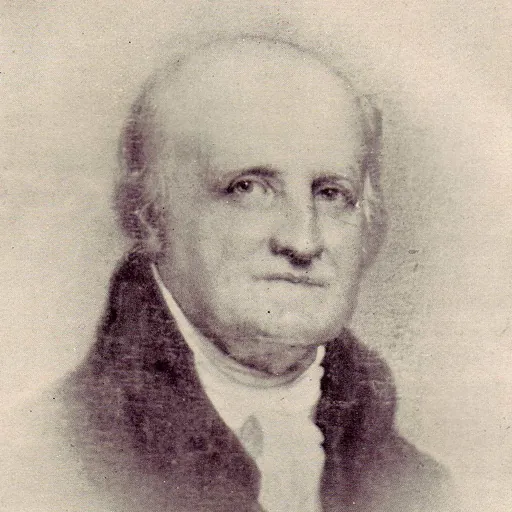
About Richard Peters
Lived 1744 – 1828 (aged 84). Richard Peters was an American lawyer, judge and politician.
Richard Peters (June 22, 1744 – August 22, 1828) was a Pennsylvania lawyer, Continental Army soldier, Federalist politician, author and United States District Judge. Before his federal judicial service in the United States District Court for the District of Pennsylvania, Peters served as secretary of the Continental Board of War, delegate to the Congress of the Confederation and as member and speaker of the Pennsylvania House of Representatives and later the Pennsylvania State Senate. His son of the same name, Richard Peters became reporter of the decisions of the United States Supreme Court.
Early life and education
Born on June 22, 1744, at Belmont Mansion (then in the outskirts but now in Philadelphia, Province of Pennsylvania, British America). His father William Peters, had emigrated from Liverpool, England with his brother Rev. Richard Peters. His uncle had become involved in a family scandal, which caused their emigration. Both brothers had been trained as attorneys in England. The elder Richard became the secretary to William Penn as well as an assistant (later rector) at Christ Church, Philadelphia, held various positions with the Penn family, and beginning in 1749 became a member of the colony's Governor's Council (where he served until dying of natural causes early in the American Revolutionary War). William Peters was register of admiralty and judge of the courts of common pleas, quarter sessions and the orphan's court. From about 1762 until the war, all three Peters men lived at Belmont, and the first Judge Peters died in 1786. Meanwhile, young Peters (sometimes called Jr. to distinguish him from his uncle) graduated from the College of Philadelphia (now the University of Pennsylvania) in 1761, then read law in 1763.
Career Peters had a private legal practice in Philadelphia from 1763 to 1771. In 1780, he was one of several prominent citizens who personally subscribed 5,000 pounds to the Pennsylvania bank to provision troops. Peters was then elected to the Pennsylvania State Senate, and he succeeded General Thomas Mifflin as its speaker from 1791 to 1792. Following the Judiciary Act of 1802, Washington was assigned to the Third Circuit, and sat on many occasions on a panel with Judge Peters. When Congress created separate judicial districts in Pennsylvania, Peters was reassigned by operation of law to the United States District Court for the Eastern District of Pennsylvania on April 20, 1818, the new seat authorized by . and United States v. Peters.
The Ganges Incident: In 1800,The U.S. Navy sloop Ganges captured two illegal American slave vessels off Cuba and brought them to Philadelphia. 135 African men, women, and children were freed from the ships and cared for at the Lazaretto quarantine station. The owners of the ships took the government to court to return their property. Judge Richard Peters was assigned the case and ruled that the captives were people rather than property and granted them their freedom.
The freed individuals were given the surname "Ganges" and placed under the care of the Pennsylvania Abolition Society via indentures that notably guaranteed them an education and skills training."
Peters' grandson Richard Peters migrated to the South, where he became a founder of Atlanta, Georgia. That Richard's son, Edward C. Peters, bought and then sold off for development the land that is now the southern half of Midtown Atlanta.
Don’t just read it —
keep it.
Full-length biographies made to live with: read them, listen on the way to work, watch them tonight.
- E-book
- Audio
- Video
Instant download · yours to keep · every purchase keeps this site free
Important facts
Family & relationships
People in Richard Peters's life
Named in this biography and alive at the same time
Related people
Same field, nearest in time


Contemporaries
People whose lives overlapped Richard Peters's





Frequently asked questions
Who was Richard Peters?
United States federal judge 1744-1828
When was Richard Peters born?
Richard Peters was born on 22 June 1744 in Belmont Mansion.
When did Richard Peters die?
Richard Peters died on 22 August 1828 in Pennsylvania, Philadelphia.
What was Richard Peters's occupation?
Richard Peters was a lawyer, judge and politician.
What nationality was Richard Peters?
Richard Peters was American.
Sources & further reading
· DBpedia: Richard Peters (Continental Congress)
Cite this page
APA: Biography.guide. (2026). Richard Peters. https://biography.guide/richard-peters-lawyer/
MLA: "Richard Peters." Biography.guide, https://biography.guide/richard-peters-lawyer/.
Chicago: "Richard Peters." Biography.guide. https://biography.guide/richard-peters-lawyer/.
Data last updated: 2026-09-21 · Spot an error? Report a correction.
Portrait: Wikimedia Commons · author & licence
Page generated 2026-09-27 04:58 UTC