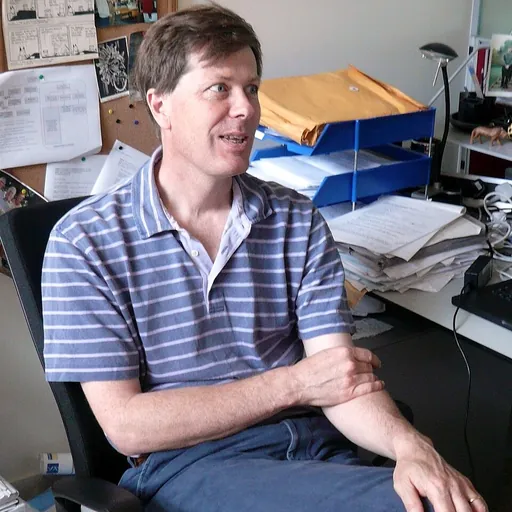
Richard M. Durbin
British computational biologist
About Richard M. Durbin
Born 1960. Richard M. Durbin is a British computational biologist, bioinformatician, university teacher and scientist.
Education Durbin was educated at The Hall School, Hampstead and Highgate School in London. he went on to study at the University of Cambridge graduating in 1982 with a second class honours degree in the Cambridge Mathematical Tripos. After graduating, he continued to study for a PhD at St John's College, Cambridge and the MRC Biorad confocal microscope, alongside contributions to neural modelling.
He then led the informatics for the Caenorhabditis elegans genome project, and alongside Jean Thierry-Mieg developed the genome database AceDB, which evolved into the WormBase web resource. Following this he played an important role in data collection for and interpretation of the human genome sequence.
He has developed numerous methods for computational sequence analysis. These include gene finding (e.g. GeneWise) with Ewan Birney and Hidden Markov models for protein and nucleic acid alignment and matching (e.g. HMMER) with Sean Eddy and Graeme Mitchison. A standard textbook Biological Sequence analysis coauthored with Sean Eddy, Anders Krogh and Graeme Mitchison describes some of this work. Using these methods Durbin worked with colleagues to build a series of important genomic data resources, including the protein family database Pfam, the genome database Ensembl, and the gene family database TreeFam.
More recently Durbin has returned to sequencing and has developed low coverage approaches to population genome sequencing, applied first to yeast, and has been one of the leaders in the application of new sequencing technology to study human genome variation. Durbin currently co-leads the international 1000 Genomes Project to characterise variation down to 1% allele frequency as a foundation for human genetics.
Awards and honours Durbin was a joint winner of the Mullard Award of the Royal Society in 1994 (for work on the confocal microscope), won the Lord Lloyd of Kilgerran Award of the Foundation for Science and Technology in 2004, and was elected a Fellow of the Royal Society (FRS) in 2004 and a member of the European Molecular Biology Organization (EMBO) in 2009. The Royal Society awarded its Gabor Medal to Durbin in 2017 for his contributions to computational biology. In 2023 he received the International Prize for Biology for his work on the Biology of Genomes.
Durbin's certificate of election for the Royal Society reads:
Personal life Durbin is the son of James Durbin and is married to Julie Ahringer, a scientist at the Gurdon Institute. They have two children.
Don’t just read it —
keep it.
Full-length biographies made to live with: read them, listen on the way to work, watch them tonight.
- E-book
- Audio
- Video
Instant download · yours to keep · every purchase keeps this site free
Important facts
Family & relationships
People in Richard M. Durbin's life
Named in this biography and alive at the same time







Related people
Same field, nearest in time



Contemporaries
People whose lives overlapped Richard M. Durbin's


Frequently asked questions
Who is Richard M. Durbin?
British computational biologist
When was Richard M. Durbin born?
Richard M. Durbin was born on 30 December 1960.
What is Richard M. Durbin's occupation?
Richard M. Durbin is a computational biologist, bioinformatician, university teacher and scientist.
What nationality is Richard M. Durbin?
Richard M. Durbin is British.
Sources & further reading
· Wikipedia: Richard M. Durbin
Cite this page
APA: Biography.guide. (2026). Richard M. Durbin. https://biography.guide/richard-m-durbin/
MLA: "Richard M. Durbin." Biography.guide, https://biography.guide/richard-m-durbin/.
Chicago: "Richard M. Durbin." Biography.guide. https://biography.guide/richard-m-durbin/.
Data last updated: 2026-09-22 · Spot an error? Report a correction.
Portrait: Wikimedia Commons · author & licence
Page generated 2026-09-27 05:04 UTC