
About Richard Byron
Lived 1769 – 1837 (aged 67–68). Richard Byron was a naval officer.
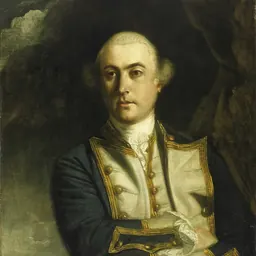
Rear-Admiral Richard Byron (1769–1837) was an officer in the British Royal Navy. He served in the American Revolutionary War where he saw action at the Battle of the Saintes, the French Revolutionary Wars where he fought at the Glorious First of June and the Battle of Groix, and the Napoleonic Wars where he served in North-American waters. Byron was in command of HMS Belvidera when she was attacked by a squadron of heavy frigates in one of the first actions of the 1812 Anglo-American War.
Personal life Richard Byron was born in 1769 to the Honourable Richard Byron, rector of Haughton, and Mary, née Farmer. He was the nephew of Admiral John Byron.
Early career
In October 1781 he was listed as a volunteer aboard his cousin's ship, HMS Proserpine and when his cousin, George Byron, was given command of the newly built, HMS Andromache in January 1782, the young Richard went with him as an Able seaman. Andromache sailed for the West Indies, arriving in the Dominica Channel on 9 April 1782 and was thus present at the Battle of the Saintes. Returning to home waters, Andromache joined Lord Howe's fleet in The Channel and later participated in the relief of Gibraltar. The battle was the last of three engagements between these fleets, that occurred over five days.
Howe's initial plan was for his 25 ships to independently turn and cut the enemy line of 26 ships, so that each British ship passed between the stern and bow of a different pair of French ships, raking both. Once through the line, the British ships would turn and engage their opposite number on the leeward side thus preventing any possibility of an escape. Only a few captains followed Howe's orders however, either because they had misunderstood or had willfully chosen to disobey, or they had been prevented from doing so by damage incurred in the previous actions. Despite this the British were able to capture seven ships, although one almost immediately sank, while the rest of the French fleet was so badly damaged it was forced to retire.
The British suffered 290 killed and 858 wounded during this and the encounters which took place on 28 and 29 May. French accounts give their losses as 3,000 killed or wounded; however as the dead and wounded on board the six captured ships amounted to 690 and 580 respectively, plus the 300 or so estimated to have gone down with the seventh, British estimates are much higher some claiming 7,000.
Impregnable was eighth in line and one of those that did not engage as Howe intended. She had seven of her crew members killed and 24 wounded. After the battle, Byron served aboard the 100-gun, HMS Queen Charlotte and in her took part in another large engagement off the island of Groix a year later. Although both fleets were affected by periods of calm, by 19:00 the leading British ships were in a position to open fire. The chase continued through the night and at 03:00 the following morning the wind began to pick up. By dawn, Queen Charlotte, which had forged ahead through superior sailing, was alongside Irresistible with the rest of the British fleet spread out behind. The French fleet by contrast had remained together, except three or four ships astern, the closest of which was some three miles ahead. The Queen Charlotte's sails and rigging had become so badly damaged that by 07:14, she was beginning to drift out of the action. She continued to fight however, firing into what ships she could and forcing the surrender of the Alexandre before leaving the battle completely.
Command In September 1797, Byron joined HMS Doris then the following month he joined La Virginie, as flag-lieutenant to Hugh Christian, and in her sailed to the Cape of Good Hope.
Anglo-American war On 23 June 1812 Belvidera was 35 miles south-west of the Nantucket Shoals where she was waiting to ambush the French privateer Marengo. There an American squadron spotted Belvidera. The United States had declared war on Britain four days previously but word had not yet reached Byron, who nevertheless prudently moved away. The heavy frigates President and United-States, together with the 18-pounder 36-gun frigate Congress, the 20-gun ship-sloop Hornet and the 18-gun brig-sloop Argus, gave chase.
After ten hours in pursuit, the leading American ship, President, had closed to 600 yards and began firing. One of Belvidera's guns was hit and the resulting explosion killed two seaman and wounded three others. Belvidera returned fire and a running battle ensued.
When President renewed her attack she did so by bringing her starboard guns to bear, which caused considerable damage to Belvideras sails and rigging. While repairs were carried out, Byron personally supervised the chase guns, despite having sustained a wound to his leg. By 17:00, President had closed the gap to 400 yards and again put her helm over in order to give Belvidera a second broadside. President continued alternating between her chase and maindeck guns and only once did Belvidera yaw in an attempt to use hers, but President matched the manoeuvre and Belvidera was forced to turn back without firing. Having by this time repaired much of the damage that had been done, Byron ordered the studding sails out and set course for Halifax. The American squadron gave up the chase and returned to their original mission, searching for the Jamaican merchant fleet, not realising that Belvidera had, over the last 15 hours, led them further away from it.
Belvidera arrived in Halifax on 27 June with a number of American prizes she had managed to capture en route. On hearing of the altercation, Admiral Sawyer despatched the sloop to New York to demand an explanation. Once confirmation was received, the schooner sailed to England with news of the war, arriving on 25 July.
Constitution
On 14 July 1812, Byron, still in command of Belvidera, was part of a squadron under Philip Broke which also included: Shannon, Aeolus, Guerrière and the 64-gun Africa. The squadron was cruising off the coast of New Jersey when at 15:00, on 16 July, a strange sail was spotted. Having received word two days previous, that an American squadron was in the vicinity, Broke ordered his ships to investigate. The light winds caused the pursuit to drag on into the night when the British ships lost sight of each other and their quarry.
At about 22:00 Guerrière had relocated the ship and by 03:00 the following morning, closed to within half a mile. When Guerrière spotted two other frigates which did not appear to answer her signals correctly, she erroneously believed them to be part of the American squadron, and veered away but the two frigates were in fact Belvidera and Aeolus. The heavy American frigate, USS Constitution, it was later discovered, was sailing alone and the result of Guerrière's course change was that when daylight came, the nearest British ship was the Belvidera four miles away. Guerrière was a little astern of Belvidera and, Shannon and Aeolus two miles further back from her. The larger, slower Africa was already a long way astern of these two and the distance was widening all the time as the smaller, faster frigates pushed on. Constitution was thus forced to jettison some cargo in order to maintain her advantage. When the wind dropped again, Byron ordered his boats to row out and began warping using two anchors alternately. By 14:00 this had resulted in Belvidera getting close enough to exchange fire with its chase but with little effect on either side. An hour later the breeze increased and Constitution once more began to pull away.
By daybreak on 18 July, Belvidera was four miles behind and the next British ship a further six miles. At 09:00, an American merchant vessel was spotted and in a ruse de guerre to lure the ship closer, Belvidera hoisted American colours. In response, Constitution raised British colours and the merchantman veered off. The wind held all day and by 16:00 Constitution had increased her lead to seven miles, and by dawn the next day, she had doubled this distance. The British continued their pursuit until 08:30 when they headed off to the north-east.
Later life Byron retired from the navy on 25 October 1814. He was made a Companion of The Most Honourable Order of the Bath (CB) on 4 June 1815. Promoted Rear-admiral 10 January 1837, Byron died 2 September that year.
Don’t just read it —
keep it.
Full-length biographies made to live with: read them, listen on the way to work, watch them tonight.
- E-book
- Audio
- Video
Instant download · yours to keep · every purchase keeps this site free
Important facts
People in Richard Byron's life
Named in this biography and alive at the same time

Related people
Same field, nearest in time




Contemporaries
People whose lives overlapped Richard Byron's





Frequently asked questions
Who was Richard Byron?
British Royal Navy officer (1769-1837)
When was Richard Byron born?
Richard Byron was born in 1769.
When did Richard Byron die?
Richard Byron died in 1837.
What was Richard Byron's occupation?
Richard Byron was a naval officer.
Sources & further reading
· DBpedia: Richard Byron (Royal Navy officer)
Cite this page
APA: Biography.guide. (2026). Richard Byron. https://biography.guide/richard-byron/
MLA: "Richard Byron." Biography.guide, https://biography.guide/richard-byron/.
Chicago: "Richard Byron." Biography.guide. https://biography.guide/richard-byron/.
Data last updated: 2026-09-20 · Spot an error? Report a correction.
Page generated 2026-09-27 05:08 UTC