
About Richard Arenstorf
Lived 1929 – 2014 (aged 84). Richard Arenstorf was an American mathematician and university teacher.
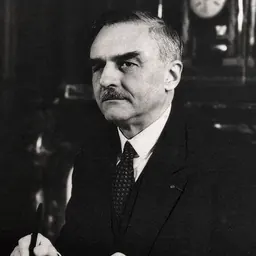
Richard F. Arenstorf (November 7, 1929 – September 18, 2014) was an American mathematician. He discovered a stable orbit between the Earth and the Moon, called an Arenstorf Orbit. It was the basis of the orbit used by the Apollo Program for going to the Moon.
Arenstorf received his Ph.D. from the Johannes Gutenberg University of Mainz in 1956.
Arenstorf orbit At the time when the United States was attempting to go to the Moon, no solution was known for orbiting regularly around two objects, such as a spacecraft traveling between the Earth and the Moon. This is a special case of the three-body problem, for which a general analytical solution is not known. However, the case of an Earth-Moon satellite can be simplified to four interactions (from the usual 6), because although the three objects gravitationally pull on each other, the effect of the spacecraft's gravity upon the motion of the vastly more massive Earth and Moon is negligible.
Arenstorf found a stable orbit for a spacecraft orbiting between the Earth and Moon, shaped like an "8" with the Earth or Moon located inside the loops of the "8". For a permanent presence on the Moon, it would be the path of what Arenstorf calls a "Space Bus", a ferry that could periodically transport supplies and people between the Earth and Moon without directly expending fuel. By staying on the Arenstorf orbit, lunar astronauts could efficiently return to Earth. Before leaving NASA after the first Moon landing, Arenstorf mapped out an emergency rescue orbit. This orbit was used in the Apollo 13 incident, in which a catastrophic malfunction aborted the Moon landing, but the astronauts ultimately returned to Earth without a major course adjustment.
Professor After leaving NASA, Arenstorf became a professor of mathematics at Vanderbilt University, where he specialized in celestial mechanics and analytic number theory. One of his specialties in number theory was the properties of the Riemann zeta function, which allows generalizations to be made about the nature of prime numbers.
Recognition
Arenstorf's portrait is found among Johannes Kepler's and Isaac Newton's in the "Museum" beginning the book Foundations of Mechanics by Ralph Abraham.
Arenstorf received the NASA Exceptional Achievement Medal in 1966.
Popular culture
In the movie Apollo 13, a sketch of the Arenstorf orbit is drawn on a chalkboard and referred to throughout the movie to mark the progress and dangers of the imperiled astronauts.
Death He died of heart failure on September 18, 2014, in Nashville, Tennessee.
Don’t just read it —
keep it.
Full-length biographies made to live with: read them, listen on the way to work, watch them tonight.
- E-book
- Audio
- Video
Instant download · yours to keep · every purchase keeps this site free
Important facts
People in Richard Arenstorf's life
Named in this biography and alive at the same time
Related people
Same field, nearest in time



Contemporaries
People whose lives overlapped Richard Arenstorf's

Frequently asked questions
Who was Richard Arenstorf?
American mathematician (1929-2014)
When was Richard Arenstorf born?
Richard Arenstorf was born on 7 November 1929 in Hamburg.
When did Richard Arenstorf die?
Richard Arenstorf died on 18 September 2014 in Nashville.
What was Richard Arenstorf's occupation?
Richard Arenstorf was a mathematician and university teacher.
What nationality was Richard Arenstorf?
Richard Arenstorf was American.
Sources & further reading
· Wikipedia: Richard Arenstorf
Cite this page
APA: Biography.guide. (2026). Richard Arenstorf. https://biography.guide/richard-arenstorf/
MLA: "Richard Arenstorf." Biography.guide, https://biography.guide/richard-arenstorf/.
Chicago: "Richard Arenstorf." Biography.guide. https://biography.guide/richard-arenstorf/.
Data last updated: 2026-09-20 · Spot an error? Report a correction.
Page generated 2026-09-27 05:18 UTC