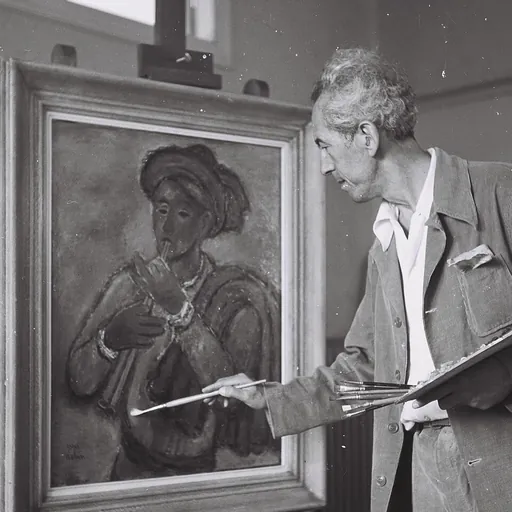
About Reuven Rubin
Lived 1893 – 1974 (aged 80). Reuven Rubin was a Romanian and Israeli diplomat and painter.
Reuven Rubin (, ; November 13, 1893 – October 13, 1974) was a Romanian-born Israeli painter and Israel's first diplomatic representative to Romania.
Biography Reuven Zelicovici (later Reuven Rubin) was born in Galaţi to a poor Romanian Jewish Hasidic family. His father, Rebbe Yoel, served as a synagogue cantor and beadle, and his mother Faige, a rabbi's daughter, was married in an arranged match at the age of 15. Reuven was the eighth of 13 children, of whom only three survived.
In February 1912, he set out for Palestine but was not happy with the school's approach and being assigned to an ivory carving workshop. In 1913, he left for Paris, France, to pursue his studies at the École Nationale Supérieure des Beaux-Arts. At the outbreak of World War I, he returned to Romania.
In 1921, he traveled to the United States with his friend and fellow artist, Arthur Kolnik, with whom he had shared a studio in Cernăuţi. In New York City, the two met artist Alfred Stieglitz, who was instrumental in organizing their first American show at the Anderson Gallery. Following the exhibition, in 1922, they both returned to Europe. In 1923, Rubin emigrated to Mandate Palestine.
Rubin met his wife, Esther, in 1928, aboard a passenger ship to Palestine on his return from a show in New York City. She was a Bronx girl who had won a trip to Palestine in a Young Judea competition. Thus Jewish national art had no fixed history, and no canon to obey. Rubin began his career at a fortunate time.
The painters who depicted the country’s landscapes in the 1920s rebelled against Bezalel. They sought current styles in Europe that would help portray their own country’s landscape, in keeping with the spirit of the time. Rubin’s Cezannesque landscapes from the 1920s were defined by both a modern and a naive style, portraying the landscape and inhabitants of Israel in a sensitive fashion. His landscape paintings in particular paid special detail to a spiritual, translucent light.
In Palestine, he became one of the founders of the new Eretz-Yisrael style. Recurring themes in his work were the biblical landscape, folklore and people, including Yemenite, Hasidic Jews and Arabs. Many of his paintings are sun-bathed depictions of Jerusalem and the Galilee. Rubin might have been influenced by the work of Henri Rousseau whose style combined Eastern nuances, as well as by the neo-Byzantine art to which Rubin had been exposed in his native Romania. In accordance with his integrative style, he signed his works with his first name in Hebrew and his surname in Roman letters.
In 1924, he was the first artist to hold a solo exhibition at the Tower of David, in Jerusalem (later exhibited in Tel Aviv at Gymnasia Herzliya). That year he was elected chairman of the Association of Painters and Sculptors of Palestine. From the 1930s onwards, Rubin designed backdrops for Habima Theater, the Ohel Theater and other theaters.
His autobiography, published in 1969, is titled My Life - My Art. He died in Tel Aviv in October 1974, after having bequeathed his home on 14 Bialik Street and a core collection of his paintings to the city of Tel Aviv. The Rubin Museum opened in 1983. The director and curator of the museum is his daughter-in-law, Carmela Rubin. 1971 Awarded the "Artist of the year", University of Judaism, Los Angeles 1973, he was awarded the Israel Prize, for painting.
Don’t just read it —
keep it.
Full-length biographies made to live with: read them, listen on the way to work, watch them tonight.
- E-book
- Audio
- Video
Instant download · yours to keep · every purchase keeps this site free
Important facts
People in Reuven Rubin's life
Named in this biography and alive at the same time

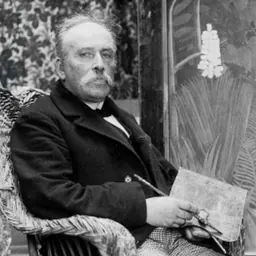
Related people
Same field, nearest in time
Contemporaries
People whose lives overlapped Reuven Rubin's


Frequently asked questions
Who was Reuven Rubin?
Israeli artist (1893-1974)
When was Reuven Rubin born?
Reuven Rubin was born on 13 November 1893 in Galați.
When did Reuven Rubin die?
Reuven Rubin died on 13 October 1974 in Tel Aviv.
What was Reuven Rubin's occupation?
Reuven Rubin was a diplomat and painter.
What nationality was Reuven Rubin?
Reuven Rubin was Romanian and Israeli.
Sources & further reading
Cite this page
APA: Biography.guide. (2026). Reuven Rubin. https://biography.guide/reuven-rubin/
MLA: "Reuven Rubin." Biography.guide, https://biography.guide/reuven-rubin/.
Chicago: "Reuven Rubin." Biography.guide. https://biography.guide/reuven-rubin/.
Data last updated: 2026-09-20 · Spot an error? Report a correction.
Page generated 2026-09-27 05:10 UTC