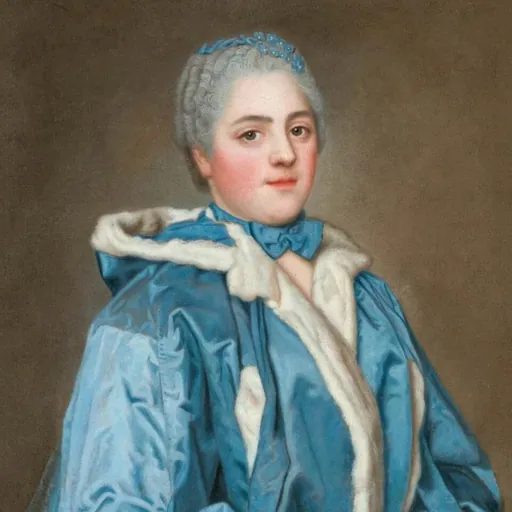
Princess Victoire of France
French princess; the seventh child and fifth daughter of King Louis XV of France
About Princess Victoire of France
Lived 1733 – 1799 (aged 66). Princess Victoire of France was a French aristocrat.
Victoire of France (Marie Louise Thérèse Victoire; 11 May 1733 - 7 June 1799) was a French princess, the daughter of King Louis XV and Queen Marie Leszczyńska. She was named after her parents and Queen Maria Theresa, her great-great-grandmother and the consort of Louis XIV.
Originally known as Madame Quatrième, signifying that she was the fourth daughter of the King, she was later known as Madame Victoire. She outlived eight of her nine siblings, and her older sister Adélaïde of France died less than a year after her. The sisters were collectively known as the Mesdames.
Life
Early years Princess Victoire was born at the Palace of Versailles on 11 May 1733. She was the seventh child and fifth daughter of King Louis XV and Queen Maria Leszczyńska. Unlike the older children of Louis XV, Madame Victoire was not raised at the Palace of Versailles. Rather, she was sent to live at the Abbey of Fontevraud with her younger sisters in June 1738. Cardinal Fleury, Louis XV's chief minister, had deemed that the cost of raising them at Versailles with all the status entitled to them would be too expensive. She remained there until 1748, when she was aged 15.
According to Madame Campan, the Mesdames had rather a traumatic upbringing at Fontrevraud and were not given an education befitting their status, and would have preferred them to be schooled at Saint-Cyr, which was much closer to the palace. Madame Louise claimed that she had not been able to read the entire alphabet at twelve years old, and could not read fluently until returning to Versailles. Victoire was traumatized by the punishments she underwent, and thereafter experienced "paroxysms of terror" that she was unable to overcome.
Reign of Louis XV Madame Victoire as Water by Jean-Marc Nattier in 1751, now in the São Paulo Museum of Art in Brazil. On 24 March 1748, being fifteen and no longer regarded a child, Victoire wrote to her father and successfully asked permission to return to court. Louis XV appointed three maids-of-honour to attend her, and sent Marie-Angélique-Victoire de Bournonville, Duchesse de Duras, to collect her and meet her with her brother the Dauphin at Sceaux. In November 1750, she was joined by her sisters Sophie and Louise.
While their education had been neglected in the convent, they reportedly compensated for this and studied extensively after their return to court. They learned how to write French properly, learned English and Italian, and educated themselves in history and math. Their endeavors were encouraged by their brother Louis, with whom they immediately formed a close attachment.
Victoire followed her sister Madame Adélaïde in her campaign against the increasing influence of her father's mistress Madame de Pompadour, and later Madame du Barry. She also had a close friendship with her favourite lady-in-waiting the Marquise de Durfort, who "afforded to Madame Victoire agreeable society. The Princess spent almost all her evenings with that lady, and ended by fancying herself domiciled with her." However, the close relationship between Marie Antoinette and Mesdames was discontinued in 1772, after an attempt to entice Marie Antoinette to humiliate Madame du Barry was thwarted— a plan which had been led by Madame Adélaïde with support of Madame Victoire and Madame Sophie.
Reign of Louis XVI
From April 1774, Madame Victoire and her sisters attended to their father Louis XV on his deathbed until his death from smallpox on 10 May. Despite the fact the sisters had never had smallpox, and the male members of the royal family, as well as the dauphine, were kept away because of the high risk of catching the illness, the Mesdames were allowed to attend to him until his death, being female and therefore of no political importance because of the Salic law. After the death of Louis XV, he was succeeded by his grandson Louis-Auguste as Louis XVI, who referred to his aunts as Mesdames Tantes. The sisters were infected by their father and fell ill with smallpox and were kept in quarantine at a little house near the Château de Choisy until they recovered.
Their nephew the King allowed them to keep their apartments in the Palace of Versailles, and they kept attending court for special occasions, such as the visit of Joseph II, Holy Roman Emperor. However, they distanced themselves from court and often preferred to reside in their own Château de Bellevue in Meudon; they also travelled annually to Vichy, always with a retinue of at least three hundred people, and made vacationing there fashionable. The Mesdames continued to be the confidants of Louis XVI, and they also maintained a good relationship with their niece, Princess Élisabeth, and often visited her in her retreat at the Domain of Montreuil.
During this period, the Mesdames did not get along well with Marie Antoinette. When the Queen introduced the new custom of informal evening family suppers, as well as other informal habits which undermined formal court etiquette, it resulted in an exodus of the old court nobility in opposition to the Queen's reforms, whom then gathered in the Mesdames ' salon. They left for Italy in a procession of wagons on 20 February 1791 with a large entourage.
Their departure was given attention in the press. The Chronique de Paris wrote: "Two Princesses, sedentary by condition, age, and taste, are suddenly possessed by a mania for travelling and running about the world. That is singular, but possible. They are going, so people say, to kiss the Pope's slipper. That is droll, but edifying. [...] The Ladies, and especially Madame Adélaïde, want to exercise the rights of man. That is natural. [...] The fair travellers are followed by a train of eighty persons. That is fine. But they carry away twelve million. That is very ugly. [...]", while the Sahhats Jacobites wrote: "The Ladies are going to Italy to try the power of their tears and their charms upon the princes of that country. Already the Grand Master of Malta has caused Madame Adélaïde to be informed that he will give her his heart and hand as soon as she has quitted France, and that she may count upon the assistance of three galleys and forty-eight cavaliers, young and old. Our Holy Father undertakes to marry Victoire and promises her his army of three hundred men to bring about a counter-revolution." In the Friday receptions of Cardinal de Bernis, Cornelia Knight described them: "Madame Victoire had also an agreeable face, much good sense, and great sweetness of temper. Their dress, and that of their suite, were old-fashioned, but unostentatious. The jewels they brought with them had been sold, one by one, to afford assistance to the poor emigrées who applied to the princesses in their distress. They were highly respected by the Romans; not only by the higher orders, but by the common people, who had a horror of the French revolution, and no great partiality for that nation in general." When news came that Louis XVI and his family had left Paris on the Flight to Varennes in June, a misunderstanding first caused the impression that the escape had succeeded; at this news, "the whole of Rome shouted with joy; the crowd massed itself under the windows of the Princesses crying out: Long live the King!",
When Naples was invaded by France in 1799, they left for Corfu and finally settled in Trieste, where Victoire died of breast cancer. Adélaïde died one year later. Their bodies were returned to France by Louis XVIII at the time of the Bourbon Restoration and buried at the Basilica of Saint-Denis.
In popular culture In Sofia Coppola's film Marie Antoinette (2006), Victoire is played by American comedian Molly Shannon.
Ancestry
Don’t just read it —
keep it.
Full-length biographies made to live with: read them, listen on the way to work, watch them tonight.
- E-book
- Audio
- Video
Instant download · yours to keep · every purchase keeps this site free
Important facts
People in Princess Victoire of France's life
Named in this biography and alive at the same time

Related people
Same field, nearest in time


Contemporaries
People whose lives overlapped Princess Victoire of France's





Frequently asked questions
Who was Princess Victoire of France?
French princess; the seventh child and fifth daughter of King Louis XV of France (1733-1799)
When was Princess Victoire of France born?
Princess Victoire of France was born on 11 May 1733 in Palace of Versailles.
When did Princess Victoire of France die?
Princess Victoire of France died on 7 June 1799 in Trieste.
What was Princess Victoire of France's occupation?
Princess Victoire of France was an aristocrat.
What nationality was Princess Victoire of France?
Princess Victoire of France was French.
Sources & further reading
· Wikipedia: Princess Victoire of France
Cite this page
APA: Biography.guide. (2026). Princess Victoire of France. https://biography.guide/princess-victoire-of-france/
MLA: "Princess Victoire of France." Biography.guide, https://biography.guide/princess-victoire-of-france/.
Chicago: "Princess Victoire of France." Biography.guide. https://biography.guide/princess-victoire-of-france/.
Data last updated: 2026-09-22 · Spot an error? Report a correction.
Portrait: Wikimedia Commons · author & licence
Page generated 2026-09-27 05:03 UTC