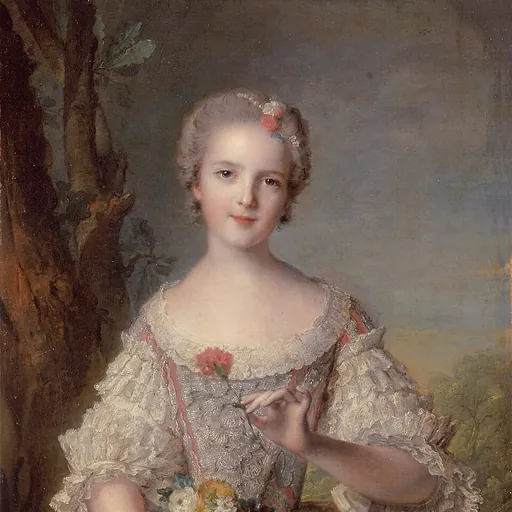
Princess Louise Marie of France
French Princess, Discalced Carmelite nun and Venerable
About Princess Louise Marie of France
Lived 1737 – 1787 (aged 50). Princess Louise Marie of France was a French christian nun.
Louise of France, OCD (Louise-Marie; 15 July 1737 – 23 December 1787) was a French princess and Discalced Carmelite, the youngest of the ten children of King Louis XV and Queen Maria Leszczyńska. She entered the Carmelite convent at Saint-Denis in 1770 and took the religious name Thérèse of Saint-Augustin. She served as prioress in 1773–1779 and 1785–1787.
Her cause for canonisation was opened in 1902 and she was declared venerable by Pope John Paul II in 1997.
Early life
Birth Louise was born at the Palace of Versailles on 15 July 1737, exactly as predicted by the royal physicians. Her parents already had seven daughters and two sons before her, but one sister (Marie Louise) and one brother (Philippe, Duke of Anjou) had already died. As Salic law precluded women from inheriting the throne, Louis XV hoped for a “spare” son from this pregnancy. After the birth, he played a joke on the crowd gathered outside, announcing the birth of a son. The news spread and people celebrated with public feasts. The newborn's maternal grandfather, the deposed King Stanisław of Poland, prepared to travel to Versailles. By evening, the truth was clarified, and Stanisław stayed home. France and the royal court were saddened by the birth of another girl.
Daughters of the French king, known as filles de France, were referred to simply as madame and their given name. French royal children were baptised immediately upon birth with a simplified ceremony called ondoiement (performed by the Archbishop of Vienne for Louise). The baptism was completed a few years later, when godparents and given names were assigned. Until their full baptisms, Louis XV's daughters were known by numbers. Accordingly, Louise was called Madame Septième as his seventh (living) daughter.
An anecdote claims that the King announced that he and Queen Marie would have no more children by calling Louise Madame Dernière (“the last madame”). However, the historian Poignant argues that this story was invented and spread by the Marquis d'Argenson, known for his malignant rumours. Queen Marie Leszczyńska, when she learnt of her baby's gender, whispered to her husband in an exhausted voice, “I would suffer once more [and] just as much [to] give you a duke of Anjou”. Louis XV and France still hoped for a future son, but Louise was his last child.
Infancy in Versailles The royal children lived in an apartment in the aile des Princes (“Wing of Princes”) of Versailles. They shared an antechamber and a cabinet for receiving visitors, where a private altar also stood. The walls and furniture were upholstered in red damask and covered with protective red serge outside of the most important ceremonies. The rooms were decorated with tapestries of mythological and historical scenes. There had been no changes made to the apartment since the time of Louis XIV's children and there were no personal touches added, except the dressing table, provided to each princess at birth and differing in design. That of Louise was upholstered in gold and silver brocade with colourful flowers and lined with green taffeta.
Just like her sisters, Louise had her own bedroom with three beds and a cradle. She shared this with her wet nurse, Madame Anne (d')Hoppen, one of the (sous-)gouvernantes (there was a chief gouvernante and two vice-gouvernantes), the remueuse or “[cradle] rocker”, who was tasked with dressing and bathing the baby, and two chambermaids (who shared one folding bed as one was always awake). Louise received a complete set of solid gold tableware, engraved enfans de France (children of France, with contemporary spelling) at her birth, used only on special occasions. Every item for personal use, including chamber pots, bore the same inscription. The ingredients of their breakfast porridge were brought in a sealed container, inspected, cooked publicly, and tasted first by the gouvernante.
Louise and her siblings were under the care of the gouvernante, Marie Isabelle de Rohan, Duchess of Tallard (Madame de Tallard), who was in charge of every aspect of their upbringing. Each princess was given a large retinue. A foreign visitor to the court recorded his amazement at seeing the princesses run around the palace always followed by at least fourteen people. Like all aspects of their lives, the relationship between the children and their parents was regulated by courtly etiquette, although the King did occasionally bend the rules in private. From the moment of birth, the children participated fully in courtly representation; their meals and their morning and night dressings were public for courtiers (as were those of their parents).
Shortly after Louise's birth, Chief Minister Cardinal de Fleury announced that the presence of so many little girls “embarrassed the court” and cost too much, as well as taking up valuable space that adult courtiers needed. Except for the three eldest, (eleven-year-old Madame, Louise-Élisabeth, whose engagement was being negotiated, her twin Madame Henriette, and six-year-old Madame Troisième, later Madame Adélaïde), the princesses were thus sent to a convent. The Queen opposed the decision, but she was too afraid of her husband and his powerful minister to challenge it.
Childhood at Fontevraud Abbey Louise was not yet one year old when, on 16 June 1738, she was sent to far-away Fontevraud Abbey with her three elder sisters: five-year-old Victoire, four-year-old Sophie, and two-year-old Thérèse (known as Madame Quatrième, Madame Cinquième, and Madame Sixième, as they had not yet been baptised). Louis XV was away at Rambouillet for a day of hunting; his emotional reaction to the separation from his daughters is unknown. Louise shared a carriage with one of their sous-gouvernantes, and two chambermaids. They were followed by eight coaches, two chaises, twenty wagons of luggage, and members of the royal bodyguard.
In September 1744, the sister closest to her in age, Thérèse, died of smallpox. In September 1747, Louise and her friends later credited the nuns with curbing her pride and teaching her a humble religious outlook. thumb In July 1761, Adélaïde and Victoire went to Lorraine for a spa cure, while Sophie and Louise visited Paris for the first time, signalling a change in their degree of influence. By this time, the King had started to listen to their advice in governance, especially to Adélaïde, who received an apartment near his to enable continuous communication. Emboldened, Adélaïde started to treat her younger sisters as her inferiors. Her rule ended with the 1764 installation of Madame du Barry as the maîtresse-en-titre who overtook her apartment and stayed the King's confidant until his death.
According to their reader, Henriette Campan, Mesdames rarely saw their father. He visited the apartment of Madame Adélaïde every morning, who rang a bell to alert Madame Victoire; Victoire did the same of Sophie, and Sophie for Louise. As their apartments were “of very large dimensions”, Louise often barely had time to greet the King, despite running as fast as she could with her disability. In addition, every day at 6 p.m., the princesses attended the King's débotter (the ceremony of taking off his boots). For this, they wore ornate skirts on a hoop and a black taffeta coat to cover their otherwise non-ceremonial dress and went in a procession of attendants to the royal apartments. At the débotter, the King kissed each daughter on the forehead. This meeting was so short that Mesdames could often resume their usual activities within fifteen minutes. In the summer, he sometimes also visited them shortly before the débotter.
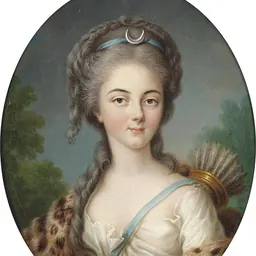
A series of events in the late 1760s led to a crisis for Louise. She was deeply affected by the banishment of the Jesuits from France and resolved to secure their return, as well as the conversion of the King from his dissolute lifestyle. This was followed by the death of her brother the Dauphin in 1765, her maternal grandfather Stanisław Leszczyński in 1766, her sister-in-law, Dauphine Maria Josepha of Saxony in 1767, and her mother Queen Marie in 1768. This arrival of Madame du Barry in 1769 finally pushed Louise to ask his confidant and spiritual advisor, Christophe de Beaumont, Archbishop of Paris to intercede on her behalf with the King so he would permit her to enter the Discalced Carmelites, a cloistered and austere religious order. The Archbishop informed the King of his daughter's vocation on 30 January 1770, disturbing the father, who repeatedly said, “this is cruel”, but adding, “if God asks her, I cannot refuse her”. On 16 February 1771, he finally responded in a letter: “If this is for God only, I cannot oppose his will and your desire […] I embrace you with all my heart, dear daughter, and give you my blessing”. thumb Louise as Thérèse of Saint-Augustine, portrait from around 1771.
Even before becoming a Carmelite, Louise had begun to secretly wear religious dress and live according to convent rules. Louise, like her sisters, was opposed to the future French king marrying an Austrian archduchess. The union had been arranged by Chief Minister Choiseul, who had exiled Jesuits. Although Mesdames pretended to receive Marie Antoinette kindly, they secretly undermined her wherever possible, jealous of her superior rank. This included Louise, but unlike her sisters, her religious status protected her from becoming unpopular because of it.
Madame Campan later remembered that one evening in April 1770, while she was reading to Madame Louise, a message came that Minister Bertin would speak with her. Louise briefly left to speak with him, then came back to continue her embroidery and the reading. The next morning, when Madame Campan returned to Louise's apartment to resume service, she was informed that Louise had left at seven in the morning for a convent, accompanied only by a maid, Madame de Guistel, and an equerry. Louise was already expected in the convent, arriving at the grille to prove that the King had authorised her decision. Her hasty departure created a great surprise at court. Adélaïde had “violent” outbursts of “rage”, blaming their father for keeping Louise's secret, while Victoire cried silently. Around this time, Madame Campan also visited Louise, who had just washed the convent's linen. She said to Campan, “I much abused your youthful lungs for two years before the execution of my project” (Louise had made Madame Campan read to her for up to five hours a day), adding, “I knew that here [in the convent] I could read none but books tending to our salvation, and I wished to review all the historians that had interested me”. uncommonly for France, highlighting the sensational nature of this event. Catholics all over France celebrated Louise's decision. She reluctantly accepted some accommodations to help her integrate into a rigorous life. For example, she was allowed to use a rope to guide herself when using the narrow stairs, which she had never done before without assistance. She served for two consecutive temrs from 1773 to 1779, and during a third term from 1785. Her decision to retire from court made her a great asset for the clergy, who were constantly petitioning her. Louise used her influence with the King to secure ecclesiastical positions for those she supported. Reportedly, Louise continued to solicit favours for others during the reign of her nephew, to the degree that Queen Marie Antoinette supposedly said to Madame de Boigne, “Here is another letter from my Aunt Louise. She is certainly the most intriguing little Carmelite in the kingdom.” She was also active in charity. In June 1782, she gave assistance to thirteen Carmelite nuns expelled from Brussels by Emperor Joseph II.
After Louis XVI's accession, Louise was often visited by her niece Madame Élisabeth, who wished to unite her prayers with that of her aunt for the king's welfare. An anecdote is given about one such visit: “Mme Elizabeth arrived at the convent one day quite early, and begged to be allowed to wait on the nuns at their dinner. Leave being granted, she put on an apron and, after kissing the ground, went to the Tour to receive the dishes. All went well, till, as she was distributing the portions, the tray slipped and a dish fell. Her embarrassment was extreme. To relieve her, the august Princess [Louise] said, ‘My niece. After such a gaucherie the culprit should kiss the floor.’ This Mme Elizabeth hastened to do, and then cheerfully resumed her office of waitress.”
In November 1787, Louis XVI allowed Protestants to openly practice their religion, granting them legal and civil status by the Edict of Versailles. Louise, who believed this to be a betrayal of the King's coronation promise to safeguard the Catholic faith, Her nephew Louis XVI commented to Madame Campan that in the “delirium” of dying, Louise must have remembered that she had been born a princess. In the last days of Madame Élisabeth's imprisonment before her execution, she received a biography written about the late Louise by Abbot Proyart, who had known her. The buildings of the convent at Saint Denis survived the turmoil and today house the Musée d'art et d'histoire de Saint-Denis. However, in 1793 the revolutionaries who desecrated the tombs of the kings of France at the Basilica of St Denis did the same to the cemetery of the Carmelite convent. Located near the cloister, the remains of the royal family were disinterred and thrown into a mass grave. The process (required at the time) of non-cult took place in 1885–1886. The process of sanctity was conducted in 1891–1892 and the process of the virtues from 1896 to 1904. The decree validating these processes was published on 28 November 1906. An association was founded in January 1986 to support the cause of her beatification. The decree of the heroic virtues of Thérèse of Saint Augustine was published on 18 December 1997, declaring her venerable. Inly lack of an officially recognised miracle attributed to her is lacking for her to be declared “Blessed”. title=Ancestors of Louise of France boxstyle_1=background-color: #fcc; boxstyle_2=background-color: #fb9; boxstyle_3=background-color: #ffc; boxstyle_4=background-color: #bfc; boxstyle_5=background-color: #9fe; 1= 1. Louise of France 2= 2. Louis XV of France 3= 3. Marie Leszczyńska 4= 4. Louis, Duke of Burgundy 5= 5. Marie Adélaïde of Savoy 6= 6. Stanisław I Leszczyński 7= 7. Katarzyna Opalińska 8= 8. Louis, Dauphin of France 9= 9. Maria Anna Victoria of Bavaria 10= 10. Victor Amadeus II of Sardinia 11= 11. Anne Marie of Orléans 12= 12. Rafał Leszczyński 13= 13. Anna Jabłonowska 14= 14. Jan Karol Opaliński 15= 15. Zofia Czarnkowska
Don’t just read it —
keep it.
Full-length biographies made to live with: read them, listen on the way to work, watch them tonight.
- E-book
- Audio
- Video
Instant download · yours to keep · every purchase keeps this site free
Important facts
more
Madame Louise, daughter of Louis XV, King of France Louise, Louise-Marie Bourbon, Louise de France, Louise Marie de Bourbon, Venerable Louise of France, Térèse of Saint Augustine, Mother Térèse of Saint Augustine, Venerable Térèse of Saint AugustinePeople in Princess Louise Marie of France's life
Named in this biography and alive at the same time


Related people
Same field, nearest in time


Contemporaries
People whose lives overlapped Princess Louise Marie of France's






Frequently asked questions
Who was Princess Louise Marie of France?
French Princess, Discalced Carmelite nun and Venerable (1737–1787)
When was Princess Louise Marie of France born?
Princess Louise Marie of France was born on 15 July 1737 in Versailles.
When did Princess Louise Marie of France die?
Princess Louise Marie of France died on 23 December 1787 in Saint-Denis.
What was Princess Louise Marie of France's occupation?
Princess Louise Marie of France was a christian nun.
What nationality was Princess Louise Marie of France?
Princess Louise Marie of France was French.
Sources & further reading
· Wikipedia: Princess Louise Marie of France
Cite this page
APA: Biography.guide. (2026). Princess Louise Marie of France. https://biography.guide/princess-louise-marie-of-france/
MLA: "Princess Louise Marie of France." Biography.guide, https://biography.guide/princess-louise-marie-of-france/.
Chicago: "Princess Louise Marie of France." Biography.guide. https://biography.guide/princess-louise-marie-of-france/.
Data last updated: 2026-09-22 · Spot an error? Report a correction.
Portrait: Wikimedia Commons · author & licence
Page generated 2026-09-27 05:01 UTC