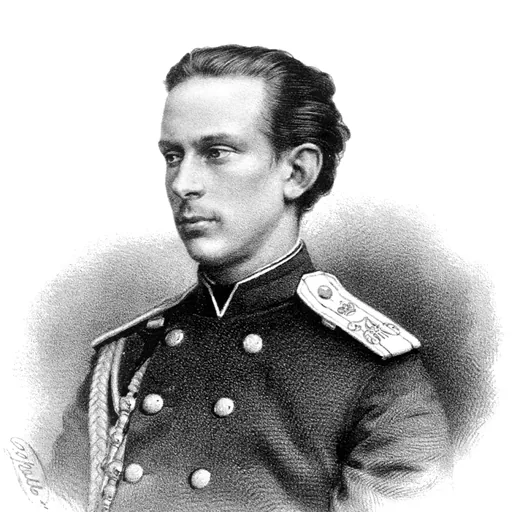
Prince Nicholas Maximilianovich, 4th Duke of Leuchtenberg
Russo-German Noble and Mineralogist
About Prince Nicholas Maximilianovich, 4th Duke of Leuchtenberg
Lived 1843 – 1891 (aged 47). Prince Nicholas Maximilianovich, 4th Duke of Leuchtenberg was a Russian mineralogist, military personnel, military officer and geologist.
Prince Nicholas Maximilianovitch, 4th Duke of Leuchtenberg (4 August 1843 - 6 January 1891) was a Russian Prince and soldier who was the 4th Duke of Leuchtenberg from 1852 until his death in 1891. Head of the House of Beauharnais, he was a grandson of Nicholas I of Russia and was a candidate for the throne of Greece and of Romania. Like his father, he was also a renowned mineralogist.
Son of Maximilian de Beauharnais, 3rd Duke of Leuchtenberg and of Grand Duchess Maria Nikolaevna of Russia, Nicholas grew up in Russia. He followed a military career but also studied mineralogy, geology and palaeontology. His was a candidate for the throne of Greece in 1862 and for Romania in 1866 but his links with Russia meant he did not accede to either.
Appointed President of the Imperial Society of Mineralogy and Honorary President of the Russian Society of Technology in 1865 by Tsar Alexander II, he carried out several scientific missions in Russia. His relationship with Nadezhda Annenkova led him to flee the country in 1868. Deprived of his fortune and abandoned by his family, he was later partially forgiven by his uncle. He spent the rest of his life in exile and died at the age of 47 of throat cancer.
Family Grand Duchess Maria Nikolaevna of Russia, with her four eldest children by Christina Robertson in 1849. From left to right, Nicholas, Eugen, Eugenia and Maria. Nicholas was the eldest son of Maximilian de Beauharnais and Grand Duchess Maria Nikolaevna of Russia. His father was the grandson of Joséphine de Beauharnais, the first wife of Napoleon and also a grandson of Maximilian I Joseph of Bavaria. His mother was the granddaughter of Paul I of Russia and of Frederick William Ill of Prussia.
Biography
Childhood and education
The first grandson of Tsar Nicholas I, Nicholas was born in a Dacha on the Serguievka estate near Petergof in Russia on 4 August 1843. His birth was difficult and he was born with one leg shorter than the other. This disability later led his parents to seek orthopaedic treatments abroad. During his childhood, he underwent no less than four operations on his leg in Germany and the United Kingdom before being entrusted to the care of Dr Nikolay Pirogov, who proscribed him gymnastic exercises. Due to this program, Nicholas grew almost normally and he no longer had this physical problem.
Career in Russia
Nicholas had a career in the military. Since his birth, he was in the Preobrazhensky Life Guards Regiment. In 1850, he became ensign and in 1852 he was appointed chief of the Kiev Hussar Regiment. In 1856 he enlisted in the Life Guards of the 4th Rifle Imperial Surami Battalion. In 1859, he entered active military service. In 1863, he became Colonel and Major General in 1865. He became Lieutenant General in 1878 and Cavalry General in 1890 and Adjutant General the same year. He fought in the Russo-Turkish War of 1877 to 1878.
Like his father, he had an interest mineralogy, geology and palaeontology and published various articles on the subjects. In 1865, he was appointed by the Tsar, President of the Imperial Society of Mineralogy and it was under the direction of Nicholas that a geological map of the Russian Empire was drawn up. Nicholas also held several other positions. He was appointed an executive member of the St. Petersburg School of Mines, a member of the Academic Council of the Ministry of State Property and honorary President of the Russian Society of Technology.
Marriage and children
In 1863, when Nicholas was 20 years old, he met Nadezhda Annenkova in Moscow, daughter of the minor Russian nobleman Sergei Petrovich Annenkov and his wife, Ekaterina Dmtrievna Shidlovskaya. Her paternal grandmother was Princess Anna Dmitrievna Prozorovskaya, granddaughter of Russian Field Marshall Prince Alexander Prozorovsky. She had separated from her husband, Vladimir Nikolayevich Akinfov, and had two daughters. She was known to have caught the interest of several men, including Alexander Gorchakov, one of his sons and two Grand Dukes. Nicholas later established a relationship with her.
After some time, the couple sought to formalise their relationship. Nadezhda therefore tried to obtain a divorce from her husband and repeatedly left St. Petersburg to convince her husband to officially accept their separation in exchange for money. Russian law recognized divorce, but prohibited spouses from remarrying or from being received at court except under specific circumstances. Tsar Alexander II opposed her divorce, as he did not want to see her unite with Nicolas.
The situation of the couple finally changed in 1868 when Nadezhda became pregnant and Nicholas convinced his uncle to let her leave Russia so that the unborn child does not bear the name of the husband of Nadezhda. Therefore, she left for Britain and Nicholas was punished by the Tsar for his part. The Tsar told Nicholas that if he leaves to find refuge in Europe, he will lose his Russian nationality, his fortune and his rank. Despite this, Nicholas leaves for Germany through Lithuania. The couple met in Paris and marry in the Orthodox Chapel of the Stein Castle in Bavaria.
In Russia, the actions of Nicholas caused a huge scandal and the Tsar was furious as he needed to cover the dishonor caused by Nicholas' desertion from the army. Nicholas' mother, Grand Duchess Maria, despite her morganatic marriage, was particularly shocked by his actions and refused to intervene in favor of Nicholas with the Tsar. Nicholas' siblings considered his actions deplorable and break their relations with him.
The couple had two children together:
Duke Nicholas Nikolaevich of Leuchtenberg (1868-1928), who married Countess Maria Nikolaevna Grabbe (1869-1948) and had seven children. Duke Georgy Nikolaevich of Leuchtenberg (1872-1929), who married Princess Olga Nikolayevna Repnina-Volkonskaïa (1872-1953) and had six children.
Exile The eldest son of Nicholas and Nadezhda was born in Geneva, Switzerland on 17 October 1868. Since his parents' marriage was still secret, he was not recognised by Nicholas and was presented as his pupil. Their second son, also presented as a pupil, was born in Rome, Italy on 10 December 1872. The two children were legitimatised following their parents' official marriage in 1878.
For several years, the family split their time between Rome and Paris. The financial situation of the family was difficult after the Tsar deprived Nicholas of his fortune and with his mother refusing to help him. However, the situation of the family improved in 1873. That year, Nicholas inherited the Stein castle following the death his aunt, Amélie of Leuchtenberg, Dowager Empress of Brazil and the family then settled there. In 1876, Nicholas managed to expand his estate in Bavaria following the death of another of his aunts, Josephine of Leuchtenberg, due to buying from her heirs small properties in Neureuth and Seeon-Seebruck.
Despite being ostracised from European society, Nicholas and Nadezhda continued their life in Stein. With their passion about the arts and sciences, they received many intellectuals including the mineralogist, Nikolai Kokcharov, and many members of the Imperial Society of Mineralogy. Despite this, their financial situation remained precarious and Nicholas missed his life in Russia.
Improved relations with Russia In 1876, Nicholas was allowed to return to Russia for the first time since fleeing in order to attend the funeral of his mother. However he went on his own as neither his wife nor his son was allowed to enter Russian territory. A year later, he was again allowed to return to Russia to serve in the Imperial Army in the Russo-Turkish War of 1877 to 1878.
The loyalty of Nicholas led to him being forgiven by his uncle in 1879. Tsar Alexander II recognised his marriage to Nadezhda and granted her a title which the French government objected to. However, the couple were not allowed to settle in Russia and the position of their children remained unclear. Later on, during Nicholas' illness, Tsar Alexander II issued a Ukase on 23 November 1890 which granted Nicholas' two sons the title of Leuchtenberg with the style of Highness although they were excluded from the Imperial family.
Illness and death Over his later years, Nicholas' health deteriorated. He was a frequent smoker, and developed throat cancer which made him suffer greatly. Rumours suggested that he was dependent on morphine given to him by his wife. Nicholas died in Paris on 6 January 1891, at the age of 47. He then received military honours from the French government and then was repatriated to Russia by his brother Eugen.
Nicholas received an official funeral in the presence of Tsar Alexander III, the court and many scientists on 24 January 1891. His mortal remains were buried in the crypt of the Chapel of Resurrection of the Coastal Monastery of Saint Sergius. His wife died six months later and was also buried there.
Ancestry
Don’t just read it —
keep it.
Full-length biographies made to live with: read them, listen on the way to work, watch them tonight.
- E-book
- Audio
- Video
Instant download · yours to keep · every purchase keeps this site free
Important facts
People in Prince Nicholas Maximilianovich, 4th Duke of Leuchtenberg's life
Named in this biography and alive at the same time
Related people
Same field, nearest in time
Contemporaries
People whose lives overlapped Prince Nicholas Maximilianovich, 4th Duke of Leuchtenberg's
Frequently asked questions
Who was Prince Nicholas Maximilianovich, 4th Duke of Leuchtenberg?
Russo-German Noble and Mineralogist
When was Prince Nicholas Maximilianovich, 4th Duke of Leuchtenberg born?
Prince Nicholas Maximilianovich, 4th Duke of Leuchtenberg was born on 23 July 1843 in Peterhof Palaces and complex.
When did Prince Nicholas Maximilianovich, 4th Duke of Leuchtenberg die?
Prince Nicholas Maximilianovich, 4th Duke of Leuchtenberg died on 6 January 1891 in Paris.
What was Prince Nicholas Maximilianovich, 4th Duke of Leuchtenberg's occupation?
Prince Nicholas Maximilianovich, 4th Duke of Leuchtenberg was a mineralogist, military personnel, military officer and geologist.
What nationality was Prince Nicholas Maximilianovich, 4th Duke of Leuchtenberg?
Prince Nicholas Maximilianovich, 4th Duke of Leuchtenberg was Russian.
Sources & further reading
· Wikipedia: Prince Nicholas Maximilianovich, 4th Duke of Leuchtenberg
· DBpedia: Nicholas Maximilianovitch, 4th Duke of Leuchtenberg
Cite this page
APA: Biography.guide. (2026). Prince Nicholas Maximilianovich, 4th Duke of Leuchtenberg. https://biography.guide/prince-nicholas-maximilianovich-4th-duke-of-leuchtenberg/
MLA: "Prince Nicholas Maximilianovich, 4th Duke of Leuchtenberg." Biography.guide, https://biography.guide/prince-nicholas-maximilianovich-4th-duke-of-leuchtenberg/.
Chicago: "Prince Nicholas Maximilianovich, 4th Duke of Leuchtenberg." Biography.guide. https://biography.guide/prince-nicholas-maximilianovich-4th-duke-of-leuchtenberg/.
Data last updated: 2026-09-28 · Spot an error? Report a correction.
Portrait: Wikimedia Commons · author & licence
Page generated 2026-10-05 02:22 UTC