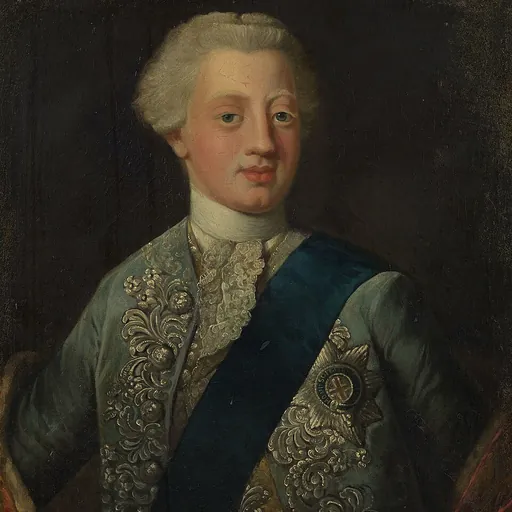
About Prince Edward, Duke of York and Albany
Lived 1739 – 1767 (aged 28). Prince Edward, Duke of York and Albany was a British aristocrat and naval officer.
Prince Edward, Duke of York and Albany (Edward Augustus; 25 March 1739 – 17 September 1767) was a younger brother of King George III of Great Britain and the second son of Frederick, Prince of Wales, and Princess Augusta of Saxe-Gotha.
Early life The young prince was baptised Edward Augustus, at Norfolk House, by the Bishop of Oxford, Thomas Secker, He was made Rear-Admiral of the Blue in 1761, vice-admiral of the blue in 1762, and in 1766, only a year before his death, rising to the rank of Admiral of the Blue.
Later life The Duke of York and Albany, 1763, as painted by Sir Joshua Reynolds. He was created Duke of York and Albany and Earl of Ulster by his paternal grandfather, George II, on 1 April 1760. When Edward's brother ascended the throne on 25 October 1760 as George III, he named Edward a privy counsellor. From the time his brother became king and until the birth of the King's first child, the future George IV, on 12 August 1762, the Duke was heir presumptive to the British throne.
On 27 July 1765, he was initiated into the Masonic Order.
In the late summer of 1767, on his way to Genoa, the Duke fell ill and had to be landed in the harbour of Monaco. Despite the care and attention he was given, he died in the Palace of Honoré III, Prince of Monaco, on 17 September. The state bedchamber where the ill duke died has since been known as the York Room.
After his death, his body was returned to London aboard , and is interred in Westminster Abbey.
Legacy The Duke of York and Albany in the robes of the Order of the Garter, approx. 1764–1765
Literature In 1762, James Boswell published "The Cub at Newmarket", a poem which he dedicated to Prince Edward, without getting his permission. Boswell met the Prince at the Newmarket races in 1760 during his first visit to London. The cub referenced in the work is Boswell himself. The dedication reads:
Prince Edward is an important character in Norah Lofts' historical novel The Lost Queen (1969), chronicling the life of his youngest sister, Caroline Matilda, Queen Consort of Denmark and Norway as wife of King Christian VII. Edward is mentioned as having had a special link with her, stronger than with his other siblings. The book also depicts Edward as having planned shortly before his death to elope with a commoner woman with whom he was in love, marry her in Russia and never go back to Britain – which is not firmly attested in historical sources.
Places and people named after Prince Edward Prince Edward County, Virginia. Cape York, the tip of the Cape York Peninsula in Far North Queensland, is the northernmost point on the Australian continent. The Duke of York Islands (formerly ) in East New Britain Province, Papua New Guinea. They are found in St George's Channel between New Britain and New Ireland islands and form part of the Bismarck Archipelago. Duke of York Island, the largest island of Duke of York Islands, Papua New Guinea. Prince Edward Augustus, fourth son of King George III, who was born the day after the Duke was buried at Westminster Abbey. Fort Edward, a town in New York located on the eastern side of the Hudson River which was formerly the site of a large British fort during the Seven Years' War.
Titles, styles, honour and arms
Titles and styles 25 March 1739 – 1 April 1760: His Royal Highness Prince Edward boxstyle_1=background-color: #fcc; boxstyle_2=background-color: #fb9; boxstyle_3=background-color: #ffc; boxstyle_4=background-color: #bfc; boxstyle_5=background-color: #9fe; 1= 1. Prince Edward, Duke of York and Albany 2= 2. Frederick, Prince of Wales 3= 3. Princess Augusta of Saxe-Gotha 4= 4. George II of Great Britain 5= 5. Princess Caroline of Brandenburg-Ansbach 6= 6. Frederick II, Duke of Saxe-Gotha-Altenburg 7= 7. Princess Magdalena Augusta of Anhalt-Zerbst 8= 8. George I of Great Britain 9= 9. Princess Sophia Dorothea of Brunswick-Celle 10= 10. John Frederick, Margrave of Brandenburg-Ansbach 11= 11. Princess Eleonore Erdmuthe of Saxe-Eisenach 12= 12. Frederick I, Duke of Saxe-Gotha-Altenburg 13= 13. Princess Magdalena Sibylle of Saxe-Weissenfels 14= 14. Charles, Prince of Anhalt-Zerbst 15= 15. Princess Sophia of Saxe-Weissenfels
Don’t just read it —
keep it.
Full-length biographies made to live with: read them, listen on the way to work, watch them tonight.
- E-book
- Audio
- Video
Instant download · yours to keep · every purchase keeps this site free
Important facts
more
Duke Of York, Prince Edward Augustus, Edward AugustusFamily & relationships
People in Prince Edward, Duke of York and Albany's life
Named in this biography and alive at the same time

Related people
Same field, nearest in time

Contemporaries
People whose lives overlapped Prince Edward, Duke of York and Albany's




Frequently asked questions
Who was Prince Edward, Duke of York and Albany?
British prince
When was Prince Edward, Duke of York and Albany born?
Prince Edward, Duke of York and Albany was born on 25 March 1739 in London.
When did Prince Edward, Duke of York and Albany die?
Prince Edward, Duke of York and Albany died on 17 September 1767 in Monte Carlo.
What was Prince Edward, Duke of York and Albany's occupation?
Prince Edward, Duke of York and Albany was an aristocrat and naval officer.
What nationality was Prince Edward, Duke of York and Albany?
Prince Edward, Duke of York and Albany was British.
Sources & further reading
· Wikipedia: Prince Edward, Duke of York and Albany
· DBpedia: Prince Edward, Duke of York and Albany
Cite this page
APA: Biography.guide. (2026). Prince Edward, Duke of York and Albany. https://biography.guide/prince-edward-duke-of-york-and-albany/
MLA: "Prince Edward, Duke of York and Albany." Biography.guide, https://biography.guide/prince-edward-duke-of-york-and-albany/.
Chicago: "Prince Edward, Duke of York and Albany." Biography.guide. https://biography.guide/prince-edward-duke-of-york-and-albany/.
Data last updated: 2026-09-28 · Spot an error? Report a correction.
Portrait: Wikimedia Commons · author & licence
Page generated 2026-10-04 13:03 UTC