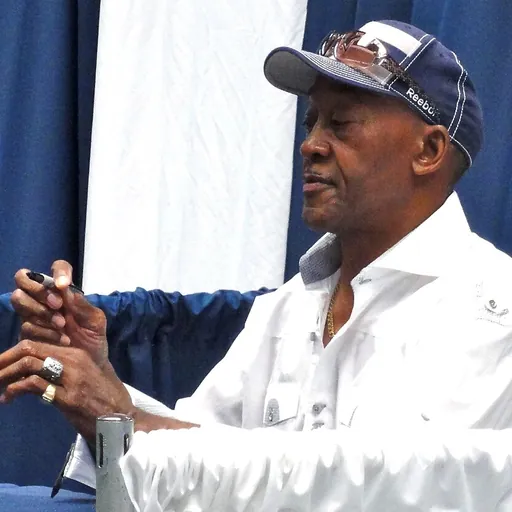
About Preston Pearson
Born 1945. Preston Pearson is an American american football player and basketball player.
Preston James Pearson (born January 17, 1945) is an American former professional football player who was a running back in the National Football League (NFL) for the Baltimore Colts, Pittsburgh Steelers and Dallas Cowboys. He played college basketball for the Illinois Fighting Illini. Pearson played in five Super Bowls with three different teams. In describing the difficulties Pearson faced over the course of his 14-year NFL career, Pittsburgh sportswriter Phil Musick stated "Pearson has had more bad breaks than a glassblower with cold sores".
Early life Pearson was born on January 17, 1945, in Freeport, Illinois. He attended Freeport High School, where he received All-State honors as the 6 ft (1.83 m) center of the basketball team. As a senior in 1963, he was unanimously chosen Big Eight All-Conference in basketball, leading the conference in scoring and his team in rebounding. He also competed in football, and on the track team in the pole vault, high jump and broad jump. He played both offensive and defensive back in high school.
Pearson's older brother Rufus Pearson Jr. starred on the school's football and track teams. For most of their high school years, the brothers were the only African Americans on the school's sports teams. Rufus went on to college at the University of Southern Illinois. He received the partial scholarship the next season as a sophomore, and reportedly only received a full scholarship for his senior year. At 6 ft 1 in (1.85 m) and 193 lb. (87.5 kg), he was known for his tough defense and became the team's defensive stopper. He was assigned to defend other Big Ten teams top offensive players, such as Michigan's Cazzie Russell, Purdue's Rick Mount, and Indiana's Tom and Dick Van Arsdale. As a senior, he was named a starter at guard, averaging 8.7 points and 6.0 rebounds per game over the 1966-67 season. He was instrumental in the team's successes that year.
Professional career Although Pearson did not play college football, he was considered a professional football prospect at defensive back because of his great athleticism, leaping ability, quickness and desire for playing with physical contact. While still at Illinois, the Chicago Bears and Pittsburgh Steelers contacted him about playing in the NFL. He was first tried at defensive back and was promoted from the taxi squad to the regular roster on November 1, 1967, playing mostly on special teams. As a rookie, he learned the most from any player by observing the meticulous work and preparation of Colts Hall of Fame receiver Raymond Berry. Later in his career, in 1975, Pearson said his biggest thrill as a professional player came during his first training camp with the Colts, seeing Hall of Fame legends like quarterback Johnny Unitas and running back Lenny Moore up close.
In 1968, he was moved to running back, at least in part because of Lenny Moore's retirement. (As Pearson only returned 15 kickoffs, Ron Smith's 27.6 yards per return average on 26 returns is recognized as high in the NFL's 1968 season. ) He registered the longest kickoff return of the year in the NFL (102 yards).
As a running back in 1968, Pearson averaged more than 4 yards per carry on 19 carries. The Colts finished the season 13–1, winning the NFL's Coastal Division. They won the divisional round playoff game against the Minnesota Vikings, with Pearson returning one kick for 31 yards. Pearson had started the game at fullback for an injured Jerry Hill, but Shula had to put Hill in for Pearson to block against the Vikings defensive line and blitzing defense.
The Colts next won the 1968 NFL Championship Game over the Cleveland Browns, 34–0, with Pearson returning one kick for 21 yards. Pearson played in Super Bowl III, with the Colts losing to the New York Jets, 16–7. He returned two kickoffs for 59 yards. This was the first of Pearson's five Super Bowl appearances.
In 1969, Pearson started in two games for the Colts at running back. On the year, he rushed 24 times for 81 yards and had four pass receptions for 64 yards. He returned six punts for 37 yards. Pearson led the NFL with 31 kickoff returns. His return average fell to 22.8. His rookie teammate Jim Duncan led the NFL with a 29.5 yards per kickoff return average, and had a 92-yard touchdown return.
On May 31, 1970, he was traded, along with defensive back Ocie Austin, to the Pittsburgh Steelers in exchange for linebacker Ray May and a twelfth-round draft choice (#294-Bobby Wuensch). Pearson wanted a trade as he saw the Colts were making Duncan their primary returner, and halfback Tom Matte was going to keep his starting role, limiting Pearson’s opportunities to play. Duncan led the NFL again in 1970, with a 35.4 yards per kickoff return average.
Pittsburgh Steelers In 1970, Pearson reunited with Chuck Noll who had become the Steelers head coach in 1969. Noll was Don Shula's defensive backfield coach with the Colts when Pearson joined the Colts in 1967, and filled that position until leaving the Colts after the Super Bowl loss. It has also been stated Noll was Shula's defensive coordinator. Pearson started all 14 games for the Steelers with 503 rushing yards on 173 attempts (2.9 yards per carry) and two touchdowns. He also caught six passes for 71 yards, but only returned four kickoffs that year. His 605 yards ranked Pearson fifteenth among running backs in the American Football Conference (AFC) and 27th overall in the NFL, while he was second on the team to Fuqua's 625 yards (on a 4.0 yards per carry average). His 4.6 yards per attempt was sixth best in the entire NFL. Pearson missed three games with the hamstring injury, and returned to play in six more games that year, chiefly on special teams; and none as a starting running back. Pearson went on to start in 13 of 14 games that year, rushing for 554 yards in 132 carries, and catching 11 passes for 173 yards, while playing alongside Harris and Fuqua in the backfield during the year. Although only starting in eight games, Harris still led the team in rushing attempts and yards; though Pearson led the team with 4.2 yards per carry. Pearson and Harris started together in the Steelers backfield in their division round playoff loss to the Oakland Raiders that year.
When Harris was injured early in the 1974 season, Pearson got an opportunity to start. In the fourth game of the season against the Houston Oilers he rushed for 115 yards on only 15 carries (including a 53-yard run), and caught three passes for 42 yards. This was the best yardage game of his career. However, he ruptured a blood vessel in his thigh the following week on a hit from a Cincinnati Bengals linebacker, that had to be surgically drained when it did not heal properly. By the time he recovered, Harris had returned and Rocky Bleier had become the starting halfback next to Harris, being both a good blocker and runner.
The Steelers were the victors in Super Bowl IX over the Minnesota Vikings, 16–6. Pearson returned one kickoff for 15 yards, and had no rushing attempts or receptions in the game.
1974 players strike During the 1974 pre-season, the players went on strike for 42 days in an effort to establish unrestricted free agency. Pearson was the Steelers union representative to the National Football League Players Association (NFLPA). During the strike, among other things Pearson was among three Steelers players addressing a meeting of all Steelers rookies on the players' strike position. Coach Noll attended the meeting at which Steelers vice president Dan Rooney spoke, who told the rookies they needed to focus solely on playing football. Pearson was among the players picketing the Steelers facility during training camp. Noll saw the strike as a bad problem for his team that was getting worse because another team in the Steelers' division had players crossing the picket line. As a leader on the picket line, he was said to have earned Noll's enmity. supported this by pointing out that future Hall of Famer Mel Blount once sued Noll and Noll did not hesitate to start Blount. Even before the strike, Pearson believed there was a communication issue between him and Noll, and he typically dealt with running back coach Dick Hoak. He and Noll also had a difference in their rushing style philosophies. Years later, Pearson said about being cut, "'Chuck did me a favor. I was able to get to Dallas – and away from him'". It has been noted that the acquisition of Pearson and the success of the Dirty Dozen draft were the key reasons that helped the team reach the Super Bowl that year.
Pearson was an all-around player, contributing in running, receiving, blocking and special teams. Head coach Tom Landry once said: "He's one of the best halfback blockers I've seen". During his time with the Cowboys he was widely recognized as the player who defined the position of "third-down back". Landry created the role for Pearson in the context of the shotgun formation, because of Pearson's toughness as a blocker, agility to get open as a receiver, and elusiveness from being easily tackled. This forced defenses to use nickel schemes to assign a cornerback to cover him, or to double-team him.
His best season came in 1975, when he became a starter and rushed for 509 yards, caught 27 passes for 351 yards, and gained another 391 yards on kickoff returns. One of Pearson's catches against Minnesota was on the January 5, 1976 cover of Sports Illustrated, next to the heading "The Cowboys Win A Shocker". (tying an NFC/NFL championship game touchdown record set by Gary Collins in 1964). He also rushed seven times and gained 20 yards. His team ended up losing Super Bowl X to the Pittsburgh Steelers, with Pearson rushing for 14 yards and catching five passes for 53 yards.
In 1976, he was limited after having surgery for damaged knee ligaments, an injury suffered during a training camp tackling drill. He was expected to be in the Cowboys' starting backfield before the injury, but was able to start just two games in the regular season.
In 1977, he began the season as the starter at running back, and was the starter for nine games before giving way to future Hall of Fame rookie Tony Dorsett. Dorsett’s extraordinary play early in the season foreshadowed the change, and he gained over 1,000 yards on the season even though starting only four games. The change to Dorsett as starter was made for the week 10 game against the Pittsburgh Steelers, in Pittsburgh, where Pearson resided and Dorsett played college football. Pearson broke Calvin Hill's franchise record for receptions by a running back and finished second on the team with 46 (just two behind All-Pro wide receiver Drew Pearson), while also tallying 535 receiving yards (second on the team).
The 1977 Cowboys went on to win Super Bowl XII over the Denver Broncos, 27–10. Dorsett and fullback Robert Newhouse did the lion's share of rushing for the Cowboys, but Pearson, in his fourth Super Bowl, led the team with five receptions that day; while also gaining 11 rushing yards in three attempts. Pearson had three receptions for 48 yards in the Cowboys' 23–6 victory over the Minnesota Vikings in the NFC Championship Game.
In 1978, he played behind Dorsett and Newhouse, with only 25 rushing attempts on the year. However, Pearson led the team and broke his own club season record for receptions by a running back with 47, while collecting 526 receiving yards (third on the team behind receivers Tony Hill and Drew Pearson). He played in his fifth and final Super Bowl, a 35–31 loss to the Steelers in Super Bowl XIII. He had one rushing attempt and two receptions in the game.
In 1979, Pearson registered 26 receptions (23 for first downs) for 333 receiving yards, one receiving touchdown, 7 carries for 14 yards, and one rushing touchdown. He also had a diving 26-yard touchdown reception at the end of the first half, and two catches for 47 yards in the final drive, including a 25-yarder that set up the winning touchdown pass to Tony Hill from the Redskins' eight yard line. Staubach said it was the most exciting football game in which he had ever played.
Legacy Throughout his NFL career, Pearson was used frequently as a rusher, receiver, and kickoff returner on special teams. He played for some of the most famous teams of his era, and played in five Super Bowls (Super Bowl III, IX, X, XII, and XIII) – tied for third most all-time with a number of players, behind Tom Brady at 10 and Stephen Gostkowski and Mike Lodish at six (as of January 2025). The three coaches for whom he played, Don Shula, Chuck Knoll and Tom Landry were selected among the ten greatest coaches in the first 100 years of the NFL. Two of the running backs who took his starting job, Franco Harris and Tony Dorsett, are in the Hall of Fame.
During the formation of the Asia Pacific Football League, Pearson was contracted by the league to consult and assist the league in its organizational efforts. What became of his role is unknown as the APFL was never formed.
Pearson wrote a 1985 memoir, Hearing the Noise, My Life in the NFL.
Don’t just read it —
keep it.
Full-length biographies made to live with: read them, listen on the way to work, watch them tonight.
- E-book
- Audio
- Video
Instant download · yours to keep · every purchase keeps this site free
Important facts
People in Preston Pearson's life
Named in this biography and alive at the same time


Related people
Same field, nearest in time


Contemporaries
People whose lives overlapped Preston Pearson's



Frequently asked questions
Who is Preston Pearson?
American football player
When was Preston Pearson born?
Preston Pearson was born on 17 January 1945 in Freeport.
What is Preston Pearson's occupation?
Preston Pearson is an american football player and basketball player.
What nationality is Preston Pearson?
Preston Pearson is American.
Sources & further reading
Cite this page
APA: Biography.guide. (2026). Preston Pearson. https://biography.guide/preston-pearson/
MLA: "Preston Pearson." Biography.guide, https://biography.guide/preston-pearson/.
Chicago: "Preston Pearson." Biography.guide. https://biography.guide/preston-pearson/.
Data last updated: 2026-09-20 · Spot an error? Report a correction.
Portrait: Wikimedia Commons · author & licence
Page generated 2026-09-27 04:57 UTC