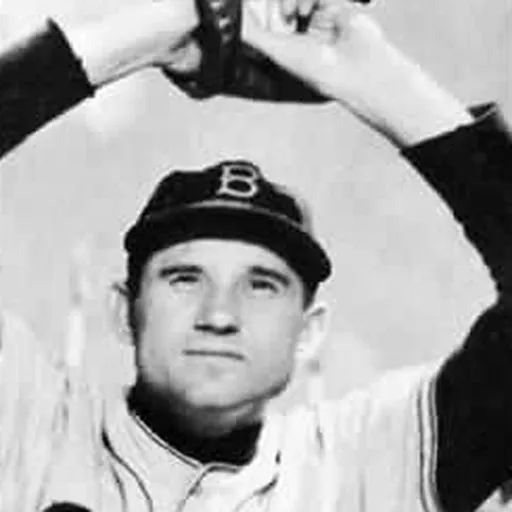
About Preacher Roe
Lived 1916 – 2008 (aged 92). Preacher Roe was an American baseball player.
Elwin Charles "Preacher" Roe (February 26, 1916 – November 9, 2008) was an American professional baseball pitcher. He played in Major League Baseball for the St. Louis Cardinals, Pittsburgh Pirates (1944–47), and Brooklyn Dodgers (1948–54). Roe was a five-time All-Star.
Early years Roe was born on February 26, 1916, in Ash Flat, Arkansas and grew up in Viola, Arkansas. The nickname "Preacher" came at the age of three when an uncle asked his name and Roe responded "preacher" because of a minister who would take him on horse-and-buggy rides. For some time, Roe’s father, Charles Roe, played semi-professional ball for a Pine Bluff, Arkansas team before he began practice as a country doctor.
College career From 1935 to 1939, Roe attended Harding College (now University).
Pittsburgh Pirates As a fastball pitcher with the Pittsburgh Pirates, Roe had a record of 13–11 with a 3.11 earned run average (ERA) in 1944 and a 14–13 record with a 2.87 ERA in 1945. His 148 strikeouts in the 1945 season led the National League and he was selected for (but did not play in) the 1945 All-Star Game. He improved further in the 1949 season, finishing with a 15–6 record and a 2.79 ERA.
Roe posted an exceptional 22–3 win-loss record for the Dodgers in 1951, becoming only the fifth pitcher since 1916 to begin the season 10–0. He had a winning percentage of 88% in the season. Had he not lost his second-to-last start of the year (he got a no-decision in his last start), he would have become the first pitcher ever with a winning percentage above 90% in a 20-win season (as it turned out, no pitcher has ever gone on to win 90% of their games for a 20-win season since Roe's near miss).
Roe was an exceptional pitcher, but notorious as a poor hitter, finishing his career with a .110 batting average. When asked to explain his longevity, he replied "Clean livin' and the spitball." He described his methodology in a 1955 article in Sports Illustrated, "The Outlawed Spitball Was My Money Pitch", published a year after he retired. He was acquired along with Billy Cox by the Baltimore Orioles from the Dodgers on December 14, 1954 for a pair of minor-leaguers, infielder Harry Schwegman and right-handed pitcher John Jancse, and $60,000.
Roe's overall career statistics were hurt by the fact that he was away from baseball during World War II and that for two of the years he pitched for the Pirates they were among the worst teams in the National League. Contrasting the fielding of the Dodgers and the Pirates, he once said that a pitcher should pay to pitch for the Dodgers, whereas the Pirates' second baseman and shortstop were like goalposts with the ball bouncing between them. After being taken out of a game in the second inning, Roe commented that, "Sometimes you eat the bear and sometimes the bear eats you."
Willie Mays said of Roe, "We used to say he had two fastball speeds—slow, and slower." Sal Maglie, star pitcher for the Giants, said Roe used to have a slow fastball: "Believe me, it really wasn't fast at all." Maglie noted that Roe would strike out hitters with it, though, by throwing it after a bunch of slower pitches, as this messed with the hitter's timing.
After baseball Roe lived in West Plains, Missouri, where for many years he operated a small grocery store (now home to another grocery store, The Truck Patch) on the northeast corner of Broadway and Porter Wagoner Boulevard, and has a street named after him (Preacher Roe Boulevard), which included U.S. 160 north of the US 63 bypass until the city rerouted U.S. 160 and Route 17 after 2000. U.S. Route 160 still runs as Preacher Roe Boulevard south of U.S. 63. A favorite son of West Plains, Roe was the subject of a 1984 cover story written by Terry Fuhrmann Hampton for Issue #26 of the West Plains Gazette magazine. There is an image of him on a mural inside the Ozark Heritage Welcome Center, located in West Plains.
A community ball field in Salem, Fulton County, Arkansas, from Roe's birthplace of Ash Flat, is known as Preacher Roe Park.
The book Carl Erskine's Tales from the Dodgers Dugout: Extra Innings (2004) includes short stories from former Dodger pitcher Carl Erskine. Roe is prominent in many of these stories.
Roe died on November 9, 2008, from colon cancer.
Don’t just read it —
keep it.
Full-length biographies made to live with: read them, listen on the way to work, watch them tonight.
- E-book
- Audio
- Video
Instant download · yours to keep · every purchase keeps this site free
Important facts
People in Preacher Roe's life
Named in this biography and alive at the same time




Related people
Same field, nearest in time

Contemporaries
People whose lives overlapped Preacher Roe's



Frequently asked questions
Who was Preacher Roe?
American baseball player (1916–2008)
When was Preacher Roe born?
Preacher Roe was born on 26 February 1916 in Ash Flat.
When did Preacher Roe die?
Preacher Roe died on 9 November 2008 in West Plains.
What was Preacher Roe's occupation?
Preacher Roe was a baseball player.
What nationality was Preacher Roe?
Preacher Roe was American.
Sources & further reading
Cite this page
APA: Biography.guide. (2026). Preacher Roe. https://biography.guide/preacher-roe/
MLA: "Preacher Roe." Biography.guide, https://biography.guide/preacher-roe/.
Chicago: "Preacher Roe." Biography.guide. https://biography.guide/preacher-roe/.
Data last updated: 2026-09-23 · Spot an error? Report a correction.
Portrait: Wikimedia Commons · author & licence
Page generated 2026-09-27 05:07 UTC