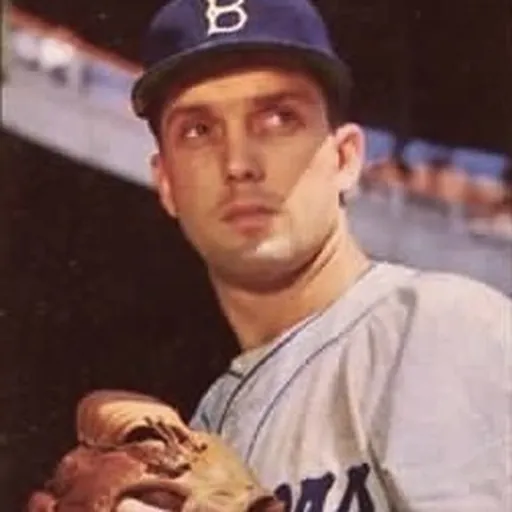
About Carl Erskine
Lived 1926 – 2024 (aged 97). Carl Erskine was an American baseball player and writer.
Carl Daniel Erskine (December 13, 1926 – April 16, 2024), nicknamed "Oisk", was an American professional baseball pitcher in Major League Baseball who played his entire career for the Brooklyn/Los Angeles Dodgers from 1948 through 1959. He was a pitching mainstay on Dodger teams which won five National League pennants and the 1955 World Series.
During the 1953 season, Erskine won 20 games and set a World Series record with 14 strikeouts in a single game. He was an All-Star the following season. Erskine pitched two of the NL's seven no-hitters during the 1950s.
After his baseball career ended, he was active as a business executive and an author. In particular, he was involved deeply with the Special Olympics and charities which aimed at helping people with developmental difficulties such as his son Jimmy, who was born with Down syndrome. Erskine died in 2024, the last surviving member of the "Boys of Summer" Brooklyn teams of the 1950s.
Early life Erskine was born in Anderson, Indiana, the youngest of three sons. He attended Anderson High School where he was a standout pitcher, attracting the attention of the Brooklyn Dodgers. After graduating, however, he joined the United States Navy in 1945. During his time with the Navy, he was stationed at Boston Navy Yard.
While in Boston, Erskine worked out with the Boston Braves who showed interest in him. However, Erskine remained loyal to the Dodgers and stalled the Braves' general manager John Quinn until an offer came from Dodgers' general manager Branch Rickey who gave him a bonus of $3,500 ($ today) to sign with the Dodgers.
Erskine was a member of the beloved Dodgers team that won the 1955 World Series for the franchise's first Series title.
Erskine threw two no-hitters during his career. His first was against the Chicago Cubs on June 19, 1952, during which he walked only one batter, just missing a perfect game. His second no-hitter came against the New York Giants on May 12, 1956. Erskine is one of two Dodger pitchers to throw multiple no-hitters, the other being teammate Sandy Koufax who threw four.
In 1958, the Dodgers moved to Los Angeles. On April 18, Erskine started the home opener at the Los Angeles Coliseum against the San Francisco Giants, who had moved west with their rivals, and won the game 6–5. However, his career in Los Angeles but lasted only a season and a half. He made his final appearance on June 14, 1959. In a twelve-season career, he posted a 122–78 (.610) record with 981 strikeouts and a 4.00 earned run average in innings pitched. After retiring, he was made an assistant pitching coach in 1959 and finished the season on the team that went on to win the World Series.
To commemorate Erskine's accomplishments both as a Dodger and as a citizen, a bronze statue was built in front of the Carl D. Erskine Rehabilitation and Sports Medicine Center. Erskine also donated part of his land to the Anderson Community School System to build a new school, which was named Erskine Elementary. In 2002, Erskine Street in Brooklyn was created and named after him.
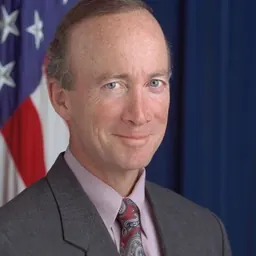
In 2010, he was awarded the Sachem Award by Governor Mitch Daniels of Indiana, the state's highest honor which is given to recognize lifetime achievement of citizens of Indiana.
Erskine served as a member of the advisory board of the Baseball Assistance Team, a non-profit organization dedicated to helping former Major League, Minor League, and Negro league baseball players through financial and medical difficulties. Additionally, the Carl and Betty Erskine Society was formed by Erskine in order to raise money for the Special Olympics in which he was involved for more than 40 years.
In 2023, the National Baseball Hall of Fame and Museum awarded Erskine the Buck O'Neil Lifetime Achievement Award for his contributions to charity and his work towards the Special Olympics.
Personal life and death Erskine married Betty Palmer on October 5, 1947, they remained married for the next 76 years. The couple had four children together: Danny, Gary, Susan, and Jimmy. After his retirement, the couple lived in his hometown of Anderson, Indiana.
Following a bout of pneumonia, Erskine died on April 16, 2024, at Community Hospital Anderson. He was 97. Erskine outlived his son, Jimmy, who had died in 2023.
Erskine was the last surviving member of the "Boys of Summer" Brooklyn Dodgers of the 1940s and 1950s, and the last surviving member of the 1955 World Champion Brooklyn Dodgers. Upon his death, Dodgers president and chief executive officer Stan Kasten released the following statement:
Erskine's funeral was held in Madison Park Church of God in Anderson, Indiana on April 22. His body was later interred at Anderson Memorial Park.
Don’t just read it —
keep it.
Full-length biographies made to live with: read them, listen on the way to work, watch them tonight.
- E-book
- Audio
- Video
Instant download · yours to keep · every purchase keeps this site free
Important facts
People in Carl Erskine's life
Named in this biography and alive at the same time




Related people
Same field, nearest in time
Contemporaries
People whose lives overlapped Carl Erskine's



Frequently asked questions
Who was Carl Erskine?
American baseball player (1926-2024)
When was Carl Erskine born?
Carl Erskine was born on 13 December 1926 in Anderson.
When did Carl Erskine die?
Carl Erskine died on 16 April 2024 in Anderson.
What was Carl Erskine's occupation?
Carl Erskine was a baseball player and writer.
What nationality was Carl Erskine?
Carl Erskine was American.
Sources & further reading
Cite this page
APA: Biography.guide. (2026). Carl Erskine. https://biography.guide/carl-erskine/
MLA: "Carl Erskine." Biography.guide, https://biography.guide/carl-erskine/.
Chicago: "Carl Erskine." Biography.guide. https://biography.guide/carl-erskine/.
Data last updated: 2026-09-20 · Spot an error? Report a correction.
Page generated 2026-09-27 05:09 UTC